
Rouen Cathedral, End of the Day
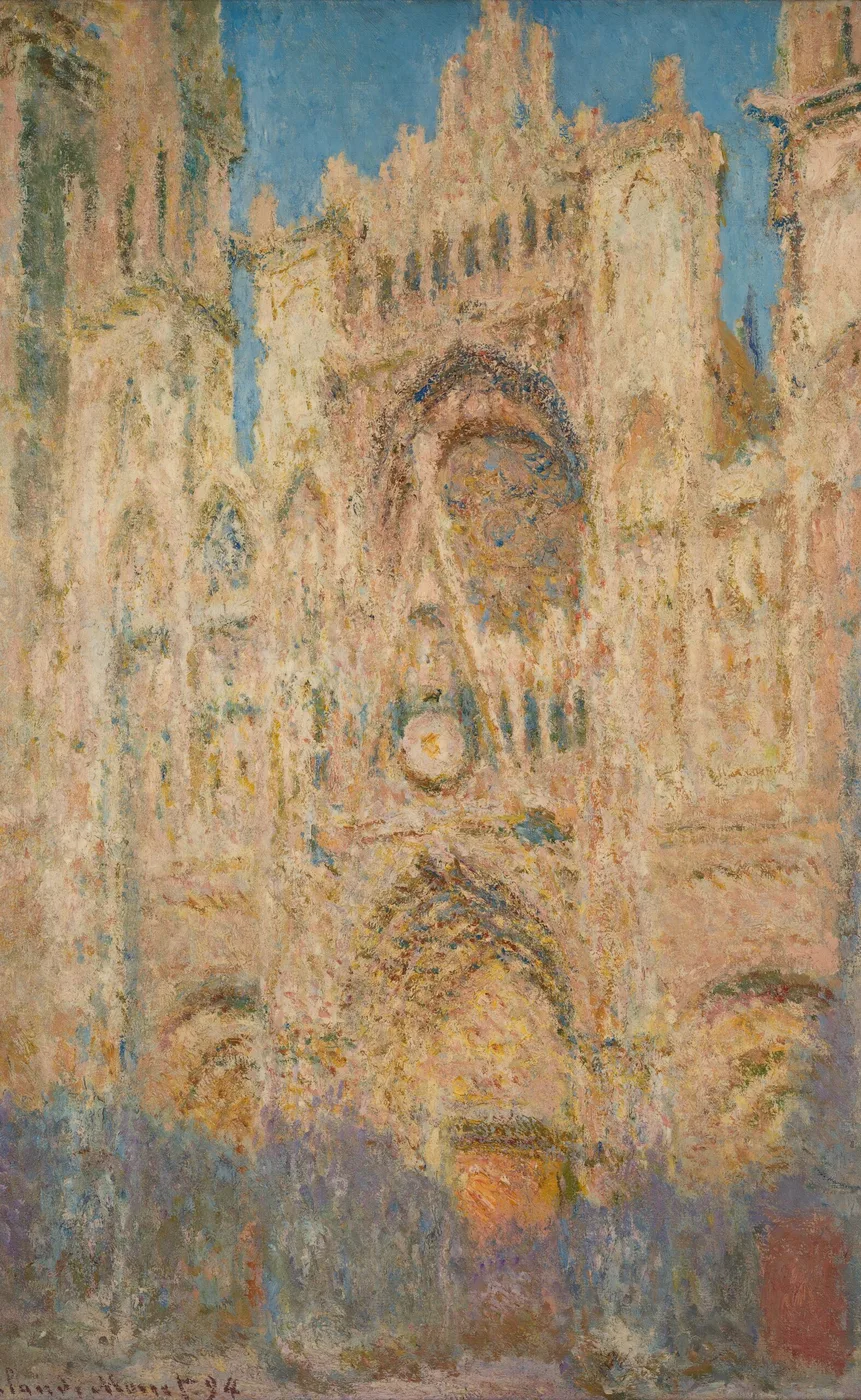
The last light of a day does not fade evenly off a building. It climbs. The street goes blue first, then the portals, then the lower stonework, while the top of the tower holds a scrap of warmth for a few minutes longer than everything beneath it. Anyone who has watched a west-facing facade at the end of an afternoon knows this. Monet watched it from a rented room across the street from Rouen Cathedral, and it very nearly broke him.
He worked there in two campaigns, in 1892 and again in 1893, from rooms taken opposite the west front. Not one canvas at a time. Many at once, propped and stacked, so that when the light shifted he could put one aside and take up another that matched the new conditions. The room was a workshop for the interception of a moving target. He described the work as tormenting. He said it gave him nightmares.
A man in a rented room, losing
Understand the trap he set for himself. He had decided that the subject of these paintings was not a cathedral. The subject was the light on a cathedral at a specified moment, which meant the motif expired while he was painting it. A cloud crossing the sun did not interrupt the work. It ended that day’s version of the work.
By fifty-two he had the technical means to paint almost anything he could see. What he did not have, and could never have, was time. The end of the day made that plain in the cruellest way, because the terminal hour is the fastest hour. The colour temperature of the light falls off a wall in minutes at dusk. Whatever you have on the canvas when it goes is what you have.
He did not finish these pictures in Rouen. He brought them home and worked them through in the studio in 1894, adjusting each against the others until the series held together as a set, and showed them in 1895. That delay tells you how hard the fight had been. He needed a year of calm to resolve what he had seized in a few frantic weeks.
Why the end of the day is not a colour, it is a collapse
At noon the sun does the describing for you. At the end of the day the sun stops describing and starts editing. Detail is removed. Shadow rises and pools. The stone, which has absorbed heat all day, seems for a while to be lit from inside rather than outside, and then that impression goes too.
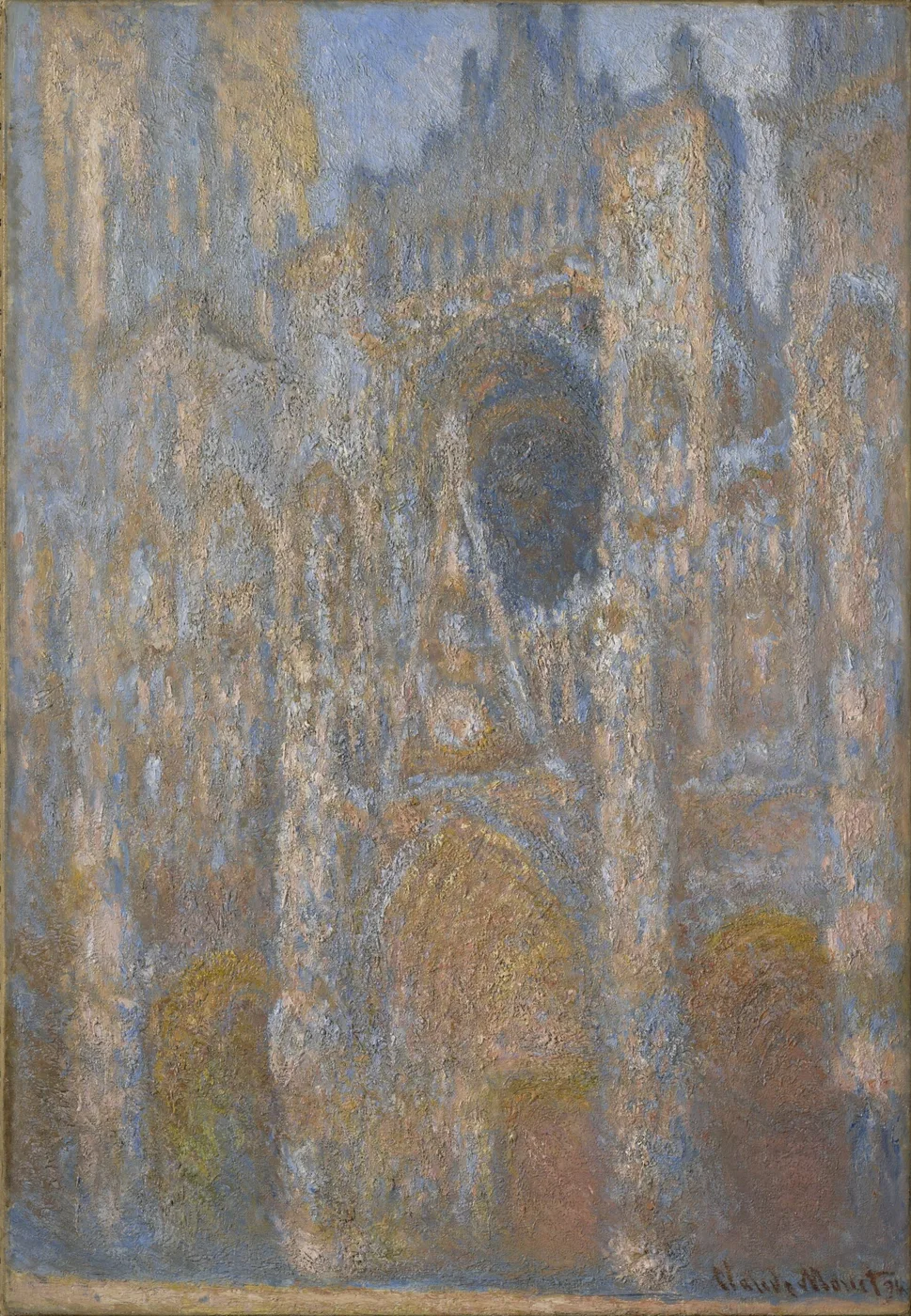
This is why the picture reads less like architecture than like a curtain of stone. The tracery, the statuary, the vertical logic of a Gothic front, all of it is present as bulk and rhythm rather than as drawing. Monet was not being careless. He was reporting what a facade actually looks like when the light on it has drained: a mass with hollows, not a diagram.
How it was made
The paint is thick. Not decoratively thick, but built up in ridges and clots that catch real light in a real room, so that the surface of the canvas has an answering roughness to the surface of the building. This is one of the strangest and best ideas in the whole series. He gave a picture of carved stone a skin that behaves a little like carved stone.
The colour is laid in small adjacent notes rather than mixed to a single tone. Blues sit against violets, violets against dulled rose, and where warmth survives it is dragged over the cool rather than blended into it. Look at the deepest recesses of the portals and you will find that the darks are not brown or black. They are saturated blue and purple, which is what a shadow on pale stone truly is at that hour, and which is precisely the observation the previous generation of painters had not been willing to make.
A building painted as though it were weather
It is worth pausing on how strange the whole project is. A Gothic cathedral front is the most deliberately designed object in a medieval city. Every course of stone was cut with intent, every figure placed according to a scheme, and for centuries the correct way to draw one was to record that intent accurately. Measure it, respect the symmetry, get the tracery right.
Monet did none of that. He treated a great designed object as though it were a bank of cloud, something with no fixed appearance at all, whose only reliable property is that light happens to it. The building here is not described. It is reported at a moment, in the same spirit that a painter might report a wave or a fog.
That was an aggressive idea, and the series makes the argument impossible to duck, because you cannot look at one canvas without knowing there are others. Shown together in 1895, the group told viewers something uncomfortable: that the permanent stone monument you thought you were looking at is only ever available to you as a temporary appearance. See it at eight, at noon and at dusk and you have seen three different objects, none of which is more real than the others.
The end-of-day canvas is the extreme case of that argument. It is the version in which the building has nearly surrendered. Another twenty minutes and there would have been nothing left to paint but a dark mass against a cooling sky, and the day’s work would have ended, as so many did, unfinished.
What to look at now
- Start at the top and read downward. Find the highest point still carrying warmth and note how quickly, in inches, that warmth turns to cold violet. That gradient is the clock of the picture.
- Look into the portal openings. Let your eye adjust the way it would in a dim room. The darks separate into distinct colours after a few seconds.
- Notice that no edge in the painting is truly sharp. At dusk the human eye loses acuity before it loses colour, and the canvas reproduces that failing.
- Stand close enough to see the ridges of paint, then walk back until the stone reassembles. Somewhere around eight feet the whole thing snaps into a building. That is the exact distance the picture was engineered for.
How it behaves on a real wall
A dusk painting is an evening painting. Under cool daylight the blues dominate and the canvas holds itself at a slight distance, dignified and a little severe. Under warm lamplight after dark, the surviving oranges and roses in the upper stonework wake up and the picture becomes noticeably warmer and more intimate. Few paintings change so much between four in the afternoon and nine at night.
The format is emphatically vertical and the composition is one great mass with no relief, so it needs breathing room on either side. On a crowded gallery wall it turns into a grey slab. Alone on a narrow pier of wall, above a console or at the end of a hallway, it does the opposite: it gives the wall height and stops the eye at the end of a room.
Because the surface is textural, raking light is your friend. A lamp set to one side, rather than a spot straight on, will pick up the built paint and animate the whole face. And because the palette lives in blue, violet and stone grey, it sits naturally with cool walls, dark wood, iron and unbleached linen, and it will quietly kill any nearby object that is trying to be bright. That is not a flaw. Monet spent two campaigns and a year of studio work making a picture that ends the argument in a room. It still does.
Sizes and materials for Rouen Cathedral, End of the Day are listed on its product page.
More from this collection
Bring this painting home
Choose a hand-painted oil reproduction for real brushwork, or an archival canvas print for a crisp museum-image edition. Every size preserves the original proportions.
View this work & options
Further reading
Verify the original in the Pushkin Museum of Fine Arts collection record and continue through related works in the catalogue.