
Poplars Collection: Claude Monet Oil Painting Reproductions
In 1891, the year after his Grainstacks series, Monet turned to a row of poplar trees along the Epte river near Giverny and painted them roughly two dozen times through the changing seasons; when the trees were due to be sold for timber partway through the project, he reportedly arranged with a local timber merchant to delay the sale until he had finished painting them. The resulting canvases use the trees’ tall, evenly spaced trunks as a near-abstract vertical structure across the canvas, closer to a repeated pattern than a conventional landscape composition, while the color and light around them shift from spring green to autumn gold. Like the Grainstacks, the series was built on returning to one fixed, simple subject to isolate the effect of changing light and season rather than changing scenery. A visitor to this collection is usually after that rhythmic, structural side of Monet. In a room, they work as strong vertical lines and a repeating pattern, tall and narrow rather than wide and open.
Showing all 13 results
-
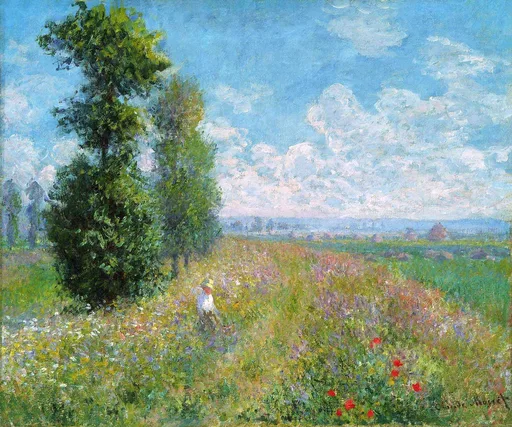
Meadow with Poplars
From $109 -
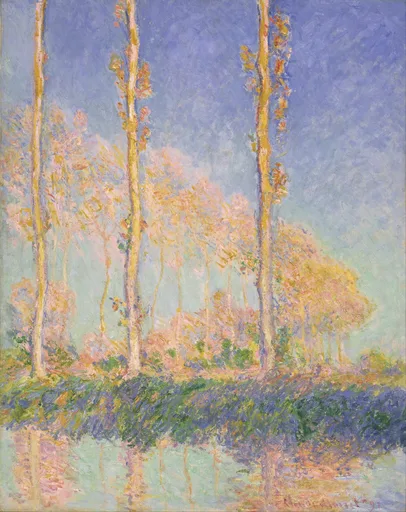
Poplars
From $109 -
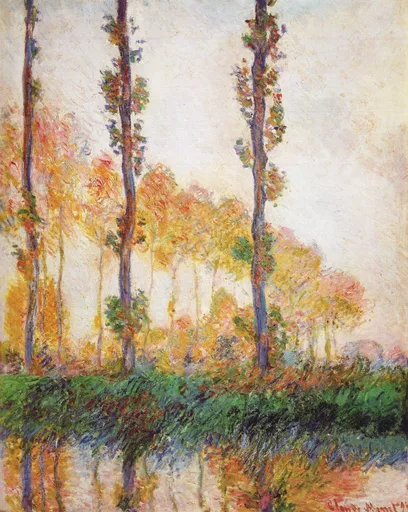
Poplars (Autumn)
From $109 -
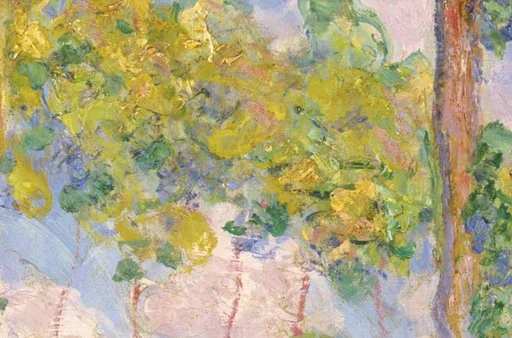
Poplars in the Sun
From $109 -
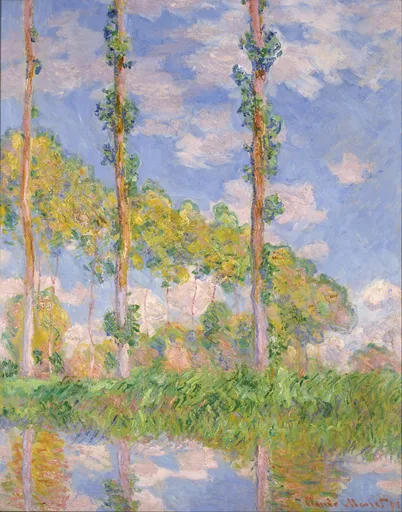
Poplars in the Sun
From $109 -
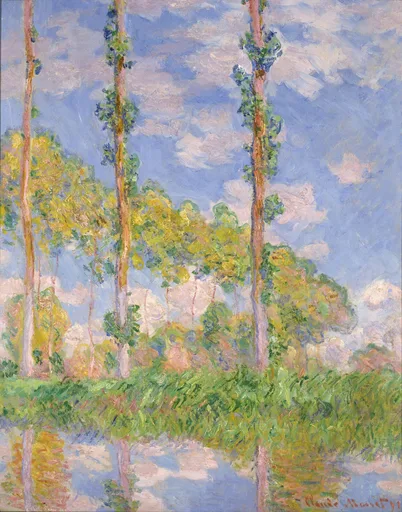
Poplars in the Sun
From $109 -
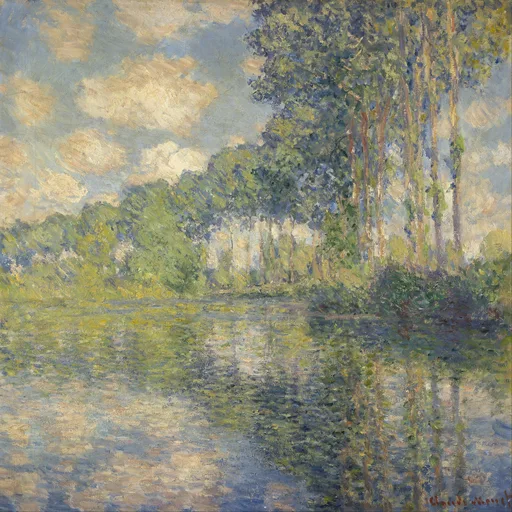
Poplars on the Epte
From $109 -
Poplars, Pink Effect
From $109 -
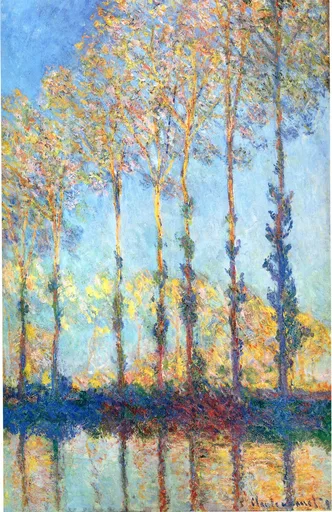
Row of poplars in autumn
From $109 -
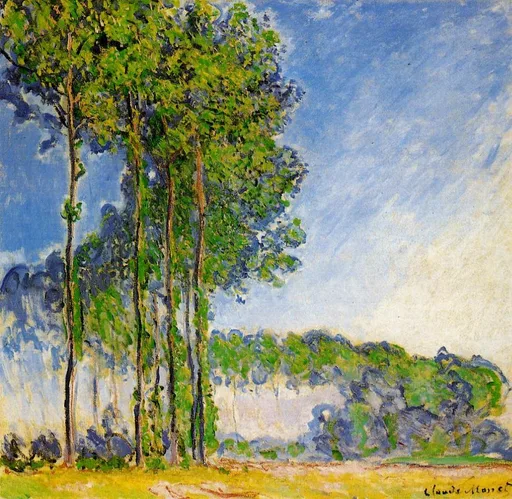
The Poplars
From $109 -
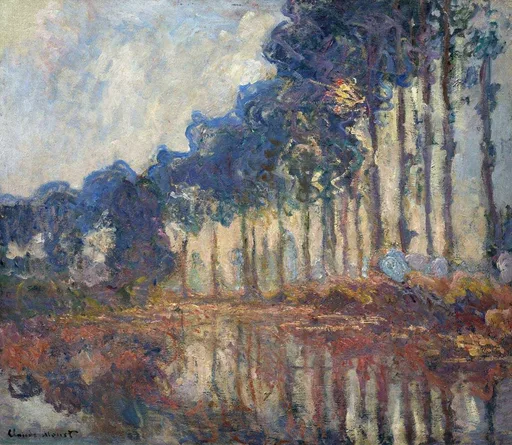
The Poplars, Autumn
From $109 -
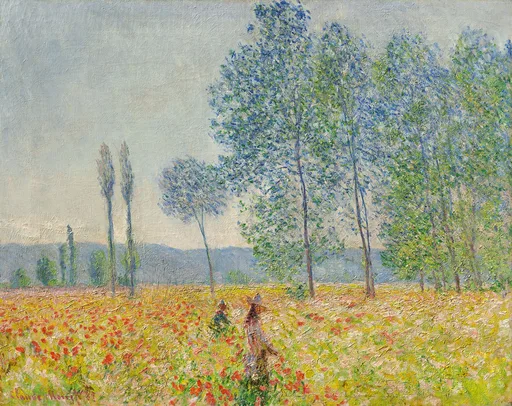
Under the Poplars
From $109 -
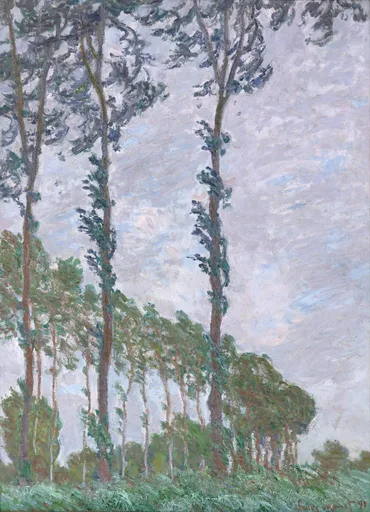
Wind Effect, Row of Poplars
From $109
Eleven paintings of a single line of poplars growing along the river Epte, a short row upstream from Monet's house at Giverny. He painted them through 1891, immediately after the grainstacks, and pushed the same idea further: one motif, many canvases, the weather doing the work.
The trees he had to buy
The row belonged to the local commune, which put the trees up for sale as timber while Monet was in the middle of the series. Rather than lose his subject, he went to the auction and bought them, on the understanding that they would be left standing until he had finished, then handed on to the timber merchant. It is one of the plainest pieces of evidence we have of how seriously he took a series once it was under way.
He worked much of it from the water, using a broad flat-bottomed boat fitted out so canvases could be swapped in and out as the light turned. That low viewpoint is why the trees rise straight past the top edge of so many of these pictures, and why the row curves away as a long shallow S into the distance. The formats are often tall and narrow, the rhythm of the trunks almost musical, the reflections doubling everything below the waterline. Several were sold through Durand-Ruel, who had handled the grainstacks the year before.
Hand-painted oil reproductions, made to order
Each of these works is available as a hand-painted oil reproduction, painted in real oils on artist-grade cotton canvas by a senior studio painter rather than printed, or as a lower-priced archival canvas print. Choose your size and orientation, then finish rolled, stretched, or framed in a thin or a thick moulding. Everything is made to order and hand inspected before dispatch, with free worldwide shipping and a 30-day return guarantee.
Which room this collection suits
This is the vertical collection. The tall formats are made for the walls other pictures fail on: the narrow panel between two windows, the space beside a doorway, a stairwell, a chimney breast. Colour runs green, gold and lavender against high, light skies, so they hold up well on soft white, pale grey-green and warm stone. Give a poplar canvas a little empty wall on either side; crowding it with shelves or sconces kills the height that makes it work.
Frequently asked questions
Are the poplars related to the haystacks?
Closely. Monet began the poplars in 1891, immediately after the stacks, using the same method of multiple canvases worked in rotation. Many collectors hang one from each series together, since the vertical rhythm of the trees plays off the low horizontal mass of a stack.
Which is right for me, the hand-painted oil or the print?
The hand-painted oil is brushed by a studio painter in real oils and has genuine surface texture, which suits these pictures because so much of the foliage is short, flicked strokes. The archival canvas print is a lower-priced option and works well at modest sizes or where a room already has a lot happening. Both use the same choice of sizes and finishes.
What size works on a narrow wall?
Tall and slim rather than large all round. As a rule of thumb, leave at least ten to fifteen centimetres of clear wall on each side of the canvas so the verticals can breathe. The size guide shows the common panel widths measured out.
Do they suit a room with low ceilings?
Yes, and they can help. A tall narrow canvas draws the eye upward and makes a low room read taller, which is one of the few genuinely useful things a picture can do to a space.