
Arrival of the Normandy Train, Gare Saint-Lazare, 1877: Steam Turned Into Weather Under Glass
Paris, 1877: The Glass-and-Iron Train Shed
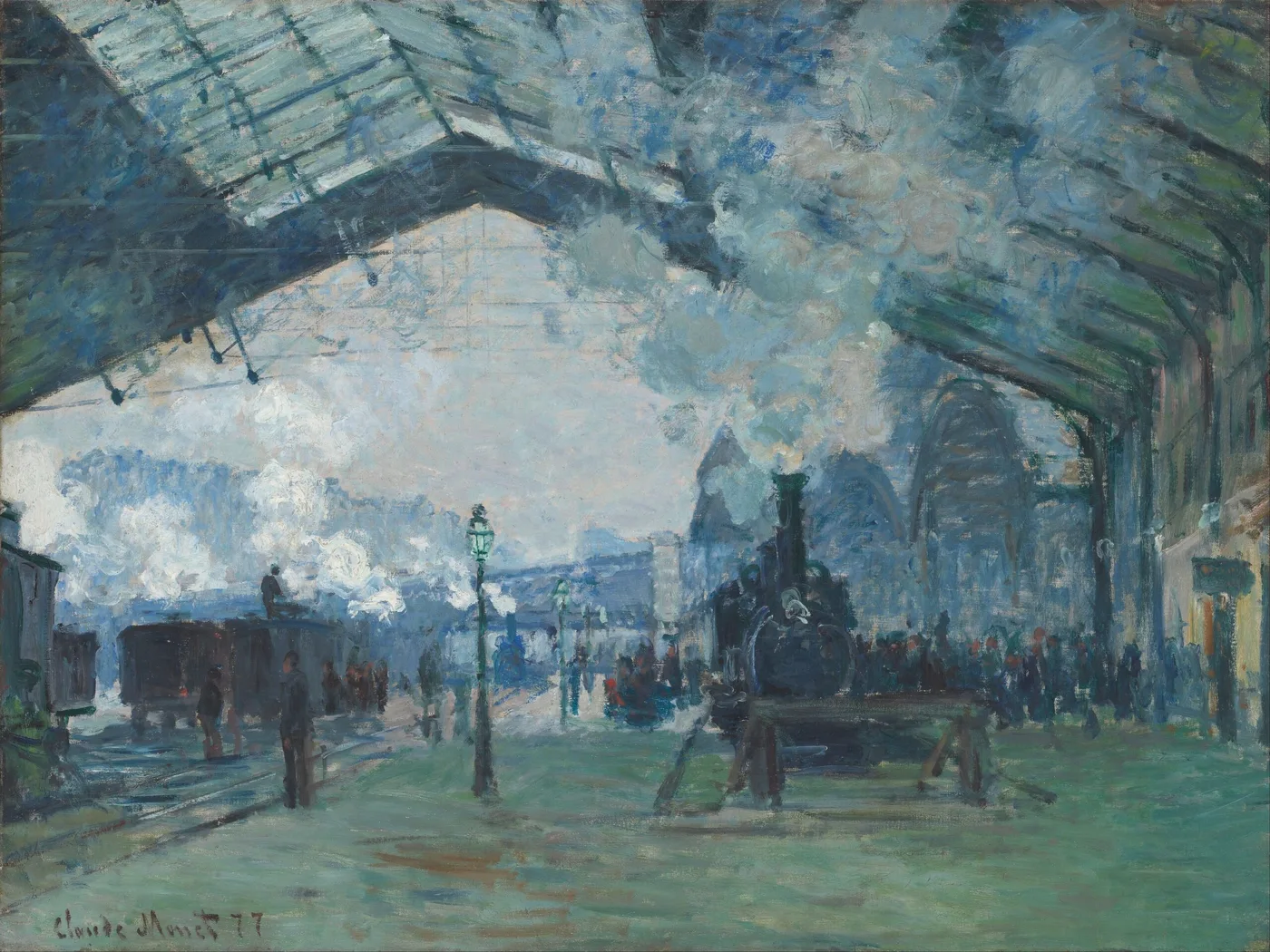
Arrival of the Normandy Train, Gare Saint-Lazare is an oil on canvas Claude Monet painted in 1877, now held by the Art Institute of Chicago.
The Gare Saint-Lazare was a working Parisian terminal that year, the station linking the capital with Normandy and with the suburbs north and west of the city. The painting brings the viewer inside the glass-and-iron train shed.
Born in 1840, he had already exhibited with the independent painters who became known as the Impressionists. Working inside a station gave him a different kind of light to study, filtered through an iron and glass roof, in place of the open sky he had painted for years along rivers and coastlines.
The Art Institute of Chicago, which holds this canvas, describes the glass and iron roof of the shed, the locomotive steam trapped beneath it, and the daylight passing through the large glazed sections above the platforms. Monet treated that combination, steam filling an iron and glass structure, as a motif he returned to more than once in his work.
A different Monet setting, a garden rather than a station, appears in the story on Camille Monet in the Garden at Argenteuil. Set beside that garden, this station is an enclosed, built interior, worked in iron trusses and glass under a roof rather than open sky.
Inside the shed: iron, glass and a rising cloud of steam
The composition is built on the shed itself. Dark iron trusses, painted in teal and blue-green, rise from both sides of the canvas and meet near the top in a ridge, seen from below so the two slopes run out past the edges of the canvas. Through the gaps in that ironwork, panes of glass let a cool, pale light fall over the whole scene.
At the far end of the shed, where the roof opens to the outside, the light turns a soft, bleached blue-white, and the buildings beyond the station flatten into blue-grey smudges. That opening is the brightest passage in the painting, and the point where the converging lines of the platforms and the roof meet.
The locomotive sits right of centre, a dark green-black wedge with a tall, narrow funnel. It takes up a small part of the canvas next to what it produces: a column of steam rising from the funnel and spreading into a wide, pale cloud across the whole upper right quarter of the picture, in white, pale blue and a soft lilac-grey.
On the platform beside the locomotive, a crowd of dark, narrow figures stands and waits, each one built from a few quick strokes of a loaded brush. Near a row of dark carriages on the left, one figure stands on a carriage roof and others move along the track bed. None of them has a face you could describe.
A single green lamppost stands upright in the centre foreground, against the horizontal sweep of the platform. The ground is laid in long, loose strokes of green, grey and a dull rose, with the rails running off to the lower left and a touch of orange breaking the cool range of the rest of the canvas.
Across much of the canvas, soft edges join the steam to the pale light through the glass. Dark marks in the roof and locomotive remain distinct against that haze. Monet signed and dated the canvas Claude Monet 77 in the lower left corner, in the same loose hand as the rest of the picture.
Reading the steam: an ordinary terminal as a subject for light
The subject is a station at the moment a train arrives, but little of the picture lingers on the train as a machine. The locomotive is a dark, blunt shape, with the boiler and funnel laid in as flat masses rather than drawn. The engine’s steam fills the canvas instead, filtered through the glass roof until it behaves like weather inside the building.
Monet painted the shed the way he painted rivers and coasts, as a subject for the light moving through it. The glazed roof lets daylight down onto the steam, which gives the light something to catch on.
The figures on the platform read as commuters and travellers, anonymous shapes standing in for the ordinary traffic of a working terminal.
Monet carried this same interest in atmosphere into other urban subjects later in his life, among them the fog over the Thames in London, as the Waterloo Bridge, Sunlight Effect page describes. In both paintings, a built, modern setting supplies the hazy, changing light he had spent years painting outdoors.
The Chicago Canvas and Its Catalogue Measurements
Arrival of the Normandy Train, Gare Saint-Lazare is held by the Art Institute of Chicago, the museum that catalogues this 1877 oil on canvas. The painted canvas measures 60.3 × 80.2 cm (23 3/4 × 31 1/2 in.), height before width.
Framed, the canvas measures 80.7 × 100.4 × 10.2 cm (31 3/4 × 39 1/2 × 4 in.), the frame’s full depth with the canvas mounted inside it. The catalogue records the framed dimensions separately from the painted canvas. Those measurements help identify the original; they do not prescribe a reproduction size or a viewing distance.
A reproduction brings the same composition to a wall at home, in whatever size a room asks for, and the product page lists the sizes available if the museum’s own dimensions are not what the space needs.
Choosing a hand-painted oil or print of the Gare Saint-Lazare
A hand-painted reproduction is made to order by a studio painter working in oils on cotton canvas. The roof’s diagonal beams and the loose marks in the steam call for different edges. Look for a clear structure in the ironwork and a softer treatment of the cloud above the locomotive.
A hand-painted oil keeps that surface, raised where the steam and the ironwork were laid on thickly, so light in the room can pick out the raised brushwork. Painting the oil by hand takes 2 to 4 weeks. An archival canvas print carries the same image flat, without the raised paint, and printing it takes 2 to 4 business days.
This is a dark, cool composition built from blue-greens, greys and white steam, with only a few warm touches of orange and rose in the ground. The blue-greens take a black or dark walnut frame, and the picture holds a hallway or a study wall where there is metal or dark wood nearby. The product page shows the frame choices and the sizes that keep its proportions.
Delivery once a piece ships takes 5 to 7 business days. It ships free and tracked worldwide by express courier. Every order carries a certificate of authenticity and a return guarantee, so you can send it back if it is wrong for the wall. For a rolled canvas instead of a stretched or framed one, check the product page for the rolled-canvas options currently offered.
Questions about this painting of the Gare Saint-Lazare
What is actually happening in this painting?
A train is arriving under the glass and iron roof of the Gare Saint-Lazare in 1877. The locomotive’s steam rises into the upper right quarter of the canvas, lit by daylight from the open end of the shed.
Did Monet paint this station more than once?
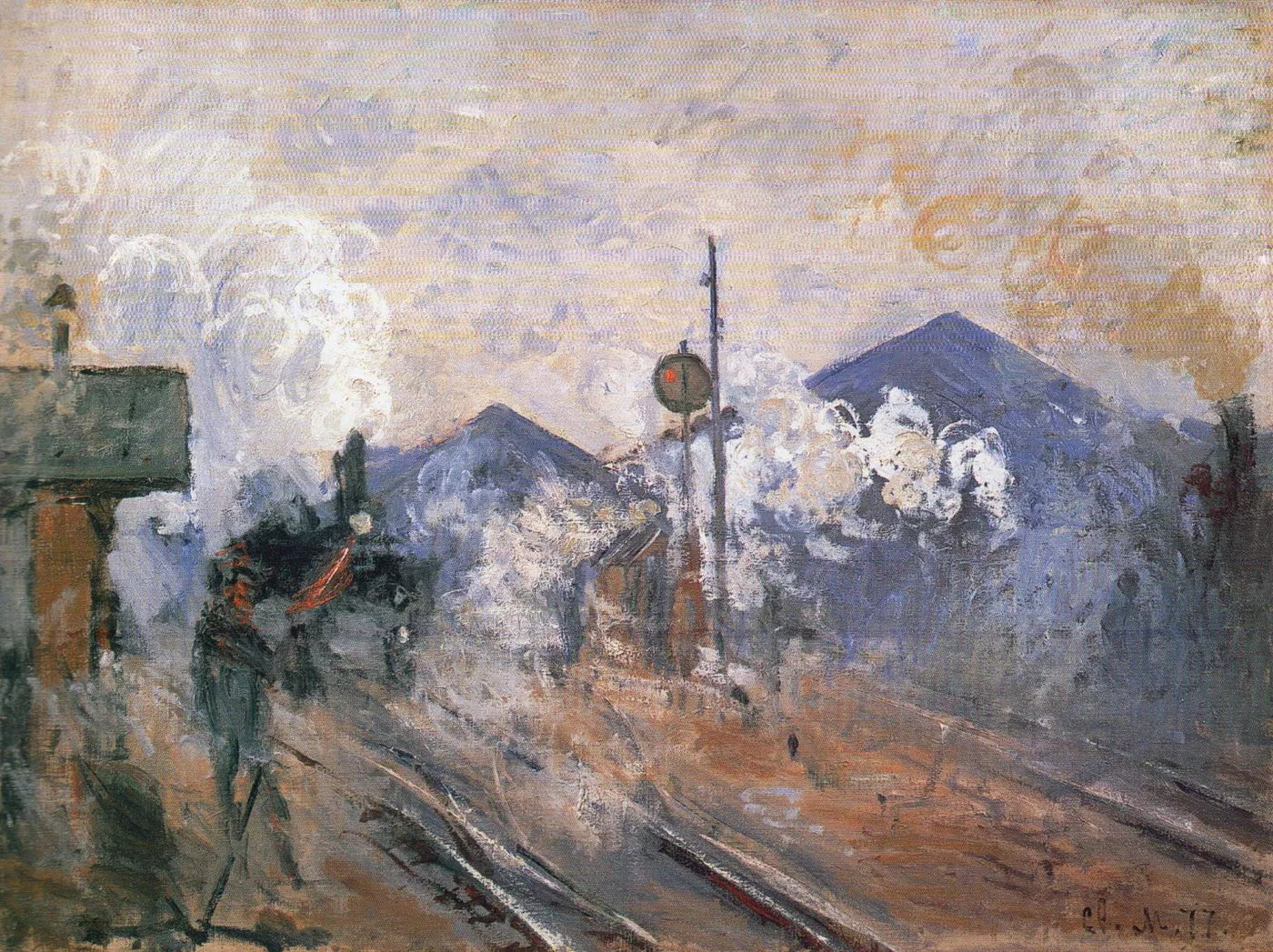
Yes, he returned to the glass-roofed shed and its steam more than once. This page describes only the 1877 version held by the Art Institute of Chicago.
Is the hand-painted version really painted by hand?
Yes, by a senior studio painter working in oils on canvas, one painter per canvas, with nothing printed or transferred at any stage.
Which size suits a smaller room?
A reproduction can be ordered close to the original’s canvas size, or smaller. The product page for this painting lists the sizes kept in proportion to the original.
What is the difference between the oil and the print?
The oil is built up in real paint by hand and takes 2 to 4 weeks. The print reproduces the same image flat on canvas and takes 2 to 4 business days.
More from this collection
Bring this painting home
Choose a hand-painted oil reproduction for real brushwork, or an archival canvas print for a crisp museum-image edition. Every size preserves the original proportions.
View this work & options
Further reading
Verify the original in the The Art Institute of Chicago collection record and continue through related works in the catalogue.