
Camille in the Garden at Argenteuil, 1876: Among Hollyhocks
Camille Beside the Central Hollyhocks
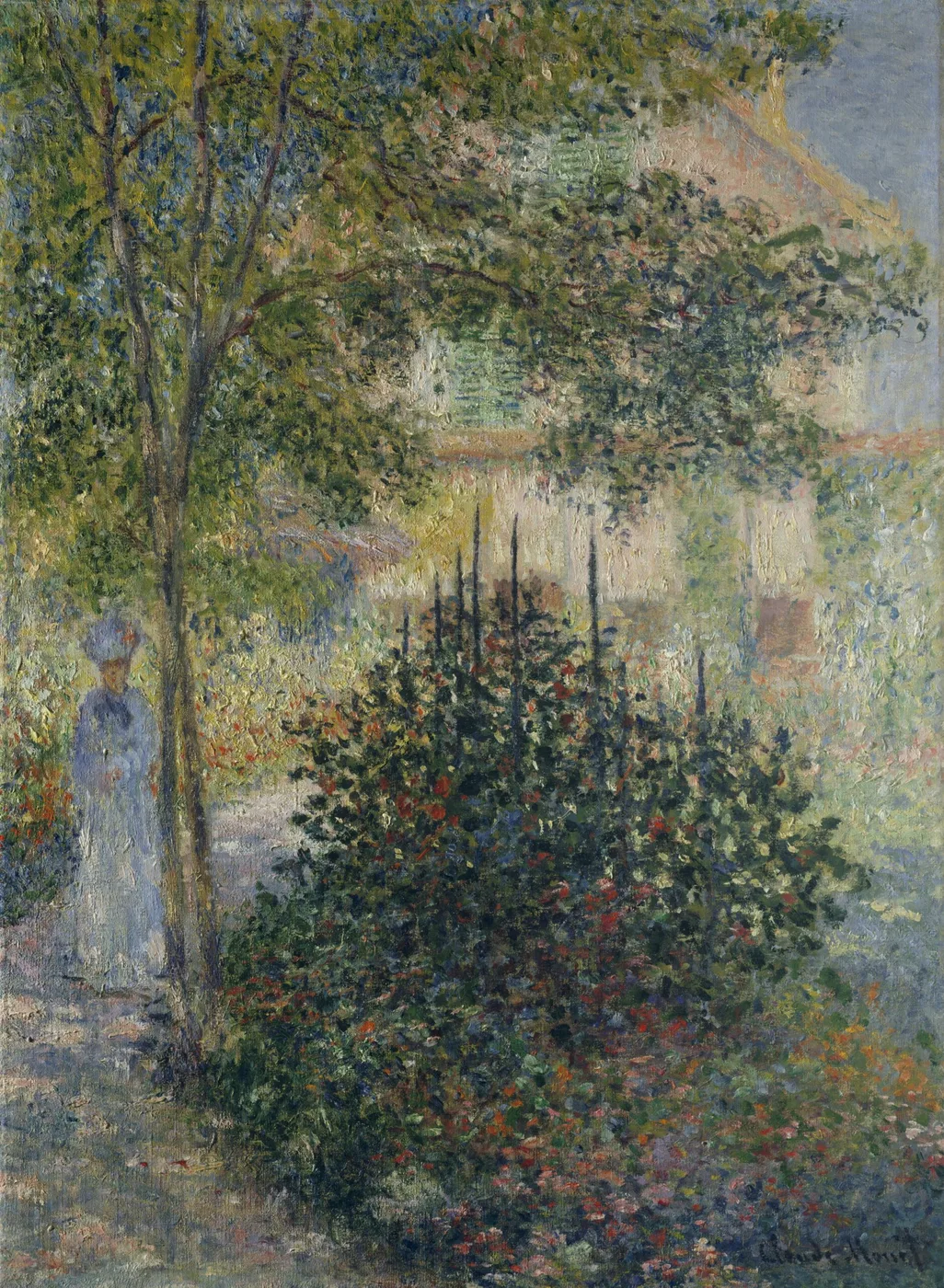
In Claude Monet’s Camille Monet in the Garden at Argenteuil, a woman in a pale blue-grey dress stands at the left beside a tree. Tall dark flower stems occupy the centre, with small red and pale blooms among their leaves. The Metropolitan Museum of Art dates the oil painting to 1876 and identifies the central plants as hollyhocks.
The museum places the subject at Monet’s rented house and garden in Argenteuil. It suggests that this canvas may belong to work he made in June, preserving that month as a possibility. The securely dated image shows Camille within a much larger spread of vegetation, rather than giving her a close portrait against an empty background.
The title identifies Camille, but the painting does not explain her thoughts or tell a story about what happened later. Its visible subject is a garden with a small figure at one side. The central flowers, branching tree and pale building behind them give that figure a specific setting to occupy.
A Small Figure Under the Branches
Camille stands near the left edge, her long pale dress extending toward a narrow strip of ground. Her head and hat occupy a small area beside the trunk. Blue-grey and lighter touches describe her clothing, with darker marks around the upper figure. Her scale is modest compared with the tall planting in front of the house.
A tree rises beside her and branches across the upper part of the picture. Small green and dark blue marks collect around its limbs, with gaps revealing the pale walls beyond. The trunk gives the left foreground a continuous upright line, distinct from the many shorter, broken marks in the foliage.
In the middle, tall dark stems rise above the broad mass of leaves. Red, pink and pale touches scatter among them and lower down across the flower bed. The Met identifies hollyhocks here. Their height and repeated upright forms differ from the surrounding lower patches of plants, which spread toward the right and bottom edges.
The house is partly covered by the garden. Pale cream, pink and grey passages show through, with roof shapes higher in the background. The open ground at the left is a small light area beside the denser planting. Short painted touches pass across both near and distant surfaces, while changes in their colour keep the main forms distinguishable.
The Garden Occupies More Space Than the Portrait
Camille’s pale dress helps locate her within the shaded left-hand part of the view. The eye can then follow the tree trunk upward and its branches across the house. Her position leaves the centre to the hollyhocks, which occupy much more of the image than the figure itself.
The composition combines a named person with a setting whose details remain prominent. The tall flowers overlap the building, the tree partly screens its walls and the lower plants continue toward the edges. These visible relationships explain the garden’s density without assigning the scene an emotion based on events after the painting was made.
For another arrangement of garden vegetation, see Bridge over a Pond of Water Lilies. The account of Palm Trees at Bordighera follows a different view through layered planting. Here, the small figure, central flowers and house remain within one upright garden composition.
The Upright Argenteuil Canvas
The Metropolitan Museum of Art in New York holds the original, accession 2000.93.1. The full museum title is Camille Monet (1847–1879) in the Garden at Argenteuil. The painting itself dates to 1876. The years in parentheses identify Camille’s lifespan and should not be confused with the date of this particular canvas.
The museum gives the medium as oil on canvas and the dimensions as 81.6 cm high by 60 cm wide (32 1/8 × 23 5/8 in.). This is an upright composition: the tree branches and upper house remain above the central hollyhocks, with the small figure lower at the left. Those proportions belong to the full painted area.
Check the current Met collection record for display arrangements. When comparing reproductions, use Camille’s position at the left and the tall central hollyhocks as anchors. A crop that centres the woman would remove much of the flower bed and house, changing the balance between the named figure and her garden.
Preserving the Figure at the Side of the Garden
The main Camille in the Garden oil reproduction is painted by hand on canvas. A studio artist follows the full Met composition, including the small figure beside the trunk and the tall central plants. A canvas art print is available as an alternative, carrying the same image reproduced in ink.
The painted edition has new oil brushwork and natural variation. The print reproduces the appearance of the source’s separate touches in ink. The small size of Camille’s face within the composition should remain clear: this is a view of a garden containing a person, rather than a close portrait enlarged from the figure alone.
Retain the upright proportions when choosing a size. The tree canopy, the roof shapes and the flowers near the lower edge all contribute to the scene. Think about the distance from which you will look at the small figure and narrow stems. Current dimensions and presentation options are listed in the product configuration.
Choose the edition and rolled, stretched or framed presentation on the product page. Hand-painted oil orders are photographed for approval before dispatch. Use that photograph to review Camille at the left, the central plants and the pale house together. Rolled canvas arrives without the wooden stretcher used for a stretched presentation.
Questions About Camille and the Flowers
Are the central flowers dahlias?
The Met identifies the tall central plants as hollyhocks. Their upright stems and small blooms occupy much of the composition, with Camille standing at the left. The museum’s identification is more specific than a general resemblance to garden flowers.
When did Monet paint this canvas?
The painting dates to 1876. The museum suggests that it may be among his June garden pictures. The dates 1847–1879 in the full title are Camille’s lifespan, not a range for the creation of the painting.
Where is the original and what size is it?
It belongs to the Metropolitan Museum of Art, accession 2000.93.1. The oil on canvas measures 81.6 cm high and 60 cm wide. Its full upright format includes the house, branching tree, flowers and small figure at the left.
Which reproduction is handmade?
The principal oil edition is painted by hand on canvas. A canvas art print is available as an alternative reproduced in ink. Oil orders are photographed for approval before shipping, so you can review the complete garden composition before dispatch.
More from this collection
Bring this painting home
Choose a hand-painted oil reproduction for real brushwork, or an archival canvas print for a crisp museum-image edition. Every size preserves the original proportions.
View this work & options
Further reading
Verify the original in the The Metropolitan Museum of Art, New York collection record and continue through related works in the catalogue.