
Bridge over a Pond of Water Lilies, 1899: The Bridge, the Planting and the Water
A Bridge Built at Giverny, Painted in 1899
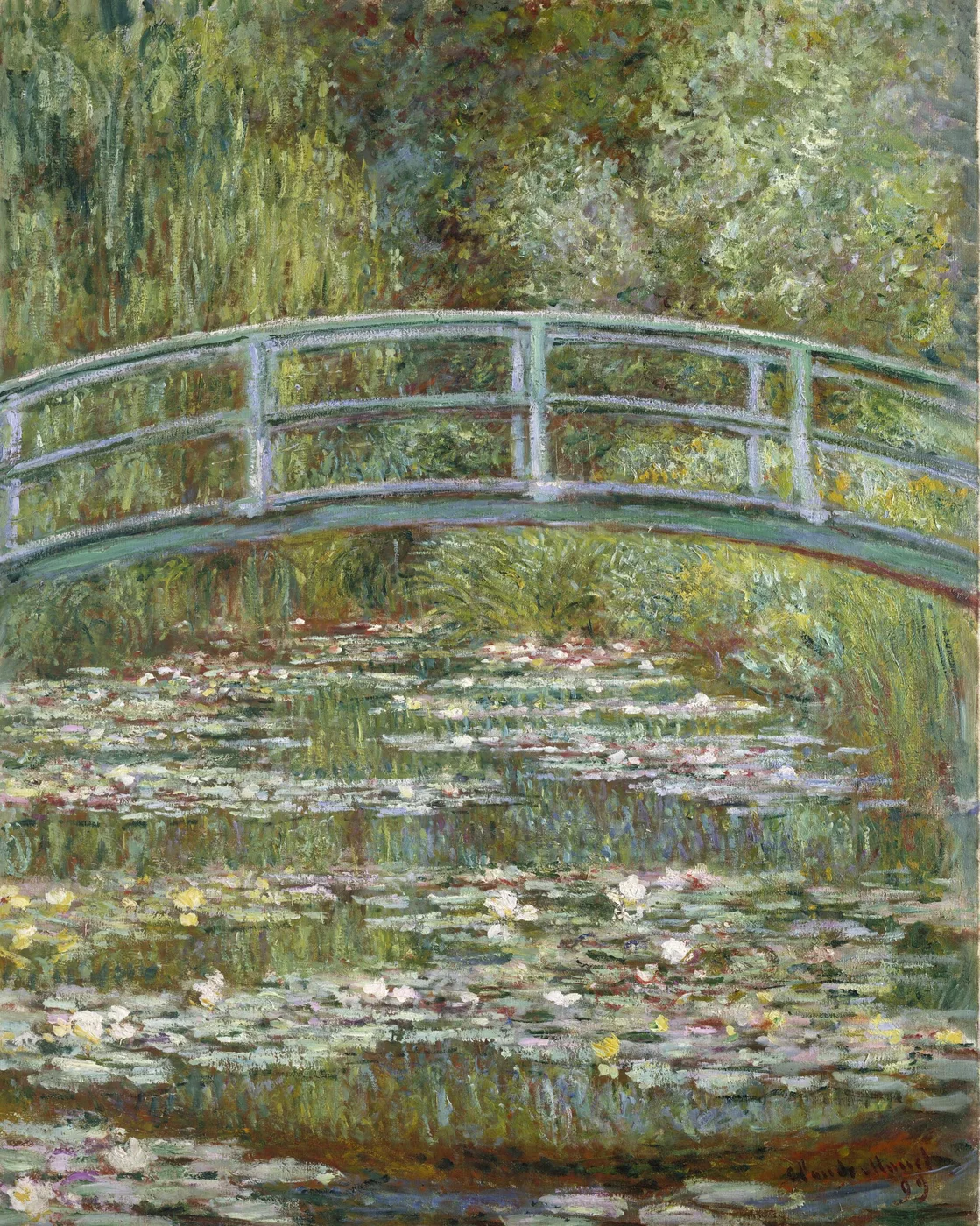
Bridge over a Pond of Water Lilies is an oil on canvas Claude Monet painted in 1899, a vertical canvas measuring 36 1/2 by 29 inches. It shows the arched footbridge he built over the water garden at his house at Giverny, with the pond filling nearly the whole view beneath it.
Water had occupied him for years before this canvas. He had diverted a small stream to fill a pond on land near his house, planted it with water lilies, and raised a curved wooden footbridge across it, painted pale green and modelled on the Japanese prints that hung throughout his rooms.
Working close to home suited him. He had already carried more than one subject through a long series: the grainstacks standing in a field near his house, in the story of the haystacks painted through a single winter, and the west front of Rouen Cathedral, in the story of the window he rented to paint it. Each subject was painted again and again as the light changed through a day or a season.
In 1899 he turned that same method on the bridge itself, working close to the water through a series of canvases that return to nearly the same view of the pond and its footbridge.
He was nearing sixty, and the pond let him work without the travel and the rented rooms that his earlier campaigns on the Normandy coast had required.
The water garden stayed his main subject for the rest of his career. He went on painting the pond, in one form or another, until his death in 1926, work that runs forward into the large canvases told in The Pond That Swallowed the Horizon.
How the Pond Is Built From Green, Violet and Ochre
The canvas stands taller than it is wide, and the bridge crosses it in a shallow arc through the upper third. Both ends of the bridge run off the edges of the canvas, so neither its supports nor its approach are visible. A bank of planting closes off the sky behind the bridge, and the open water begins just above the midline, filling roughly the lower half of the canvas.
A weeping willow hangs down at the upper left in long, narrow green strokes, next to brighter yellow-green dabs and a mass of small, pale, almost white touches that could be blossom in the shrubbery beside it. The brushwork here is short and crowded, built up in dabs rather than lines.
The bridge itself is a pale grey-green frame with a curved, near-white handrail, built from horizontal rails and vertical posts. Monet lets the foliage and water behind it show through the open rail, so the structure reads as something the eye looks through as much as something it looks at. The bridge’s own pale shadow falls across the water directly beneath it.
Just below the bridge, a low screen of reeds and grasses runs along the far edge of the pond, broken by a few strokes of yellow and ochre that suggest small flowers caught among them.
The water fills the rest of the canvas in horizontal bands of lily pads, each pad a flat touch of green or blue-green, with white, pale pink and a few pale yellow blossoms set among them in single loaded strokes. The pads sit larger and closer together near the bottom edge, which is what makes the water read as coming toward the viewer.
Between the pads, the water carries the colour of what hangs above it rather than any colour of its own. Blue and blue-violet strokes run through the middle of the pond, set among greens and a warm ochre, with a band of dark brown-red low in the canvas where the bank’s foliage reflects into shadowed water. The reflections run in longer, more vertical strokes than the pads, smearing the willow and the bank downward the way a disturbed surface would.
Monet laid the paint thickly in places, especially in the lily blossoms and the brightest foliage, so ridges of pigment stand up from the canvas and catch real light. The darker passages in the reflections are thinner and smoother by comparison, which keeps the eye moving between the raised, lit surface and the flatter shadow beneath it.
A Pond Without a Path or a Fixed Place to Stand
The subject is a corner of Monet’s own garden, but the way it is painted strips out most of what would normally orient a viewer inside one. The picture holds three things: the bridge, the planting behind it and the water.
Without a path to follow, the viewer’s eye finds a substitute in the lily blossoms themselves. Monet sets the whites and pinks at intervals across the pond, dense near the bottom edge and thinning toward the bridge, and the eye moves from one to the next the way a foot might move from stone to stone, the closest thing the picture offers to a way through the scene.
Cropping the bridge at both edges and leaving out the sky gives the viewer no fixed vantage point, closer to hovering above the pond than standing on its bank.
The arch is not quite centered on the canvas. Its highest point sits left of the middle, and the bridge’s right arm reaches the edge lower than its left arm does. The effect reads as a view taken slightly off axis, as though Monet set his easel a few steps along the bank rather than directly facing the bridge, one more way the picture withholds a single, official vantage point.
The picture can also be read as a study of what a surface hides and shows at the same time. The lily pads float on top of the pond while the reflections run through it, and both are painted in the same greens and violets, so the eye has to work to separate the plant from its mirror image.
The light is not even across the bank behind the bridge. The willow at the upper left sits in a deeper, cooler green, while the foliage at the upper right runs toward pale yellow-green and near-white, as if that side of the garden caught the sun and the willow’s side did not. There is no sky in the picture, so nothing in it shows where that light comes from.
The warm ochre in the reeds and the cool violet in the water sit close together through most of the canvas, which keeps the picture from settling into either a bright or a shadowed mood.
The Original at the Metropolitan Museum of Art, New York
The canvas measures 36 1/2 by 29 inches (92.7 by 73.7 cm). The museum catalogues it as object 29.100.113. That number and the vertical dimensions identify this particular canvas when a catalogue search turns up other paintings of the same bridge.
Monet returned to the arched footbridge in more than one canvas during 1899, working through the same motif from slightly different distances and angles, and several of those paintings now hang in other collections around the world.
Stand in front of it and you can read the brushwork: the ridges of paint in the lily blossoms and the willow catch the gallery’s light in a way no photograph repeats.
In the lower right corner, Monet signed and dated the canvas by hand, Claude Monet 99, the last two digits standing for the year 1899. The signature itself is a thin, fluid script in dark red-brown, closer to pen than to the thick paint of the blossoms.
Those who want the image without the trip to New York can order it through the painting’s own page, where every size on offer keeps the bridge and the pond in the same proportions as the original, without stretching or cropping the scene. The shop sends a photo of the finished canvas for approval before it ships.
Choosing a Reproduction of the Bridge and the Pond
A hand-painted version of this picture is painted in oil by a senior studio painter working from the museum’s own photograph of the canvas, on artist-grade cotton canvas. One painter takes one canvas from blank to finished, with nothing printed, transferred or projected at any stage; sizes and framing choices are set out on the painting’s own page.
The painter builds the blossoms and the willow up in thick paint the way Monet did, so your canvas catches the light of the room it hangs in.
Painting the oil by hand takes 2 to 4 weeks. Delivery once it ships takes 5 to 7 business days. Shipping is free and tracked worldwide. The archival canvas print is ready sooner.
The vertical format suits a narrow wall as well as a wide one: a stair landing, a hallway, the space beside a doorway. A plain stretched canvas keeps the attention on the brushwork, while a simple pale or dark frame marks the edges without competing with the greens and violets already doing the work.
Choosing between the hand-painted oil and the archival print mostly comes down to how close you expect to stand: the oil repays close viewing.
Questions About This Painting and Its Reproductions
What does Bridge over a Pond of Water Lilies show?
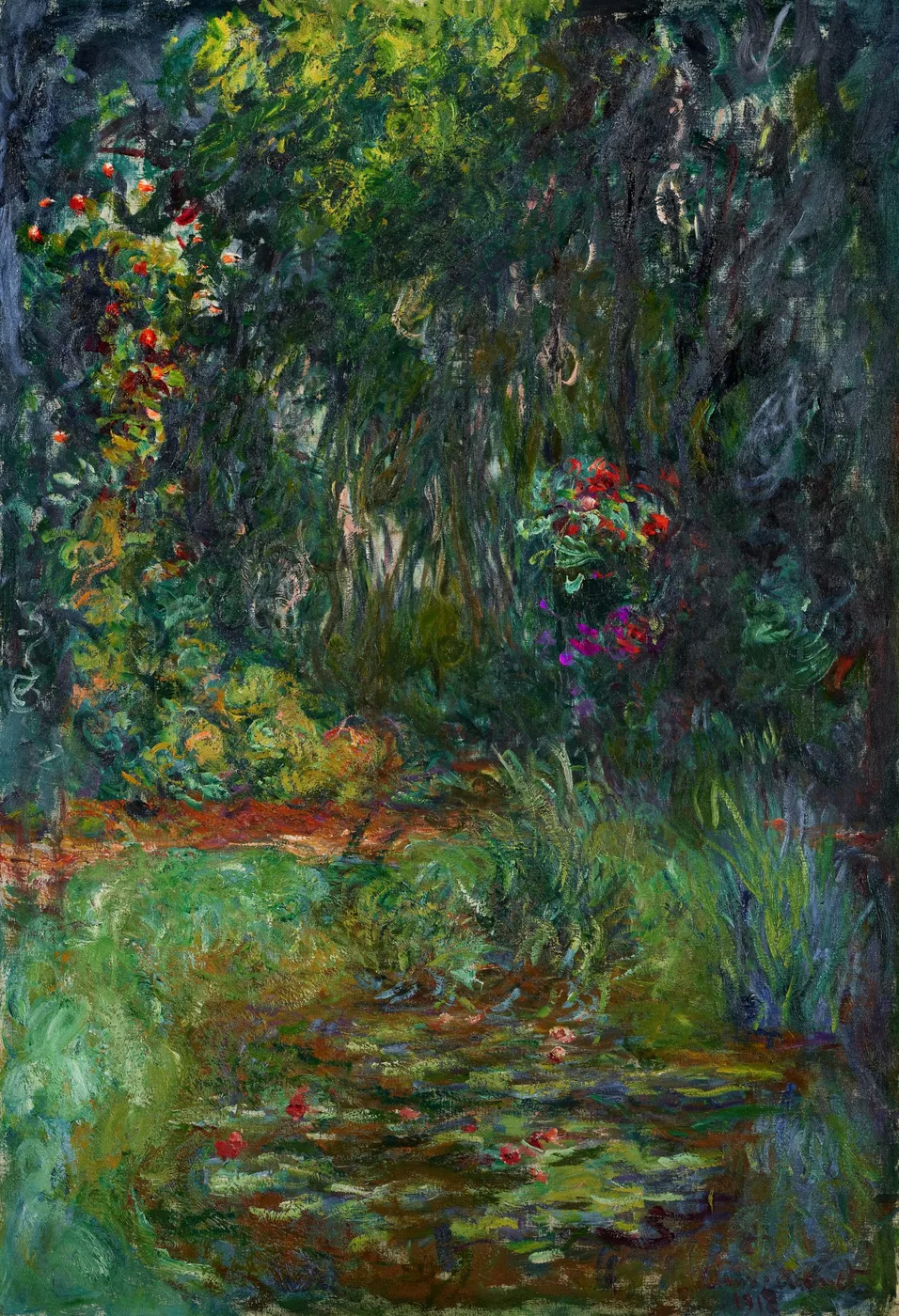
A curved, pale-green footbridge crossing Monet’s water garden at Giverny, painted in 1899. Lily pads, scattered white and pink blossoms and their reflections fill most of the canvas beneath the bridge. The canvas shows a reed bank under the bridge and a bank of planting behind it, with no sky in view.
Where is the original kept?
The original oil on canvas hangs at the Metropolitan Museum of Art, New York.
How big is the original canvas?
It measures 36 1/2 by 29 inches (92.7 by 73.7 cm), a vertical canvas taller than it is wide.
What is the difference between the hand-painted oil and the print?
A studio painter recreates the museum image in oil on canvas, using brushstrokes that give the surface texture. The archival print reproduces the image flat, without raised paint.
Can the size and frame be chosen?
Yes. Sizes, rolled or stretched canvas, and frame choices are all set on the painting’s own page when you order.
More from this collection
Bring this painting home
Choose a hand-painted oil reproduction for real brushwork, or an archival canvas print for a crisp museum-image edition. Every size preserves the original proportions.
View this work & options
Further reading
Verify the original in the The Metropolitan Museum of Art, New York collection record and continue through related works in the catalogue.