
Rouen Cathedral: The Portal (Sunlight), 1894: Pale Stone Under a Blue Sky
The Met’s Sunlit Cathedral
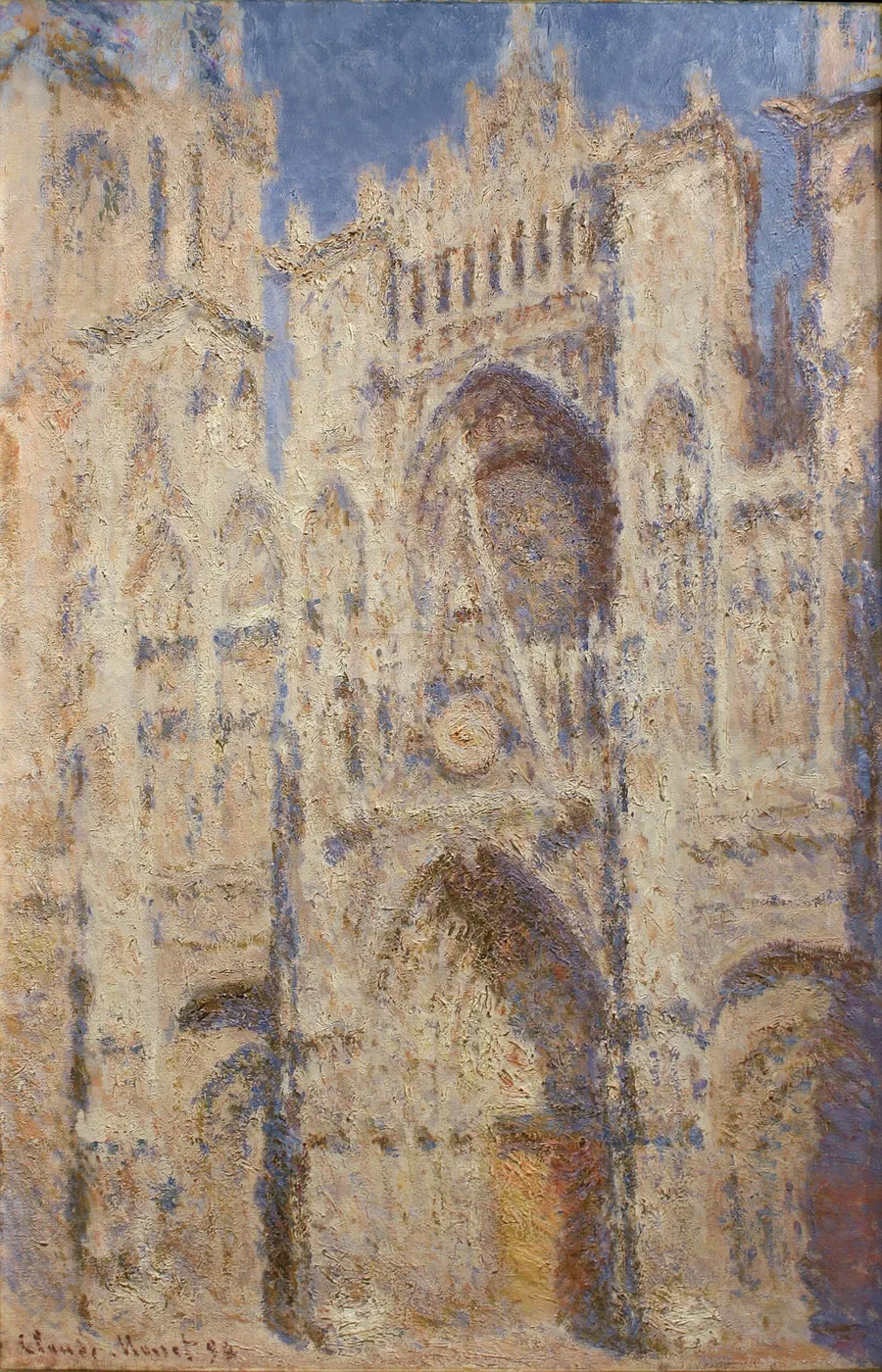
Claude Monet’s Rouen Cathedral: The Portal (Sunlight) fills a tall canvas with pale carved stone. Blue sky opens above the central facade, between its upper projections, and in a narrow strip at the right. The doorway reaches towards the lower edge. Our Rouen Cathedral reproduction follows this image in the Metropolitan Museum of Art.
Monet painted more than thirty views of the cathedral in 1892 and 1893. The Met describes him changing canvases as the day progressed. He later finished them at Giverny, adjusting individual paintings and their relationships within the group. Most carry a signature and date of 1894, including this one.
Twenty cathedral pictures appeared at Galerie Durand-Ruel in Paris in 1895. This painting was exhibited as Le Portail (Soleil), or The Portal (Sunlight). Its museum date records the finished work; it does not mean that Monet began observing the cathedral in 1894.
Following the Openings Up the Facade
Start with the large pointed doorway near the bottom. Its arch contains cream and ochre marks, with a darker blue-violet rim. Towards the lower right inside the entrance, warmer brown and rusty strokes gather in a vertical patch. The doorway has several colours within it, and its darkest passages sit beside much lighter stone.
A small circular feature sits above the entrance. Higher up, another pointed arch encloses a large dark opening. Its blue and violet passages form a second centre of shadow. Between these openings, short pale strokes interrupt the darker marks. They leave the surrounding carved details visible as a rough, broken pattern.
At the left, a broad upright section continues beyond the top of the picture. Thin recesses and darker flecks divide its pale surface. Along the right, narrower architectural forms frame the centre. Their pointed tops meet the blue sky. The painting crops the building, while keeping these upper edges and part of the sky in view.
The horizontal row of narrow openings above the upper arch gives you another place to look. Dark strokes repeat between pale upright divisions. Those small spaces run across the facade beneath the rising ornament. Their scale contrasts with the much larger arches below, so you can follow both broad shapes and smaller carved passages within the same view.
Cream, Gold and Violet in the Stone
Cream and pale gold cover much of the facade. Patches of lavender and blue remain among them, particularly around openings and vertical recesses. The blue sky at the top is a broader, less crowded area of colour. Its edge lets you trace the pointed stone forms against it.
Move across the wall beside the doorway and the colour changes over small distances. A light mark can end beside ochre, violet or a grey-blue fleck. These joins break up the face of the wall. From farther away, the same marks gather into larger pale surfaces with dark openings set inside them.
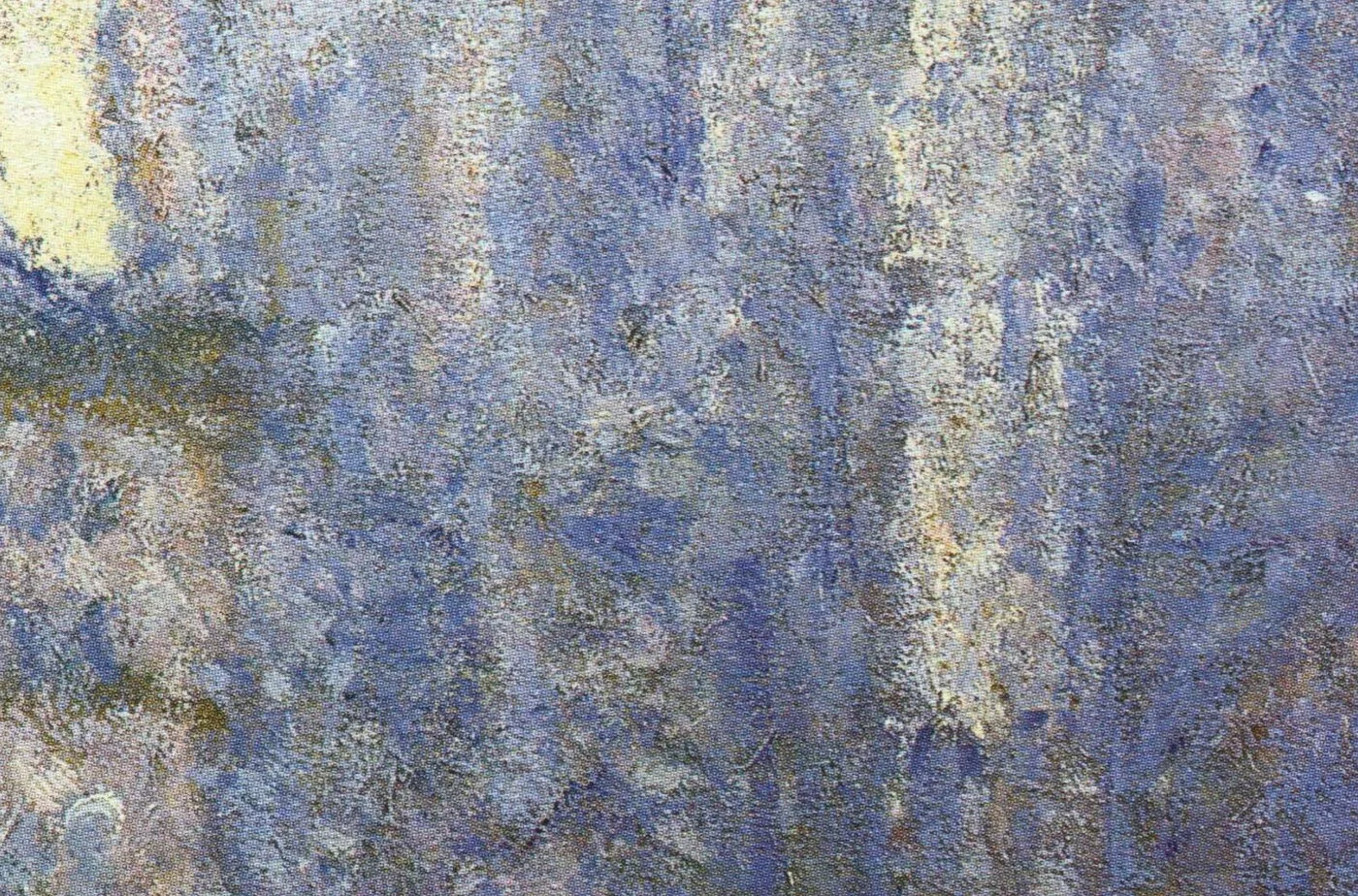
The museum photograph also records the rough paint surface. Raised and broken strokes run through the light stone, with small darker gaps between them. The Met describes this handling as conveying sculpted stone. On the photograph, you can compare the rough pale passages with the larger dark shapes inside the arches.
The lower edge contains very little space beneath the building. It keeps your view close to the entrance and the upright supports beside it. Near the bottom left, the signature sits in a quieter pale passage. Keeping this edge in the image preserves the base of the doorway as well as the small inscription.
Identifying This Original
The original is in the Metropolitan Museum of Art, New York, accession 30.95.250. The museum lists oil on canvas, dated 1894, measuring 39 1/4 x 25 7/8 in. (99.7 x 65.7 cm), with height given before width. Its English title includes The Portal (Sunlight).
Use the image alongside the title when comparing cathedral reproductions. Here, the large doorway below, the darker arched opening above and the blue sky between pale upper forms provide useful points of reference. A differently coloured facade or a different crop may belong to another view in the series.
For a wider view of a building and its surroundings, our Arrival of the Normandy Train story looks at trains beneath a glazed station roof. The Bridge over a Pond of Water Lilies story places a bridge above garden water, with planting around its arch.
Choosing a Vertical Reproduction
The product page offers sizes that retain the original’s portrait proportions. The lower doorway and upper stonework occupy different heights within that format. Compare the whole image with the available wall space, including clearance above furniture, before choosing a size.
Our hand-painted oil reproductions have a physical paint surface, with differences that come from work by hand. Canvas prints reproduce the museum image in ink. The photograph’s texture remains visible in a print, while the printed surface does not acquire the original’s raised oil strokes. The pale stone and the dark arches give you contrasting areas to examine when comparing the editions.
Select a size and presentation on the product page: rolled canvas, canvas mounted on a stretcher, a thin frame or a thick frame. Rolled canvas comes without a stretcher. The original’s height and width are listed separately from the commercial size labels, which can use rounded measurements. A photograph of a completed hand-painted oil order is sent for approval before dispatch.
Questions About The Portal (Sunlight)
Is there sky in this painting?
Yes. Blue sky is visible above the central facade and along the right side. The tall building fills most of the canvas, but these blue areas remain within its crop.
Why does the museum date it to 1894?
Monet painted the cathedral group in 1892 and 1893, then finished the works in his studio. This example is signed and dated 1894.
Which original does the reproduction follow?
The Met’s Rouen Cathedral: The Portal (Sunlight), accession 30.95.250. The original is 99.7 cm high and 65.7 cm wide.
Can I change the orientation?
The offered sizes preserve the vertical composition. You can choose the size, oil or print edition and presentation on the product page.
More from this collection
Bring this painting home
Choose a hand-painted oil reproduction for real brushwork, or an archival canvas print for a crisp museum-image edition. Every size preserves the original proportions.
View this work & options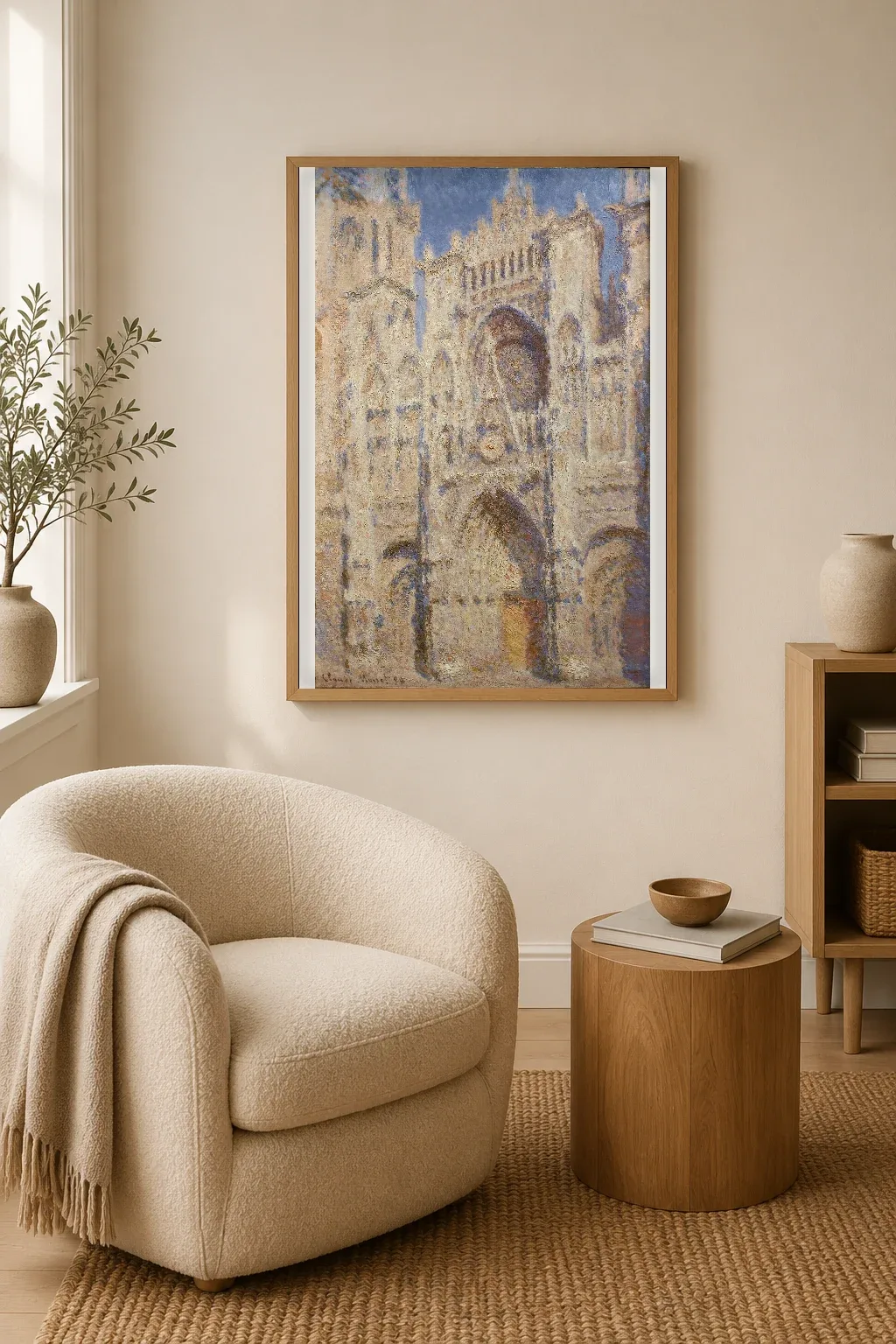
Further reading
Verify the original in the The Metropolitan Museum of Art, New York collection record and continue through related works in the catalogue.