
Haystacks (Effect of Snow and Sun), 1891: Light on Straw and Violet Shadows
Monet’s 1891 Grainstacks in Snow and Low Sun
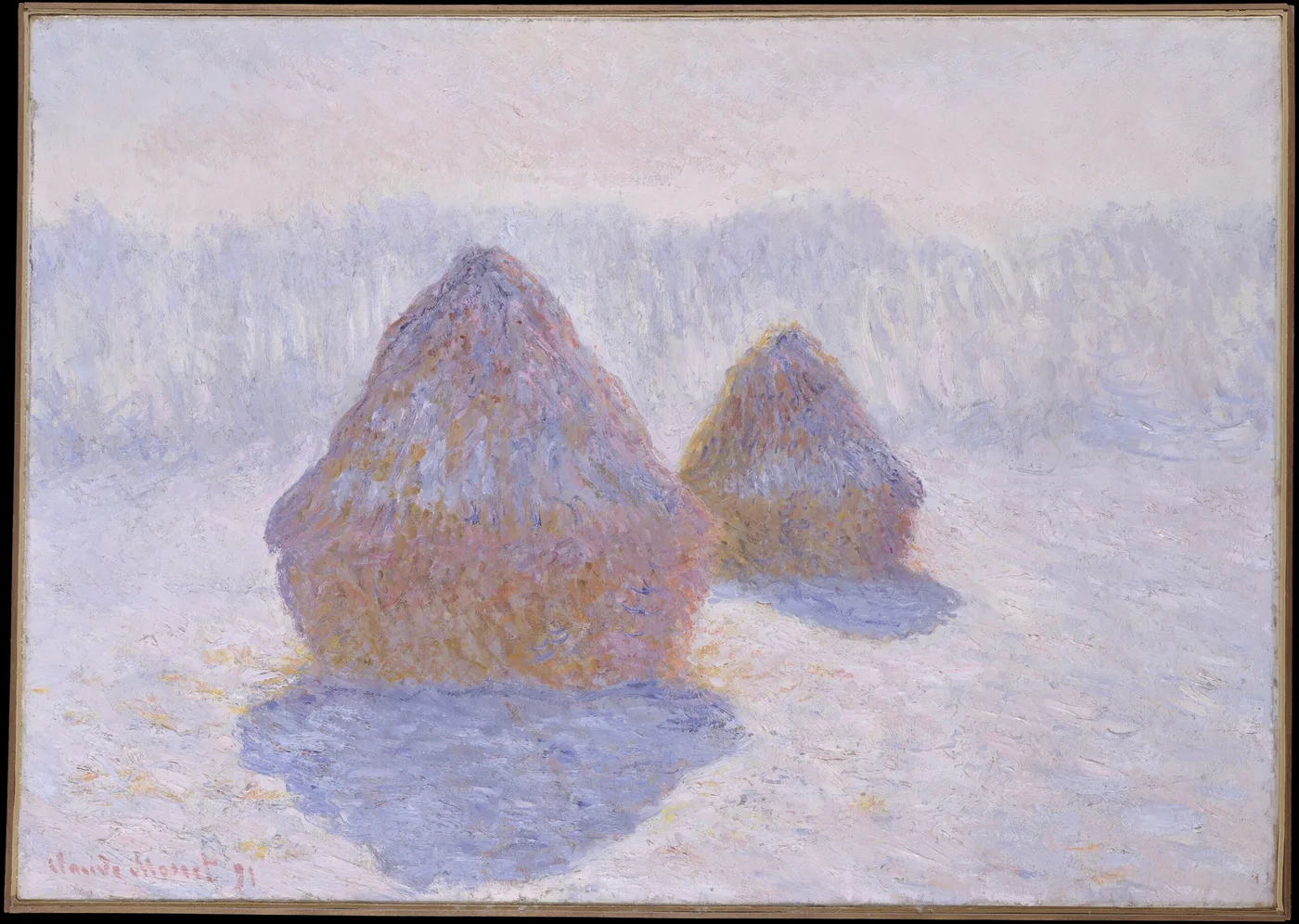
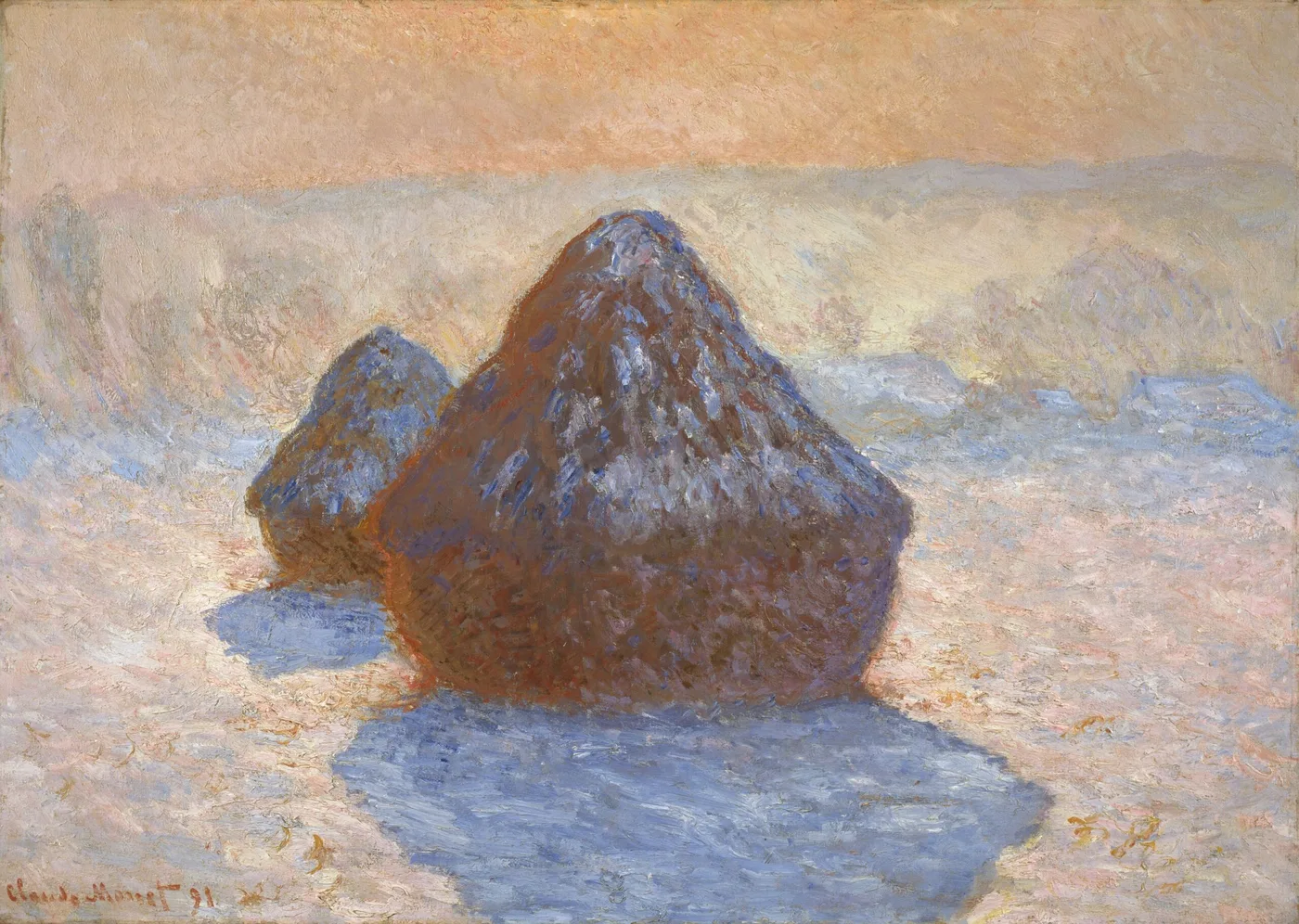
Haystacks (Effect of Snow and Sun) is an oil on canvas Claude Monet painted in 1891, now held by The Metropolitan Museum of Art in New York. Two grainstacks stand in a snow-covered field, with a pale sky behind them and broad violet shadows in front.
The painting belongs to Monet’s grainstack subjects. Keeping a familiar motif allowed him to study changes in light and colour. This canvas shows the particular combination named in its title: snow on the ground and sunlight reaching the stacks from the left.
The larger stack stands closer to the viewer, just left of centre. A smaller one rises behind it on the right. Their unequal scale and overlapping bases give the field depth without a road, a person or a line of buildings leading into it.
Snow removes many of the details that would make a field look busy. Here the stacks, their shadows and the distant line of trees are enough to establish the setting. The open ground leaves plenty of room for the colours around those simple shapes.
The repeated subject can make the grainstack paintings easy to confuse. This page concerns the Met’s 1891 canvas with two stacks, snow and low sunlight. Its composition and museum record identify this version.
Light on the Left, Violet Shadows Across the Snow
Light reaches the left-facing surfaces of the stacks. Pale yellow and warm orange touches sit beside pink and lavender marks in the straw. Cooler violet patches appear on their right-facing surfaces, continuing into the shadows on the ground.
The shadows extend towards the foreground and to the right. Their broad shapes anchor the stacks in the field. They also interrupt the pale snow with the strongest cool colour in the lower half of the painting.
Monet gives the nearer stack a wide, rounded base and a steep roof. Its outline stays recognisable even where small marks soften the edge. The smaller stack repeats that shape at a different scale, with its lower edge partly hidden behind the nearer one.
The snow has several colours: creamy white near the illuminated straw, pink in some open passages and blue-violet in shade. Short strokes remain visible within the larger patches. From further away those marks join into the field’s broad areas of light and shadow.
Behind the stacks, a loose band of grey-violet trees separates ground from sky. The sky is pale and lightly varied, with faint pink and lavender notes. Its quiet treatment gives the warmer, more densely marked straw room to stand out.
A Winter Field Organised by Light and Colour
The agricultural subject gives Monet two large, stable forms to work with. Most of the movement comes from the paint: short marks change direction across the straw, while lighter touches break up the snow around the stacks.
The warm and cool areas connect the whole composition. Orange in the straw meets violet in the shadow; a little pink passes through the snow and into the sky. Looking at those connections helps explain why the field feels unified despite its many separate strokes.
You can also read the painting through its distances. The nearer stack and its shadow occupy much of the foreground. Beyond them, the smaller stack and the softened trees lead into a quieter space. The scene remains compact, with few objects competing for attention.
Identifying the Met’s Canvas Among the Grainstack Paintings
The Metropolitan Museum of Art holds the original. The catalogue gives its dimensions as 25 3/4 x 36 1/4 in. (65.4 x 92.1 cm), height before width. These are the dimensions of the painted canvas, and they distinguish the museum work from reproductions offered in other sizes.
The museum’s catalogue identifies this painting as Haystacks (Effect of Snow and Sun), dated 1891. For a visit, consult the Met’s current information about display; a collection record alone does not establish that a painting is hanging in a particular gallery.
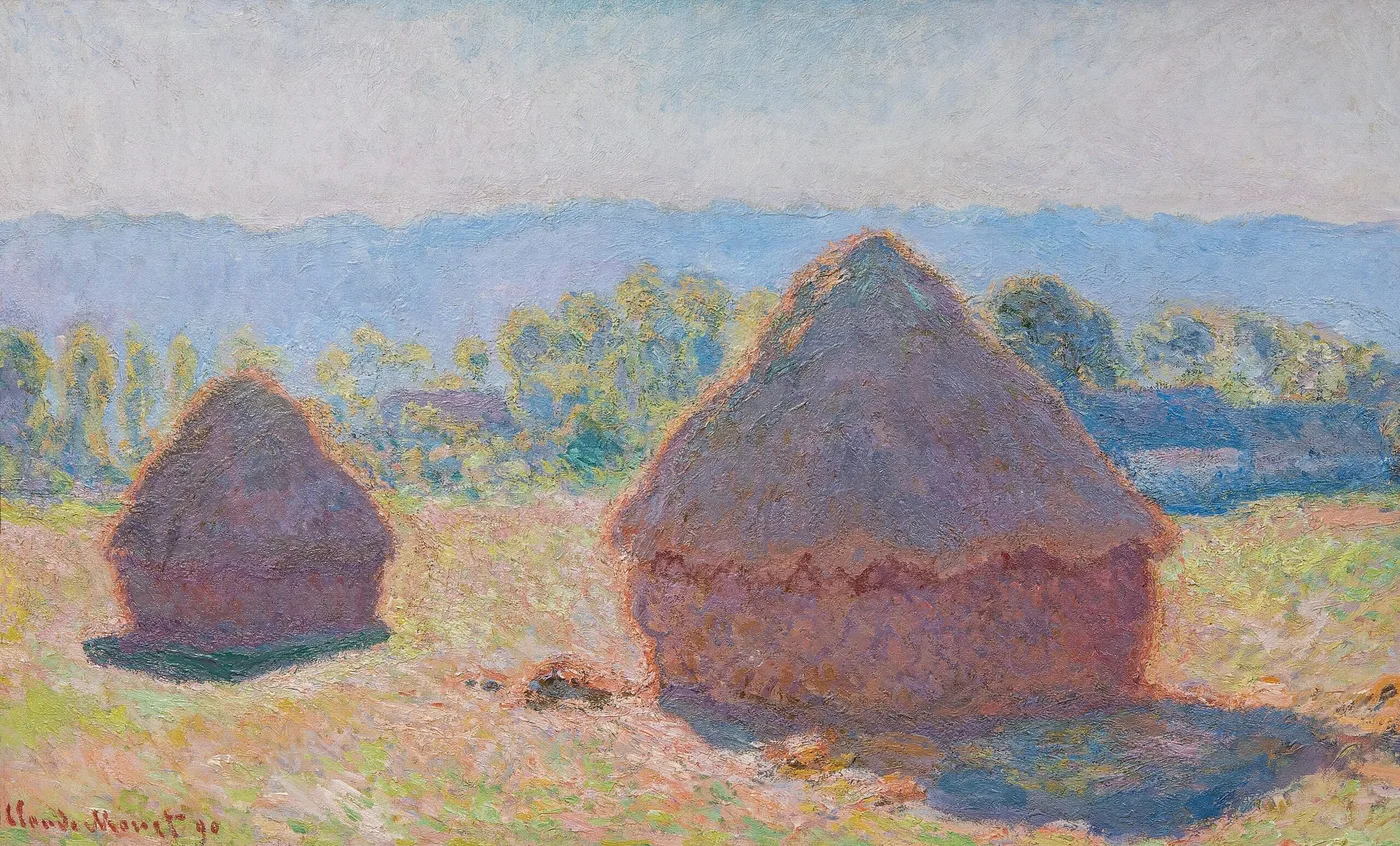
Other grainstack subjects have their own pages, including Haystacks, End of Summer and Haystacks, Snow Effect. Keep the title, date and museum together when comparing versions, rather than treating every grainstack image as the same canvas.
Choosing an Oil Reproduction or Canvas Print of This Snow Scene
The product page offers a hand-painted oil reproduction and an archival canvas print. In the oil version, a studio painter interprets the composition in real paint on canvas. The print reproduces the image with a flatter surface.
The choice matters particularly in the stacks and the shadows. Oil brushwork can catch light on its raised marks; a print keeps the appearance of the museum image on a flat printed surface. Choose the medium according to the surface you want to see at home.
Painting time: 2 to 4 weeks. Print production: 2 to 4 business days. Delivery after shipping: 5 to 7 business days. Each piece is made to order. The shop’s production information explains the process, and the product options show the finishes currently available.
Measure the wall before choosing a format on the product page. This composition needs enough width for both stacks and the snow around them. A larger version makes the separate marks easier to inspect; a smaller one gives a more compact view of the whole field. Rolled, stretched and framed finishes serve different installation needs.
Questions About the Met’s Snow and Sun Grainstacks
When did Monet paint this version?
The Met dates Haystacks (Effect of Snow and Sun) to 1891. This page describes that museum’s two-stack composition, with snow on the ground and violet shadows reaching into the foreground.
Which way does the light come from?
The brighter yellow and orange passages lie on the left-facing sides of the stacks. Their cooler shadows spread towards the foreground and right across the snow.
Where is the original?
The Metropolitan Museum of Art in New York holds the original oil on canvas. Its painted surface measures 65.4 by 92.1 centimetres, height before width.
How do the oil and print versions differ?
The oil reproduction is painted by hand on canvas and has its own brushwork. The archival canvas print reproduces the image on a flatter surface. Both options and their available finishes are listed on the product page.
More from this collection
Bring this painting home
Choose a hand-painted oil reproduction for real brushwork, or an archival canvas print for a crisp museum-image edition. Every size preserves the original proportions.
View this work & options
Further reading
Verify the original in the The Metropolitan Museum of Art, New York collection record and continue through related works in the catalogue.