
Woman with a Parasol, Madame Monet and Her Son: Camille High on the Slope, Jean Low in the Grass
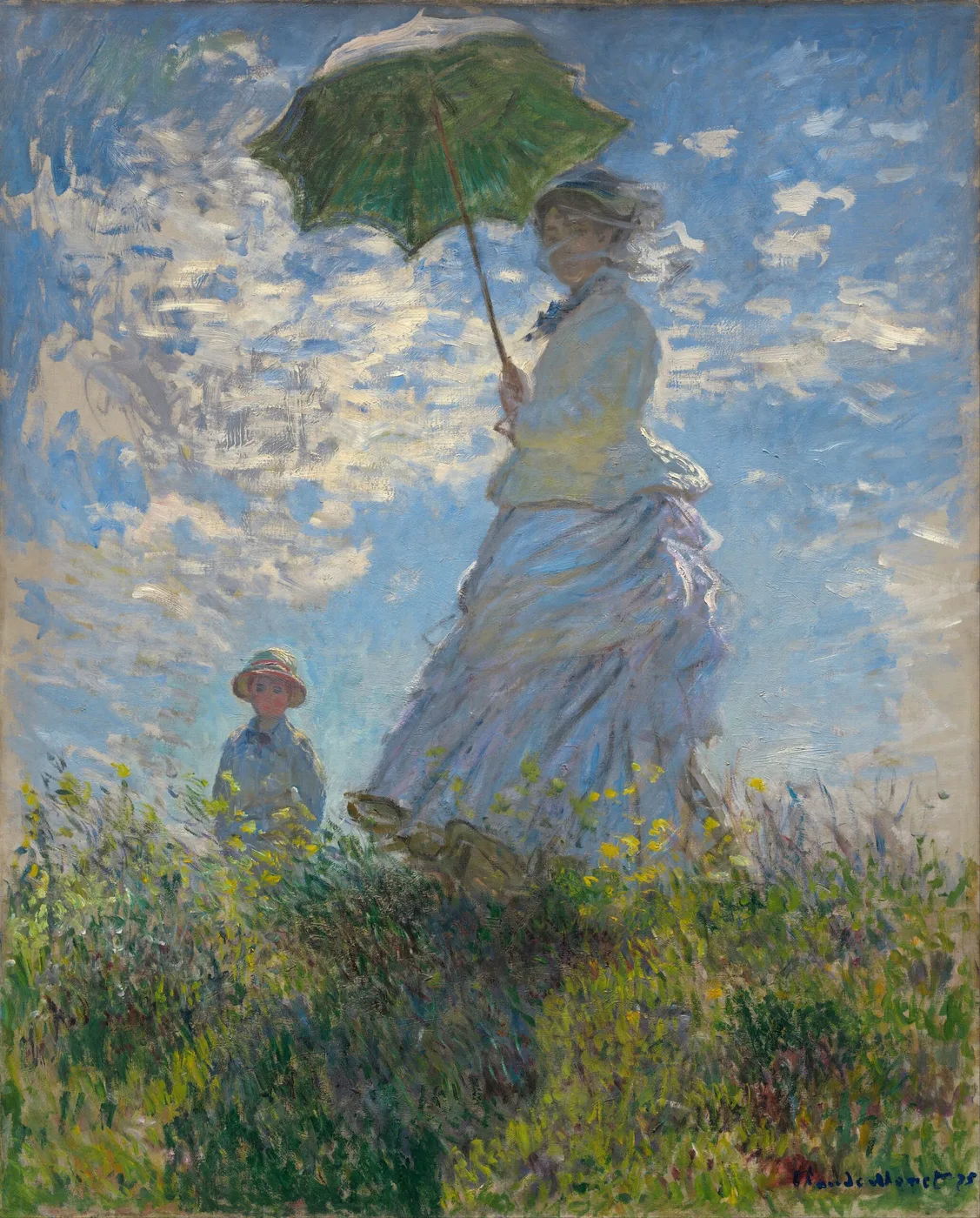
A Family Walk at Argenteuil, Painted in 1875
Claude Monet painted Woman with a Parasol, Madame Monet and Her Son in 1875, an oil on canvas measuring 100 x 81 cm and held by the National Gallery of Art, Washington, that shows his wife Camille and their son Jean outdoors, caught mid-step on a grassy slope as the wind pulls at her dress and veil.
Monet was well into the outdoor method of painting he favoured, working directly from the landscape. He and his family were living at Argenteuil, a town on the Seine west of Paris, where open fields, the riverbank and his own garden gave him subjects within easy reach of the house. He had also begun showing his pictures alongside a group of painters working outside the official Salon system, the circle that would become known as the Impressionists.
Camille turns up again and again in Monet’s canvases from these years.
Money stayed tight through this stretch of his career. Buyers were slow to take an interest in paintings built from quick, visible strokes.
He returned to a woman with a parasol as a subject again in 1886, that time alone, a single figure set against open sky. The 1875 canvas comes first, with two figures, Camille raised on the slope and Jean lower in the grass behind her.
How Monet Built Wind Into the Dress, the Veil and the Grass
Monet set the composition in two bands: a rise of grass across the bottom third, open sky filling everything above it, with no horizon line or middle distance between them. Camille stands near the top of that grass, high enough that the sky reads as her backdrop. The viewpoint is low, as though the painter knelt partway down the slope and looked up toward her.
Light comes from behind and above her, since the parasol throws a shadow down across her shoulders and the near side of her face. The lit side of the dress is warmed with cream and pale yellow, almost gold in the brightest folds. The side in shade turns blue and violet, the same cool colours that fill the clouds behind her, so the dress and the sky share a palette.
The parasol is painted in two shades of green, dark on the underside and a lighter, greyer green where the sun catches the fabric, with a pale line of trim at its edge. Its ribs read as thin darker strokes running out from the centre. Camille’s face, turned down toward the viewer, is reduced to a handful of marks for the eyes, nose and mouth, half covered by the veil falling from her hat.
Long diagonal strokes in white, pale grey and lilac make up her skirt, gathered at the waist, with a dark blue bow at her throat. The veil streams out to one side in thin, dragged strokes, loose enough that the blue of the sky shows through the cloth, which keeps it reading as moving air.
Hundreds of short upward strokes in two or three greens form the grass, darker where it falls into shadow near the ground, with small dabs of yellow scattered through it for wildflowers. Jean stands in this grass at the lower left, smaller than his mother and only partly visible above the stems, in a pale outfit and a straw hat with a dark band, painted with far fewer strokes than she is given.
Monet laid the sky above them in broad, loaded strokes of blue, white and pale grey, the clouds shaped from loose, blended masses of tone, dragged in the same diagonal direction as the pull of the veil. Monet left every stroke visible across the canvas, in the grass, the dress and the sky alike, so the paint surface stays as active as the wind it describes.
Camille Above, Jean Below: What the Arrangement Suggests
The picture reads first as a record of weather, the kind of gust that pulls at clothes and grass. Painted at the scale of a full standing figure, that passing moment carries the weight of a formal composition, and the low viewpoint turns an ordinary walk into something closer to a monument.
Camille stands at the top of the rise, outlined against the sky, while Jean is lower, partly covered by the grass, his outline breaking into the stems around him. Read as a family group, the arrangement puts her in command of the scene and leaves him smaller and set apart from her.
Her face carries the least detail in the whole picture, a few strokes under a veil that half covers it, while the dress, the parasol and the moving sky carry nearly all the information Monet gives the viewer. That choice can be read as putting the sensation of the day, the wind, the light, the shifting colour, ahead of a likeness of the person standing in it.
The casual look of the scene fits the wider Impressionist interest in a single instant over an idealised or staged one. Read that way, the picture records what one particular day looked like, with little interest in Camille and Jean as individual lives.
Beside the Other Argenteuil Pictures, and the Later Parasol of 1886
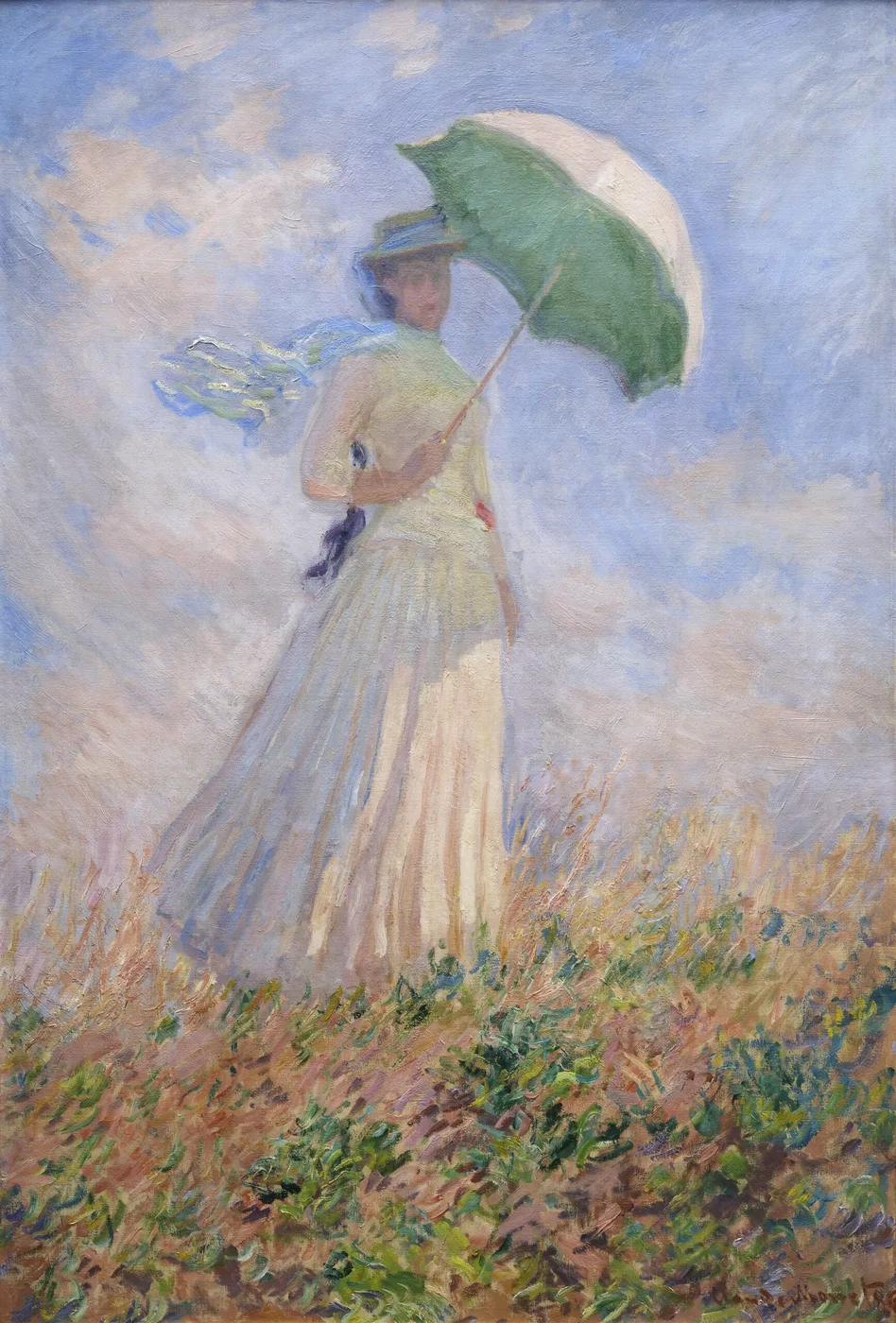
This 1875 canvas comes eleven years before the single-figure parasol paintings Monet made in 1886, including Woman with a Parasol, Facing Left. Those later pictures keep the parasol and the low viewpoint but drop the second figure entirely, a woman alone against the sky with no son standing in the grass beside her.
Camille appears elsewhere in Monet’s work from the same years, including Camille Monet in the Garden at Argenteuil, painted in their own garden.
He also painted the river and its bridge at Argenteuil in these years, as in Bridge at Argenteuil on a Gray Day.
Choosing a Hand-Painted Oil or Print, and the Right Size for a Tall Composition
This painting is available on its product page as a hand-painted oil reproduction or as an archival canvas print, both made to order, never pulled from stock. The oil version is painted by a senior studio painter working in oils on artist-grade cotton canvas, one person taking one canvas from blank to finished, with nothing printed or projected at any stage.
Painting the oil by hand takes 2 to 4 weeks. Printing the canvas version takes 2 to 4 business days. Delivery once it ships takes 5 to 7 business days. Shipping is free and tracked worldwide, and every finished piece is checked by hand before it is packed. Every order carries a certificate of authenticity and a 30-day return guarantee.
You can also choose how the canvas arrives, rolled for shipping, stretched ready to hang, or finished with a frame, selected on the same product page alongside the size.
The composition here runs tall, a vertical format, with Camille rising most of the way up the canvas and open sky filling the space above her, so it suits a wall with height to spare, an entryway, a stairwell, or the wall opposite a doorway, better than a long horizontal run. A larger size keeps the grass and the clouds easy to read from across a room, and a smaller one still holds up because the figure and the parasol carry the composition on their own. Compare the size list for this piece against your wall before you order, on the product page.
Common Questions About This Painting
What is happening in the painting?
Camille Monet, the artist’s wife, stands on a grassy slope with their son Jean, caught by a gust of wind that pulls at her dress, her veil and the grass around them.
Who are the two figures in the picture?
The woman is Camille Monet, Claude Monet’s wife, and the boy is their son Jean. Monet painted them in 1875.
Is this the same painting as Woman with a Parasol, Facing Left?
No. That picture is from 1886 and shows one woman alone with a parasol. This canvas is from 1875 and includes both Camille and Jean.
Can I order this as a print instead of a hand-painted oil?
Yes. The product page offers both a hand-painted oil reproduction and an archival canvas print, in your choice of size and finish.
What size suits a narrow wall, such as a hallway?
The tall, vertical composition suits a narrow wall well. Check the size list on the product page against the height and width of your space before ordering.
More from this collection
Bring this painting home
Choose a hand-painted oil reproduction for real brushwork, or an archival canvas print for a crisp museum-image edition. Every size preserves the original proportions.
View this work & options
Further reading
Verify the original in the National Gallery of Art, Washington collection record and continue through related works in the catalogue.