
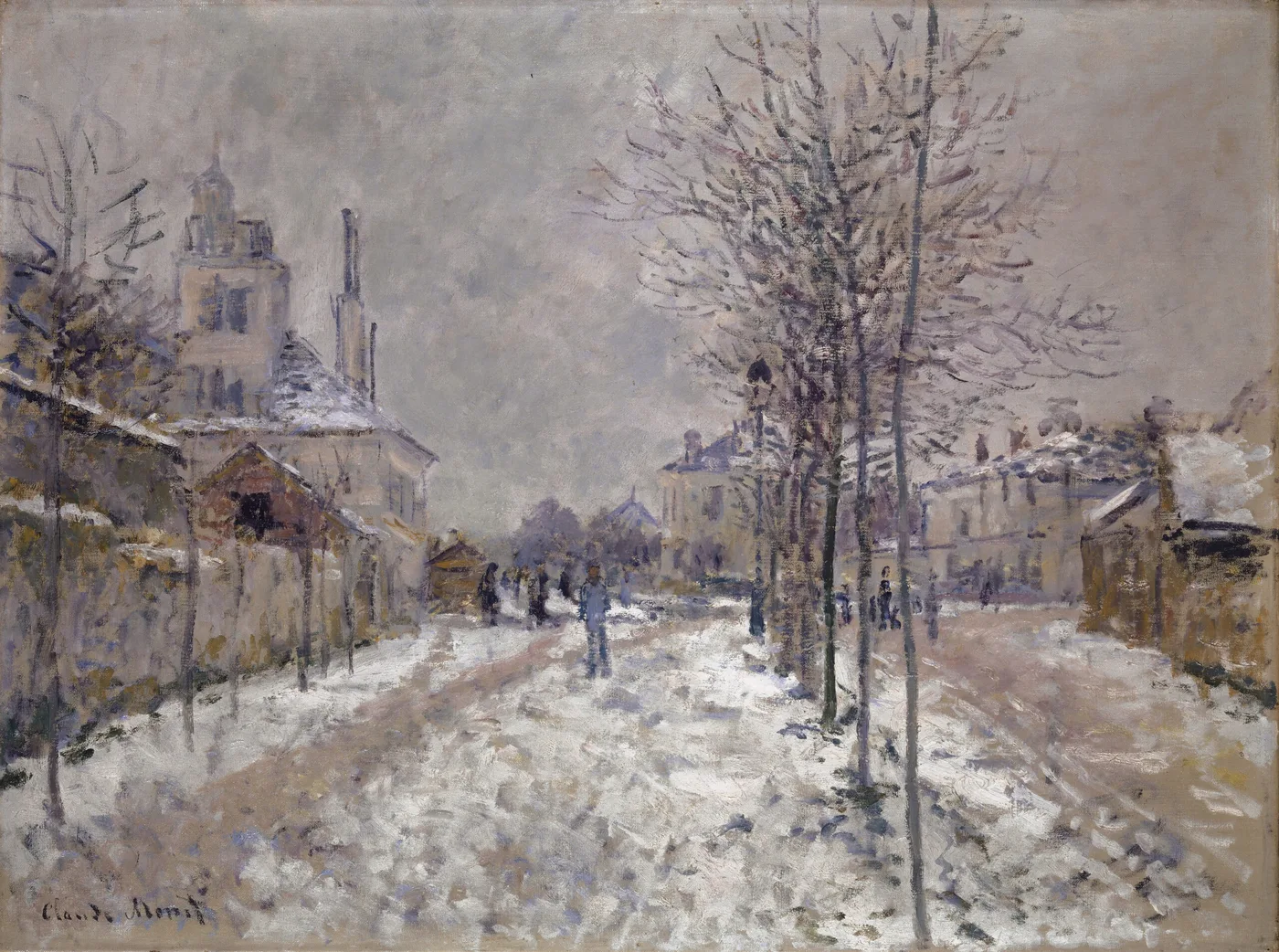
Bridge at Argenteuil on a Gray Day
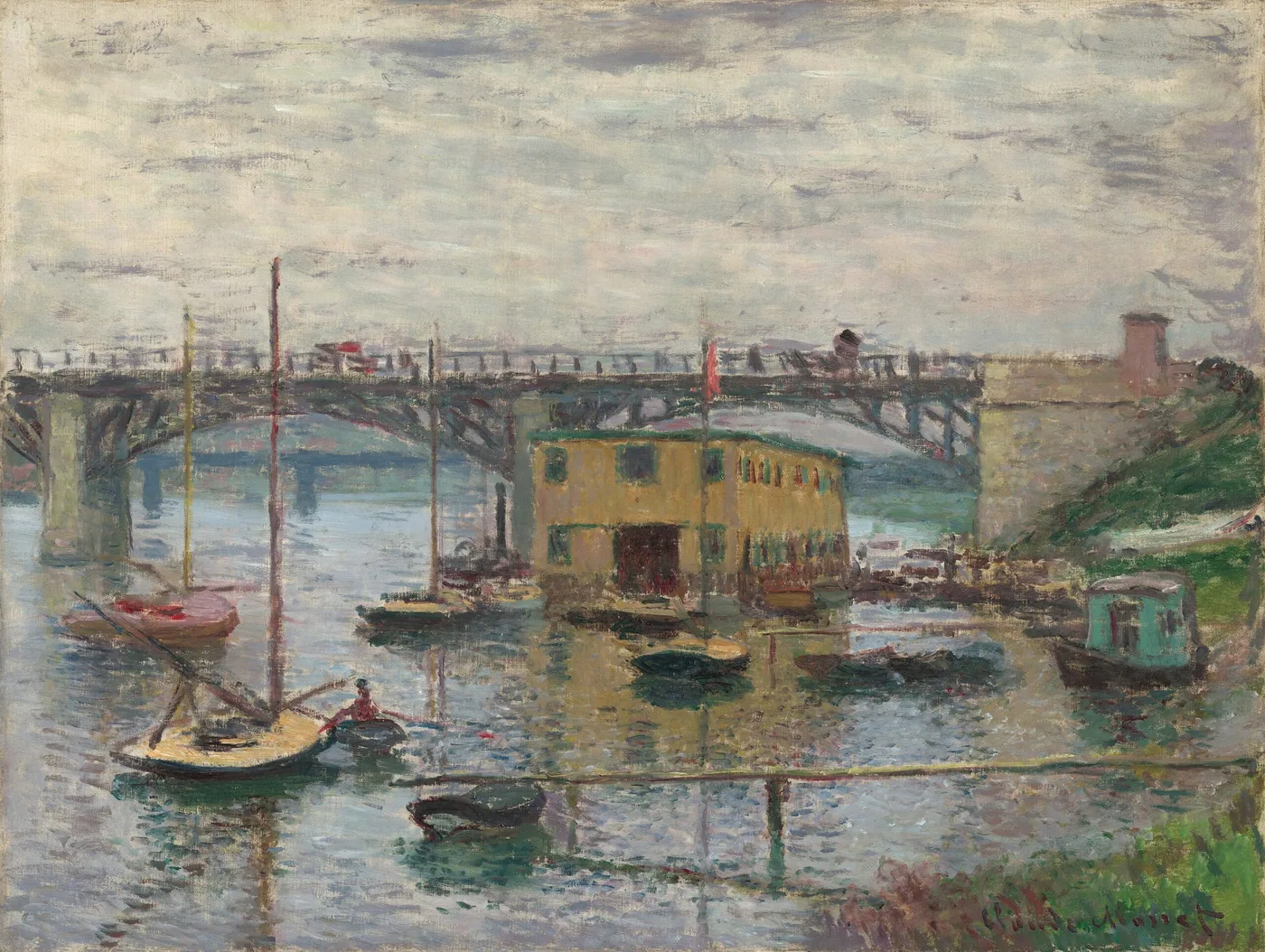
There is no sun in this picture and that is the point. The river is pewter. The sky is a low lid. The far bank has gone soft and colourless in the damp, and the bridge, which on a bright day would throw a hard architectural shadow across the water, simply stands there being wet. Most people picture Impressionism as sunshine on water. A large part of it is actually this: grey light, still air, and a painter proving he can find colour in a day that appears to have none.
Monet lived at Argenteuil from 1871 to 1878, a stretch of the river within easy reach of the city, popular with sailing parties, busy with weekend boats. He had a studio boat there, a flat-bottomed craft fitted out so he could work from the middle of the water rather than from the bank. That is a specific ambition. It means he wanted the motif to surround him, and it means the picture surface was being made in a thing that rocked.
The bridge had been broken
The bridges at Argenteuil, road and rail both, had been destroyed in the Franco-Prussian war and rebuilt afterwards. When Monet moved there the structures spanning his river were new. Fresh stone, new iron, replacement piers, a crossing that had been taken away from the town and given back to it.
He did not paint that as a subject. There is no rubble in the picture, no commemorative gesture, nothing that asks you to think about the war. But it changes what you are looking at. This is not an old bridge that has always been there. It is a repair, painted a few years after the repair, by a man who had come home to a country that had recently lost badly and was busy rebuilding its ordinary infrastructure.
Read that way, the grey day stops being a technical exercise. A rebuilt crossing on a colourless afternoon, with a couple of boats going about their business under it, is a picture about the resumption of normal life. Nothing is happening. That is the good news.
The town he chose
Argenteuil was not a beauty spot and he did not pick it for its charm. It was a river town within easy reach of the capital, close enough that friends and dealers could come out for the day, cheap enough to live in, and positioned on a wide reach of water that attracted sailing boats at weekends. It had leisure and it had traffic. Barges and pleasure craft used the same stretch, and the crossings carried people to and from the city on ordinary business.
He stayed seven years, from 1871 to 1878, and painted that water repeatedly in every condition it offered. Seven years is a long time to look at one reach of a river. It produces a particular kind of knowledge, the sort a fisherman has, where you know without thinking how the surface behaves in a given wind and what the far bank does in flat light.
This canvas is a product of that familiarity. It is not the work of someone hunting for a view. It is the work of someone who already knows the view completely and has come out on an unpromising afternoon because the unpromising afternoon is itself the subject. Only a painter with a settled relationship to a place bothers to record it on a day when it looks like nothing.
The domestic backdrop matters too. This was the household he had built with Camille, in the years before she died in 1879 at the age of thirty-two. The pictures from these seven years are, among other things, the visual record of the last stable period of his early life.
Painting from a boat, in the wrong weather
Working from the studio boat solved one problem and created several. It put him level with the water, which is why the river occupies so much of the canvas and why the bridge is seen from below rather than from a bank. It also meant a moving support, a limited working area, and total exposure to whatever the sky was doing.
A grey day is technically harder than a sunny one. Bright light hands you a big value range, obvious shadows, easy structure. Overcast light compresses everything into a narrow band of middle tones, and if you paint what your brain tells you is there you produce mud. The only way through is to stop thinking about grey as a colour and start hunting the small hue differences inside it: green in the water, violet in the far trees, a warm ochre note where the bank meets the river, a faint blue where the sky is thinnest.
Look at the reflections and you can see the second discipline at work. On a still, dull day, reflections run vertically and are almost as strong as the objects casting them. Monet paints them in long downward strokes, slightly broken where the surface stirs. The horizontal strokes belong to the water itself; the vertical ones belong to what the water is holding.
What to look at now
- Cover the bridge with your hand and the picture becomes a study of a flat river. Uncover it and the whole space organises itself. The span is the only firm horizontal in a canvas made of soft transitions.
- Hunt for the warmest touch in the painting. In a grey picture there is almost always one small warm note holding the entire cool scheme in balance, and finding it is the fastest way to understand how the canvas was built.
- Compare the sharpness of the near water with the far bank. The distant edge is deliberately softened. That single decision creates all the depth in the picture without any drawn perspective.
- Look at the boats. They are stated in a handful of strokes, and yet you can tell how they sit in the water. Economy of that order takes years.
The quiet argument inside it
Painters had been trained for generations to compose landscape with drama: a storm, a shaft of light, a ruin. This canvas has a bridge, a river and no weather event whatsoever. It insists that a dull afternoon is worth serious attention, that industry and leisure sharing a river is a legitimate subject, and that the modern iron and stone of a rebuilt crossing belongs in a picture just as much as a cathedral does.
It also insists that colour survives the loss of sunlight. That is the technical claim underneath the calm surface, and it is why grey-day Impressionist paintings tend to age better than the sunny ones. They are harder, and they are more honest about what most days actually look like.
How it behaves on a real wall
This is possibly the most cooperative picture a room can be given. The value range is narrow, the composition is horizontal and settled, and there is no bright passage fighting for attention, so it never dominates. In a room with a lot going on it acts as a rest.
It suits the exact conditions it depicts. In flat, overcast daylight it looks completely at home, which makes it a good choice for rooms with weak or indirect natural light where sunnier paintings look stranded. Under warm evening lamps the greens and violets in the water warm up noticeably and the whole surface becomes softer.
Colour-wise it lives happily with grey-green and blue-grey walls, dark and mid woods, wool, slate and pewter, and it looks unexpectedly good against a deep, saturated wall where the pale sky in the painting reads as an opening. Hang it at seated eye level, horizontally centred on a broad wall, and let the width of the composition do its work. It is a picture that asks nothing of you, which is precisely why people keep looking at it.
Sizes and materials for Bridge at Argenteuil on a Gray Day are listed on its product page.
More from this collection
Bring this painting home
Choose a hand-painted oil reproduction for real brushwork, or an archival canvas print for a crisp museum-image edition. Every size preserves the original proportions.
View this work & options
Further reading
Verify the original in the collection record and continue through related works in the catalogue.