
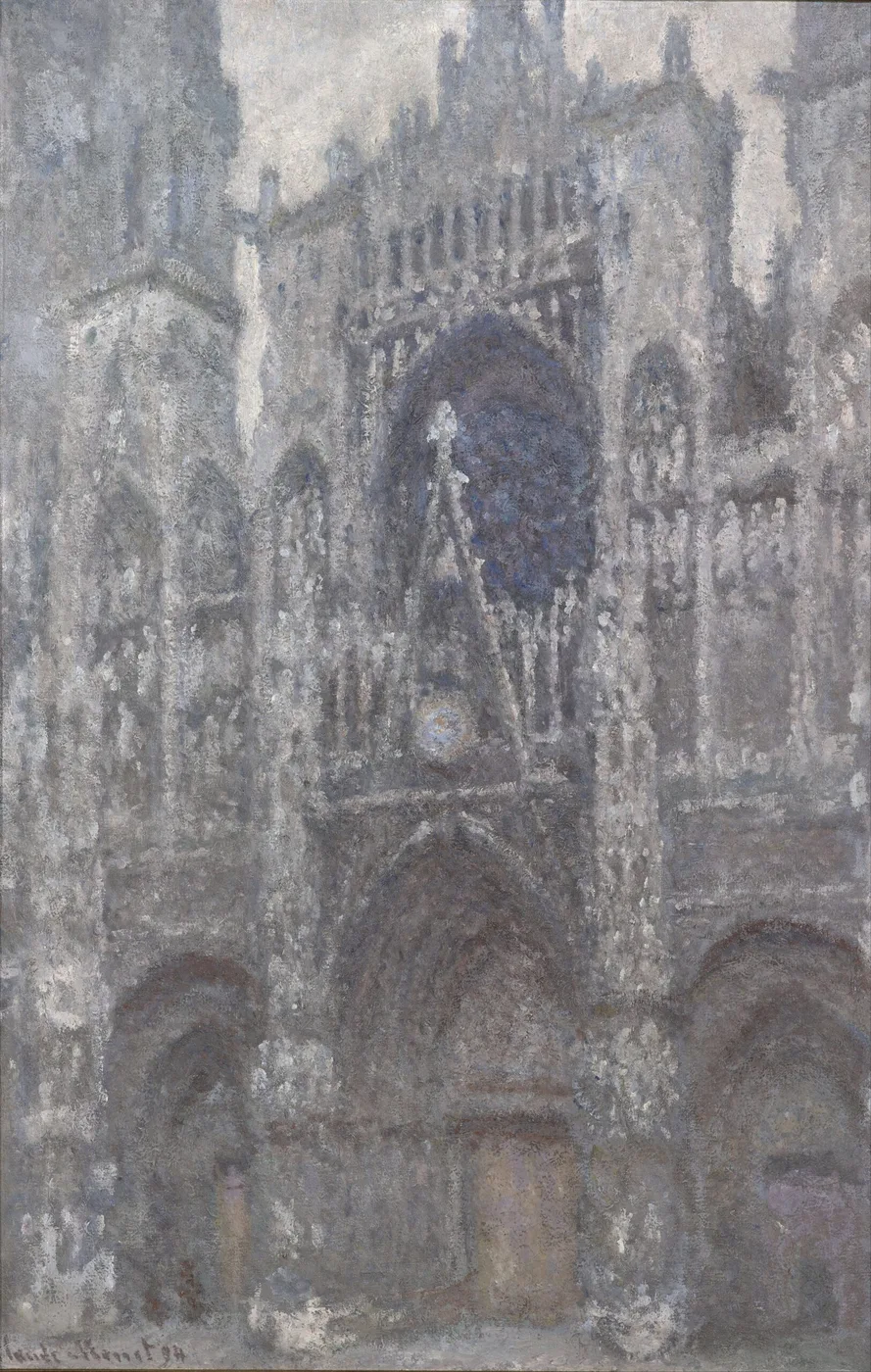
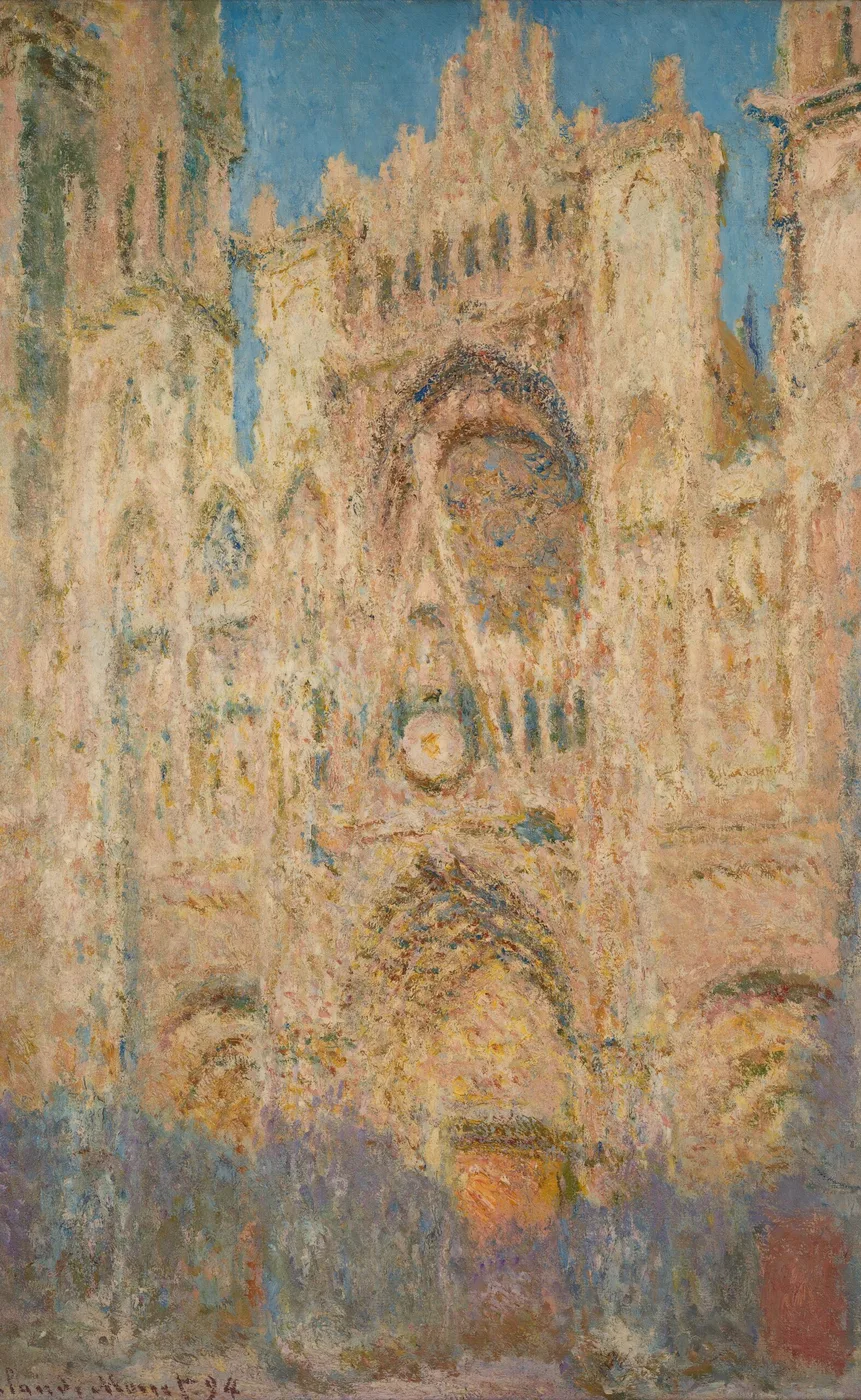
Rouen Cathedral, Portal, Cloudy Weather
Imagine a small rented room on an upper floor, a chair, a stack of canvases against the wall, and a window filled entirely by the front of a cathedral. Not a view of a cathedral; the thing itself, close enough that it fills the glass from edge to edge, so near that you cannot see the top of it or the ground it stands on.
Now imagine spending two winters in that room.
He rented spaces opposite the west front of Rouen cathedral in 1892 and again in 1893, and worked on the same wall of stone through both campaigns. Not one canvas at a time; many at once, stacked and swapped, because the light moved faster than he could paint. He finished the group in the studio in 1894 and showed them in 1895. He wrote of the work giving him nightmares.
This is the grey-weather one. Of all of them it is the least obviously appealing, and it is the one that explains what the whole project was for.
The picture that gave him nightmares
The idea sounds simple and is close to unhinged in practice: paint the same immovable object over and over, changing nothing but the light, and see what happens.
The trouble is that light on a stone facade changes continuously and never repeats exactly. On a clear morning the sun crosses the front in a matter of an hour or two, throwing the deep carving into hard relief and then flattening it. On a cloudy day the whole thing sits in a diffuse even wash which shifts as the cloud thickens or thins. To catch any given state he had perhaps twenty minutes; then that state was over, and the only way to continue was to put the canvas aside and pick up another one that matched the new conditions.
So the room filled with canvases. He moved between them as the light moved, working on each for as long as its particular effect lasted, then waiting, sometimes days, for that effect to come back. Weather does not cooperate. A week of rain means a week of not touching half the canvases in the room.
He was fifty-two, at the height of his powers and his reputation, and he had voluntarily locked himself in a small room to fight a building. The nightmares are entirely believable. There is a peculiar kind of pressure in a project where the subject cannot be changed, cannot be improved, and cannot be hurried, and where the only variable is something over which you have no control at all.
Why cloudy weather is the hard one
The sunlit versions of the cathedral are easier to admire and easier to paint. Sunlight does half the work: it produces strong shadow, clear structure and obvious colour. The stone goes gold on one side and blue on the other, and there is your picture.
Grey weather takes all of that away. Under a heavy sky the facade loses its shadows, its structure softens, and the whole front becomes a single close-valued mass. There is no drama available. A painter faced with that has two options: invent contrast that is not there, or find the colour inside a grey and make the picture out of that.
He took the second road, and it is why this canvas is worth the time.
Look closely and there is almost no grey paint in it. The stone is built from blue, lilac, a cold pink, a pale green, a dull ochre in the recesses, and these sit next to one another in small broken touches so that at a distance they fuse into something that reads as overcast stone and up close is nothing of the sort. The deep portal is not brown or black; it is a dark blue-violet with warm notes buried in it.
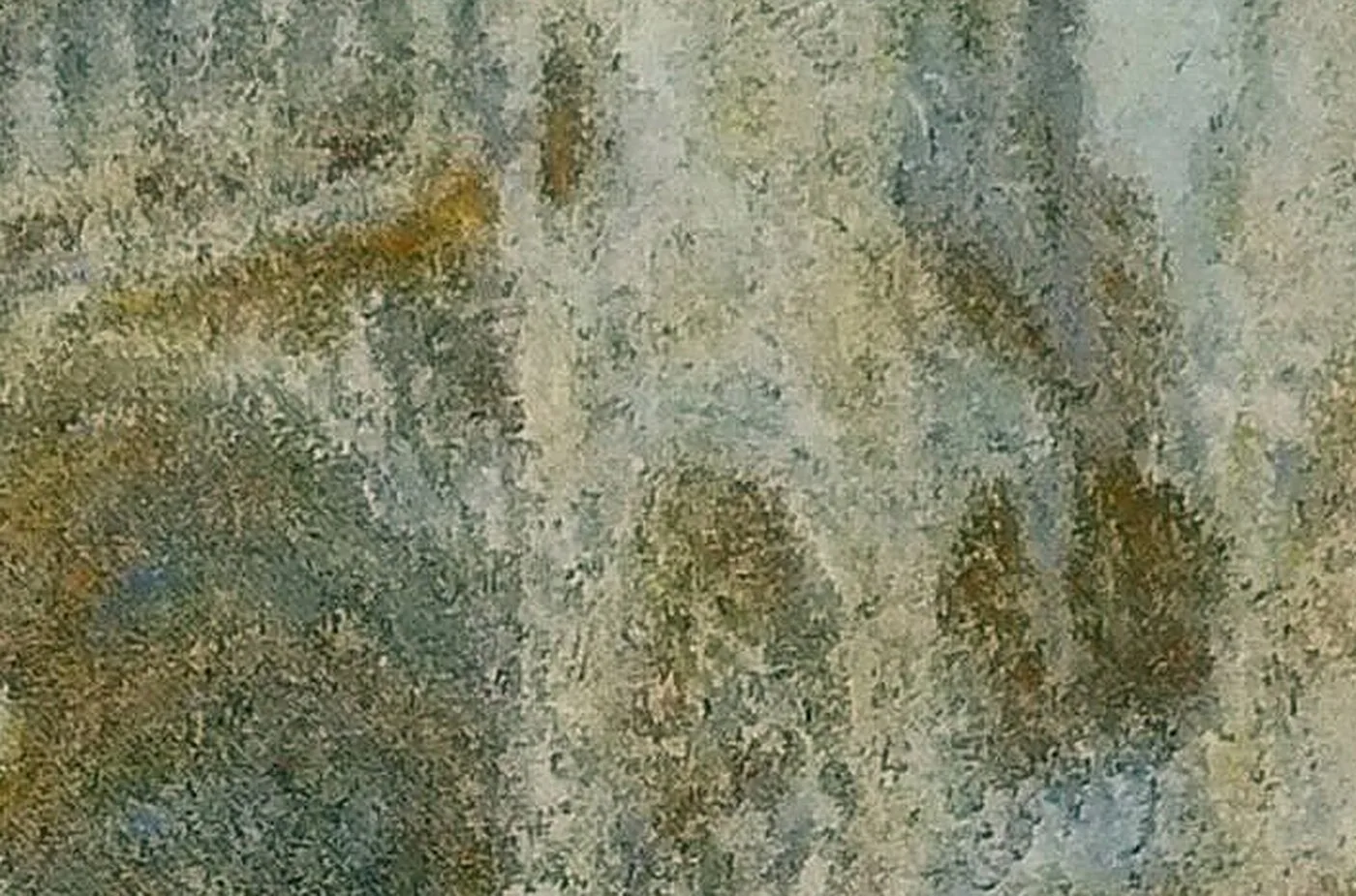
The paint is also physically thick. In these canvases the surface is built up in crusted, granular layers, and it is impossible not to notice that the painting has been given the texture of the thing it depicts. Weathered stone, painted in weathered paint. That is not a coincidence; he built the surface up over repeated sessions and then finished the group in the studio, and the accumulated matter is part of what makes it read as masonry.
Learning to see it: grey is not grey
This is a picture that gives up nothing to a quick glance and a great deal to a slow one.
- Look at one square hand-sized area of the stone. Do not scan the whole facade. Pick a patch and stay on it. Within about twenty seconds it will stop being grey and start separating into pinks, blues and greens. This is the entire experience of the painting and it cannot be rushed.
- Find the darkest point. It will be inside the portal, the recessed doorway. Note that it is not black and that it has colour in it. Then notice how everything else in the picture is measured against it.
- Find the lightest point. It is usually a small area of upper stonework catching whatever the sky is offering. Between that and the portal lies the entire range of the painting, and it is a narrow range; he is working in a tight band of values and getting an enormous amount out of it.
- Look at the edges of the architecture. The carved detail is not drawn. There are no outlines. Every arch, moulding and column is made by placing one colour against another, and where the light is weakest the forms genuinely dissolve. Step back and they reassemble.
- Notice what is cropped. The top of the facade is cut off. So is the base. There is no street, no sky to speak of, no passer-by, no sense of the building as an object standing in a town. He has removed all of it so that you cannot look at the picture as a portrait of a monument. You are stuck with the surface and the light, which is what he wanted.
The strangest thing about the grey version is how much it feels like weather rather than architecture. The building has been turned into an atmospheric event. You can almost feel the damp.
How it behaves in a real room
This is an architectural picture and it behaves architecturally, which makes it useful in ways the landscapes are not.
It is strongly vertical. That is rare and valuable, because most walls in most homes have at least one tall narrow space that horizontal pictures cannot fill: beside a door, between two windows, in a stairwell, on a chimney breast, at the end of a corridor. This canvas was built for exactly that shape, and it makes a low ceiling read higher.
The palette is soft and close-toned; muted lilac, blue-grey, pale ochre, with no saturated colour anywhere. That means it never competes. In a room with strong furniture, patterned textiles or a lot of books it holds its own without adding noise, and in a minimal room it supplies texture rather than colour.
Against a white wall it can look slightly washed out, so it is one of the few subjects that genuinely prefers a tinted background: warm grey, stone, greige, pale clay, or something considerably darker. On a deep charcoal or ink-blue wall it becomes remarkable, because the pale facade lifts off the surface and the picture gains the depth the overcast light denies it.
Light matters more here than with almost any other subject. This is a painting about the reading of subtle colour inside a narrow range, and a weak lamp will flatten it into a grey rectangle. Give it good even light, from the front, and never rake it from the side; raking light will exaggerate the physical texture of the paint and turn a picture about atmosphere into a picture about surface.
And hang it where someone can stand close. Twenty seconds at arm’s length is what this canvas asks for, and it is the only payment it requires.
Sizes and materials for Rouen Cathedral, Portal, Cloudy Weather are listed on its product page.
More from this collection
Bring this painting home
Choose a hand-painted oil reproduction for real brushwork, or an archival canvas print for a crisp museum-image edition. Every size preserves the original proportions.
View this work & options
Further reading
Verify the original in the Musée d'Orsay collection record and continue through related works in the catalogue.