
Water Lilies (1916)
In 1916 an old man had a building put up in his garden. It was large, plain and industrial, glazed along one side, and it was for one purpose only: to hold canvases too big to be handled anywhere else on the property. Nobody had commissioned them. There was no client, no contract and no guarantee that anyone would ever want them.
He was seventy-six. His second wife had died in 1911. His son Jean had died in 1914. Around 1912 he had been told he had cataracts, and he would go on working with them for another eleven years before agreeing to an operation in 1923. Outside, a war was running through its second and third years, and the country had rather more urgent things to think about than a painter’s pond.
And in that shed, on a canvas the size of a doorway, he painted water.
The scale jump
This is the fact to hold on to about the pictures of this year: the size changed, and everything followed from that.
For twenty years he had painted the pond at easel scale. Canvases you can carry to the water’s edge, set up, and work on outdoors in a morning. That size imposes a relationship: you look at the picture, the picture sits in front of you, it is an object on a wall.
A canvas of roughly human height does something else. Stand close to it and it fills your field of view, including the periphery, and the brain stops filing it as a picture and starts treating it as a space. This is the threshold he crossed from around 1914 to 1916 onward, and it is what made the large decorations possible at all; the vast panels installed at the Orangerie in 1927 after his death are the far end of a road that runs through canvases like this one.
What makes a work of this date particularly interesting is that it sits on the join. It is far too big to be an easel painting of a pond and not quite architecture. It is a single motif blown up to life size, which means it is one of the few places where you can see exactly what the enlargement does to the marks.
Painting standing up, from a pond fifty steps away
A canvas this size cannot be taken to the water. That is not a small detail; it broke a habit he had kept for fifty years.
He had built his reputation outdoors, in bad conditions, working on the motif. In the early 1880s he had painted the Normandy coast from clifftops and beaches with his canvases weighted against the wind, and in 1885 at Etretat a wave took his easel. In the 1890s at Rouen he worked from rented rooms opposite the cathedral, with many canvases going at once, moving from one to the next as the light shifted, and he finished those in the studio in 1894 and showed them in 1895. Even that compromise had required the building to be physically in front of him.
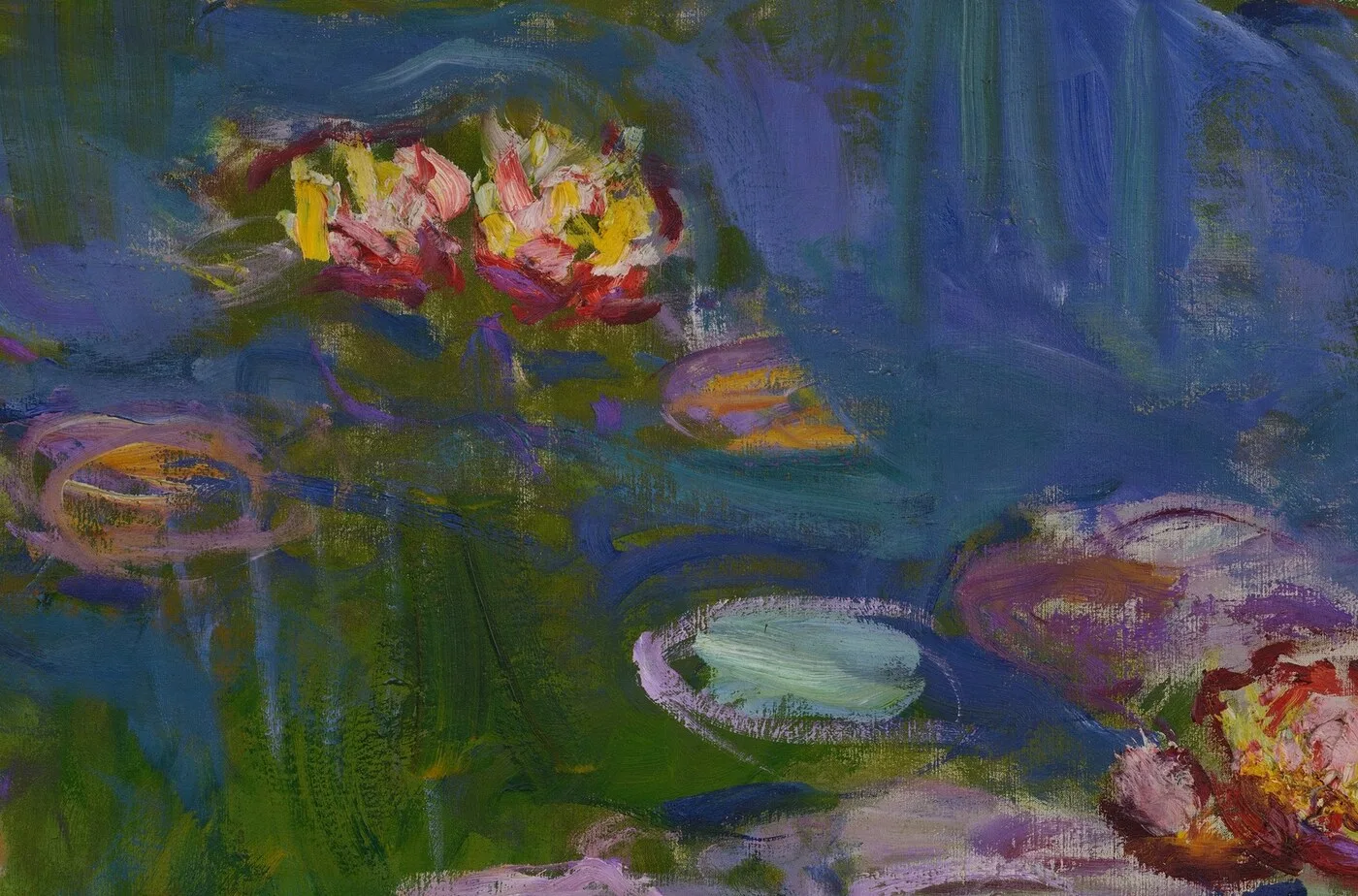
Here, the pond is fifty steps away and out of sight. He is working from studies, from memory, and from a knowledge of that water so thorough after twenty years that he could reconstruct its behaviour without checking. The paint reflects it. The marks are more decided and less fussy than in the small outdoor canvases. There is less of the nervous adjustment of a painter comparing his surface to the thing in front of him, and more of a person laying down what he already knows.
He is also working at arm’s length on an area he cannot judge from that distance. Every passage was painted close and assessed from far, which means walking backwards and forwards across a studio floor, repeatedly, at seventy-six.
Learning to see it: one motif at life size
The pleasure of a canvas at this scale is that everything is enlarged, including the mistakes and the decisions.
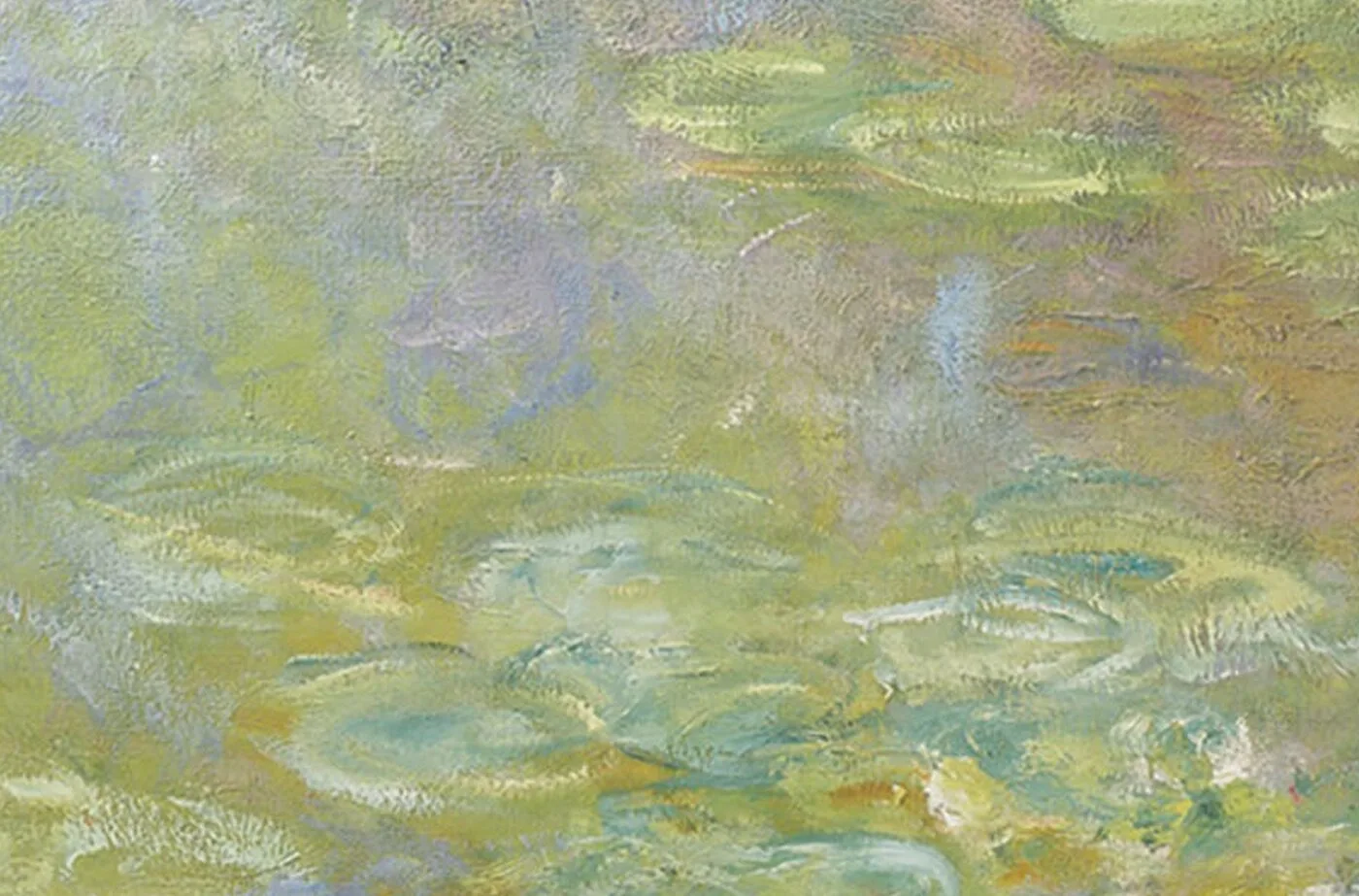
- Start at the bottom edge. The lily pads nearest you are the biggest things in the picture, sometimes the size of a hand. Look at how few strokes each one takes. Two or three loaded marks, often with the brush turned so the pad has a light edge and a dark one. There is no drawing, no outline. The shape is made entirely by the placing of colour.
- Follow them upward. They shrink and crowd together as they go. That gradient is the only perspective in the picture, and it is enough to make several metres of imaginary water.
- Look into the gaps. The open water is built from long vertical or diagonal strokes; those are reflections, stretched by the surface. Where they are dark they are trees, where they are pale they are sky. There is no other sky in the picture.
- Now find the flowers. They are the thickest paint on the canvas, small raised knots of pink, cream or white sitting proud of everything around them. At life size you can see that they were put in last, quickly, and that each one is a single gesture. They are also the only things in the picture with a definite edge.
- Stand close and let go. With a canvas this size you can get near enough that the edges leave your vision. The painting stops being a rectangle and becomes a surface you are standing over. That is the effect the whole late project was built around.
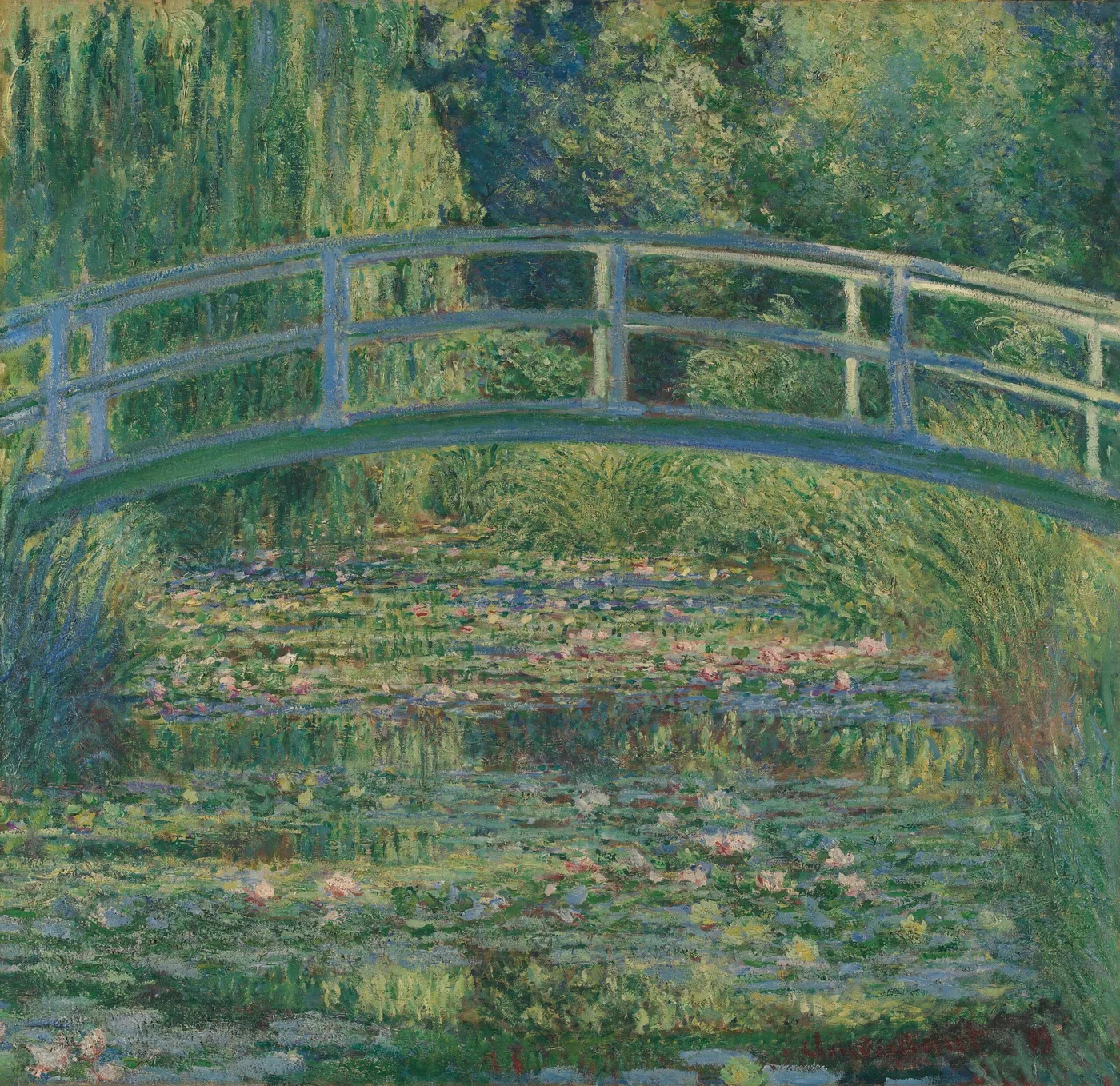
One more thing to notice: there is no shore anywhere. No bank, no bridge, no reed bed, nothing to tell you the pond is finite. He had painted the Japanese footbridge, built in 1895, for years before removing it from these pictures entirely. Taking it out is what turned a garden feature into an open field of water with no measurable size.
How it behaves in a real room
A picture at this scale is a piece of architecture in a room, not an ornament in it, and it should be treated accordingly.
Hang it on a wall that has room to be empty around it. Nothing kills a large single-motif canvas faster than crowding it with smaller frames; it needs the wall as a margin. A stairwell, a double-height space, the long wall of an open-plan living room, the wall facing a bed, an entrance hall where you see it as you come through the door.
Because the composition has no focal point and no horizon, it does something useful to proportions. Rooms with low ceilings gain height from a picture whose motif runs off all four edges; the eye does not find a stopping place and reads the wall as continuing. It is one of the rare subjects that makes a small room feel larger rather than more full.
The palette, blue-green water with lilac reflections and pale flowers, is cool and calm and will not fight furniture. It sits comfortably with wood, linen, stone and greenery. Against a white wall it reads clean and contemporary. Against a deep blue or a soft charcoal it becomes considerably more atmospheric and the flowers start to glow.
Get the height right. The centre of a large water picture wants to be at roughly the eye level of someone standing, not higher, because the whole point of the scale is that you can walk up to it and have it fill your view. Hung too high it turns back into a mere picture of a pond, which is exactly what he spent the last decade of his life trying to escape.
Sizes and materials for Water Lilies are listed on its product page.
More from this collection
Bring this painting home
Choose a hand-painted oil reproduction for real brushwork, or an archival canvas print for a crisp museum-image edition. Every size preserves the original proportions.
View this work & options
Further reading
Verify the original in the National Museum of Western Art collection record and continue through related works in the catalogue.