
Water Lily Pond
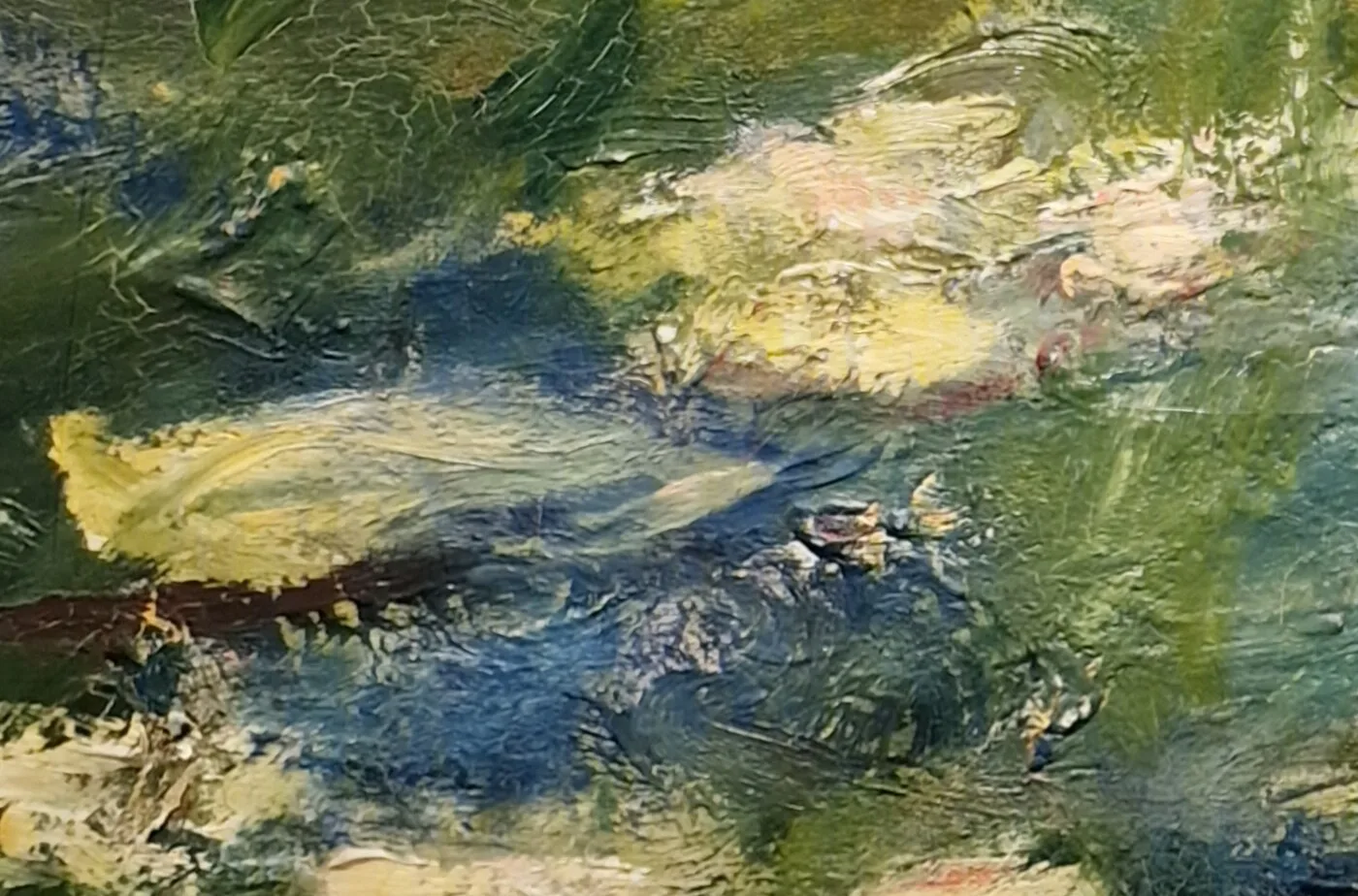
Stand at the edge of a pond in high summer and look straight down into it, and you will find that you cannot decide what you are looking at. There is the surface, with its floating pads and the film of dust and pollen on the water. There is the reflection, which is the sky and the trees, hanging apparently below your feet. And there is the depth, where stems descend into brown-green obscurity. All three occupy the same place at the same time and your eye refuses to rank them.
That confusion is the subject of this painting. There is no horizon in it, no bank, no sky except the sky lying in the water. The frame is filled entirely with a surface that is also a window, and the whole thing tips forward toward you. Monet was seventy-nine when he made it. He had been staring into this water for a quarter of a century by then, and he had given up on the idea that a landscape needs ground.
A pond he had to fight for
The water is not natural. He rented the house at Giverny in 1883 and bought it in 1890, and from 1893 he set about making a pond, diverting the small river Epte to feed it. Local farmers objected. Water is not a decoration in a farming village. It is irrigation, it is stock, it is a thing people have rights over, and a newcomer from the art world proposing to redirect it for the purpose of growing flowers to look at was not an obviously reasonable neighbour.
He got his way. The Japanese footbridge went up in 1895 and the planting thickened year by year. Every leaf in this painting stands in water that a man argued, paid and dug for. It is worth holding on to that, because these late canvases are often described as serene, and serenity is not really what they are. They are the record of an obsession that reshaped a piece of countryside so that one person could keep looking at the same twenty square metres for the rest of his life.
The eyes
Cataracts were diagnosed around 1912. He did not have surgery until 1923. That is roughly eleven years of painting through lenses that were slowly clouding and yellowing, and this canvas sits close to the end of that stretch.
Think about what that means for a painter whose entire practice was the accurate report of colour. Cataracts do not just blur. They shift the balance of what reaches the eye, warming and dimming, taking the cool end of the range down first. The most colour-dependent painter alive was losing reliable access to colour, and he kept going, at scale, daily, for a decade.
You can see the consequences in the handling here. The strokes are broad and confident, the drawing is entirely absorbed into the paint, and the colour is pitched high and warm. Whether that is failing sight or hard-won freedom is a question people have argued about for a century, and honestly it is probably both. Sixty years of looking gives a man plenty to paint from even when the instrument is failing.
A pond is a machine that has to be tended
Water gardens are not left alone. Lilies spread and have to be thinned or they close the surface completely and there is no water left to reflect anything. Fallen leaves sink and rot and darken the water. Algae blooms in warm weather. The pads themselves collect dust, and a pond that is not cleaned reads as a scum rather than a mirror.
So behind every one of these paintings is a maintenance routine. The pond in this canvas was managed continuously, its surface kept open in some places and thick in others, because the composition Monet wanted depended on the ratio between covered and clear water. He was not painting a natural scene. He was painting an arrangement he had planted, dug, diverted a river to fill, and then curated for twenty-five years.
That is an unusual relationship between a painter and a motif. Most artists find a subject. This one manufactured his, then spent decades adjusting it so that it would keep giving him pictures. By 1919 the pond and the paintings had become a single closed system: the garden supplied the motif, the motif supplied the work, the work paid for the garden.
It also explains the strange confidence of the late canvases. A man who has looked at the same water every day for a quarter of a century does not need to check anything. He knows where the pads sit, how the reflections fall at each hour, what the willows do to the far end of the pond in August. At that point the eyes matter less than they used to, which was fortunate.
Painting a surface that is also a window
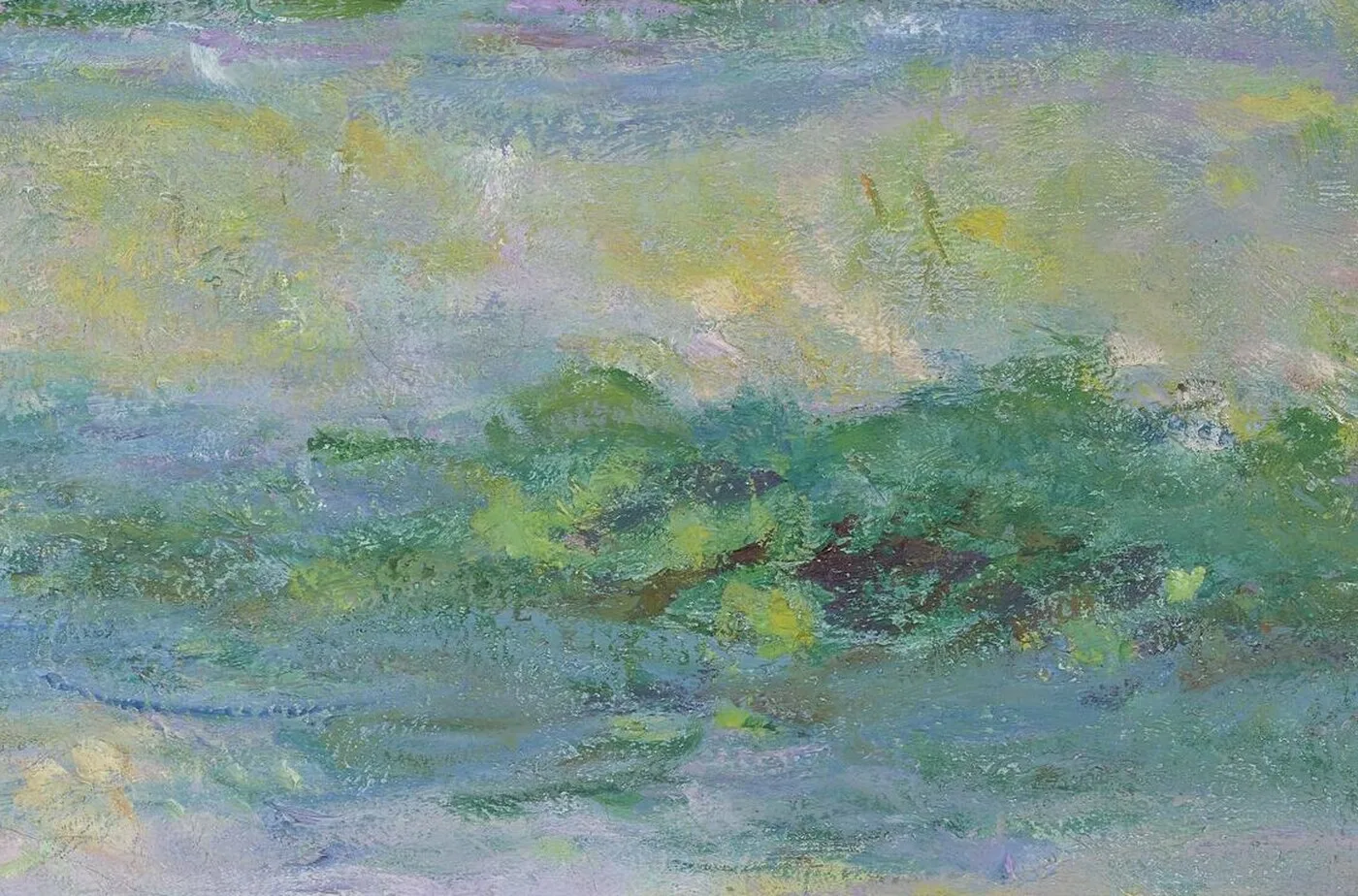
Notice how the picture is organised. The lily pads read as horizontal ellipses, lying flat, receding as they get smaller and closer together toward the top of the canvas. That is the only perspective clue in the whole painting, and it is enough. Between and beneath them, the reflected trees and sky run vertically, dropping down into the water.
So you have two directional systems crossing each other: flat things travelling away from you, and reflected things falling downward. That crossing is why the space feels unstable and why the eye keeps moving. It is also why these paintings, which contain no event, are not boring to look at. The picture will not let you settle on a single reading of where anything is.
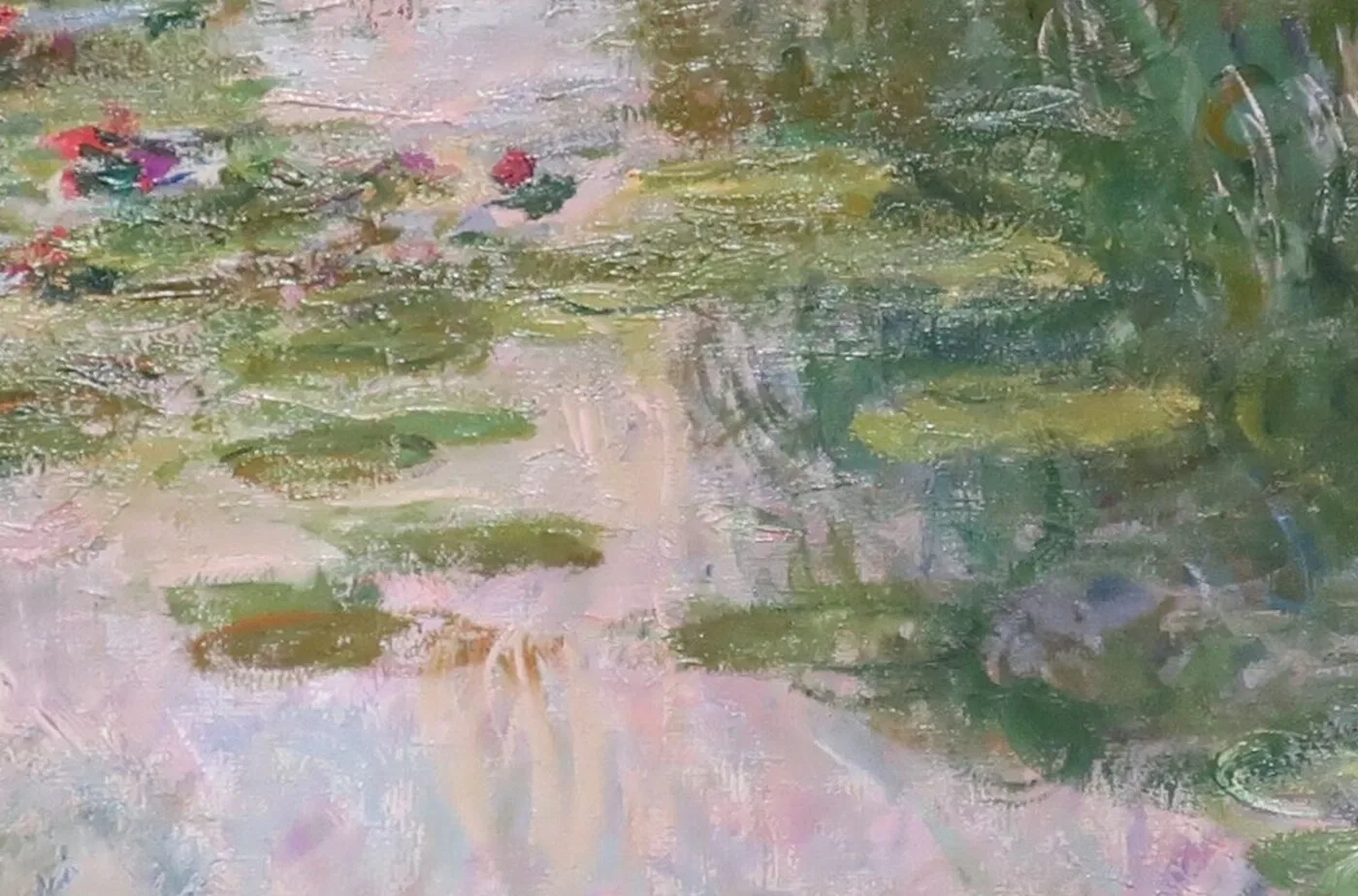
The paint is applied in long loaded strokes, often wet into wet, with the brush turning as it travels. In places the colour is scrubbed thin and the weave of the canvas comes through; in others it stands up in a rope of pigment. Get close and there is no water, no flower, nothing but marks. Step back four paces and it closes into a pond so convincingly that people lean toward it.
What to look at
- Find the darkest passages first. They are not shadows on the water. They are the reflections of trees, and they read as depth, which is the great trick of the whole late series.
- Follow one line of lily pads from the bottom edge upward and watch them compress. That compression is doing all the work that a horizon would normally do.
- Look for the flowers. They are usually the only place in the canvas with a genuinely light, opaque touch, laid on last, sitting proud of everything else.
- Try to find the edge of the pond. You will not. He cropped it out on purpose, so that the water has no boundary and the painting behaves like a fragment cut from something endless.
How it behaves on a real wall
An all-over composition with no horizon is a genuinely different object to live with. There is no correct top and no anchoring line, so the picture does not impose a direction on the room the way a landscape does. It sits like a panel of colour that reveals itself as a place when you approach it.
That makes it excellent at distance and better still up close, which is a rare combination. Put it where people walk past at a few paces and then occasionally sit near, and it will work at both ranges. It also means it can go on a wall that is off to one side of a room without seeming badly placed.
Green, blue-violet and rose dominate, with warm ochre notes in the water. It is comfortable against white, pale grey and soft green walls, and it becomes surprisingly rich against a deep charcoal or dark green, where the flower touches jump forward. Avoid hanging it beside anything with strong pattern, since the canvas is itself all texture and the two will vibrate against each other.
Light it evenly and generously. This is a painting with no dark corner to hide problems in, and it wants enough light to keep the greens from going muddy in the evening. Hang it low. Ponds are looked down into, and the picture is more convincing when your eye enters it from above.
Sizes and materials for Water Lily Pond are listed on its product page.
More from this collection
Bring this painting home
Choose a hand-painted oil reproduction for real brushwork, or an archival canvas print for a crisp museum-image edition. Every size preserves the original proportions.
View this work & options
Further reading
Verify the original in the Tel Aviv Museum of Art collection record and continue through related works in the catalogue.