Description
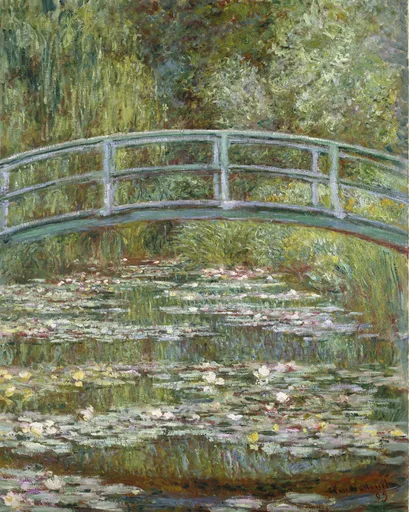
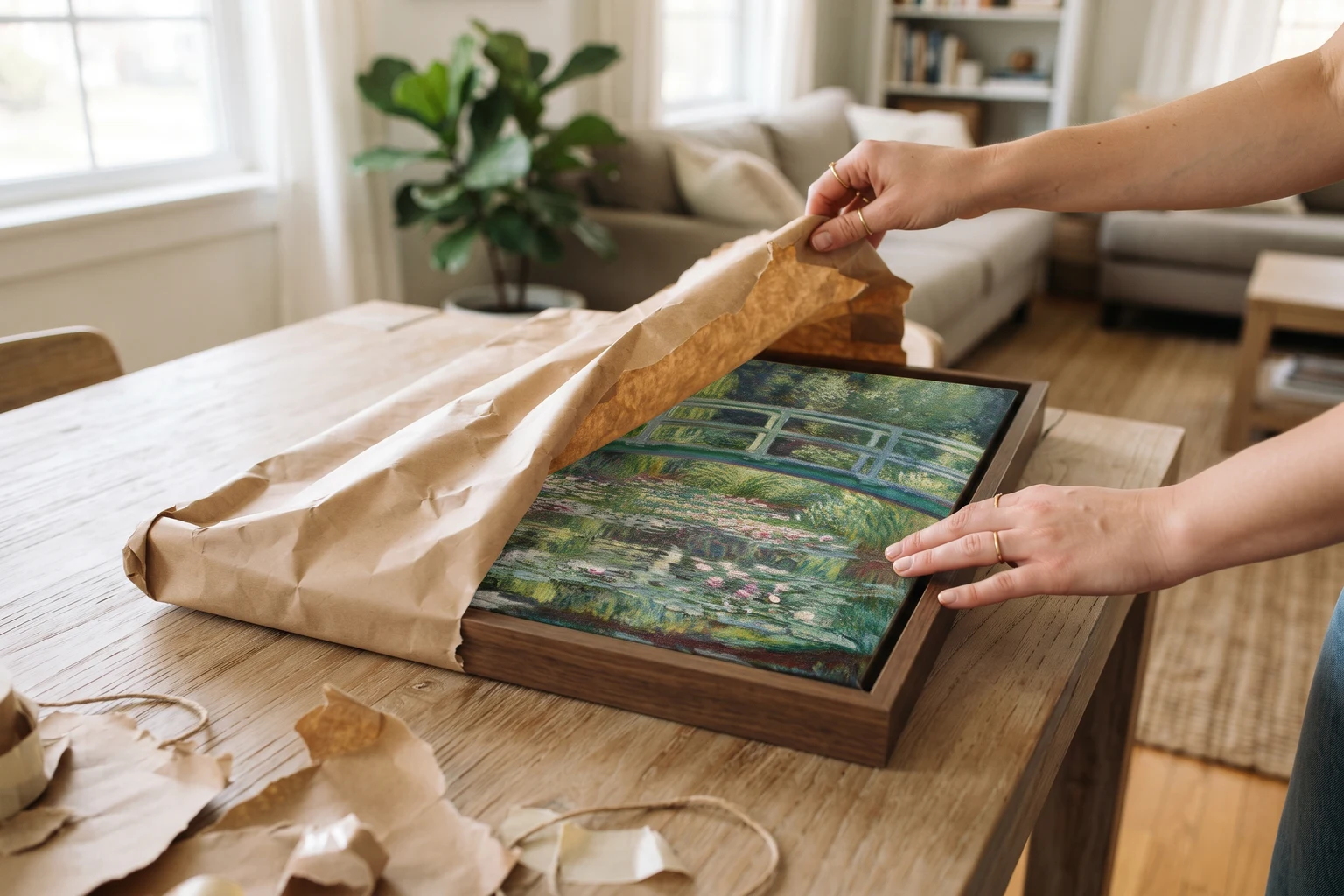
The canvas holds nothing but a pond seen from directly above, so close that no bank, no sky, and no horizon survive the crop. Rounded lily pads drift in loose diagonal bands from the lower right toward the upper left, painted in short, loaded strokes of sage, olive and turquoise green that catch the light unevenly, as if a breeze had just crossed the surface. Between the pads, ruffled blooms open in white, soft yellow, pink and a few deep wine-red accents, each flower built from four or five thick dabs rather than any drawn outline.
Underneath the pads, the water itself is not painted as a flat surface but as a second, deeper picture: long vertical smears of blue, violet and dark green run top to bottom, the ghost of overhanging willows and sky reflected and broken by the ripples. Monet, painting this pond in his own garden in the last years of his working life, had by then all but abandoned the horizon altogether, treating the pond as a field of colour that fills the entire canvas edge to edge. The brushwork is heavier and more urgent than in his earlier water paintings, laid on with a loaded brush that leaves ridges of paint visible at close range, a sign of a hand working faster and larger than before.
What sets this canvas apart even within his own lily series is the density of incident packed into a square format: three separate clusters of pads and blooms, each catching light differently, so the eye keeps moving rather than settling. There is no single focal point, no path into the picture, only a surface that behaves the way a real pond does when looked at too long, dissolving into pattern before resolving again into flowers.
On a wall, that lack of a fixed viewpoint is exactly the appeal: the picture reads as abstract pattern from across a room and resolves into recognisable water and flowers only on approach, holding attention at both distances. The high-keyed greens and the occasional flash of red make it sit comfortably in a room with warm or cool light alike, and its square shape gives it an unusual stability compared to the elongated canvases more common in the series.