
Wind Effect, Row of Poplars
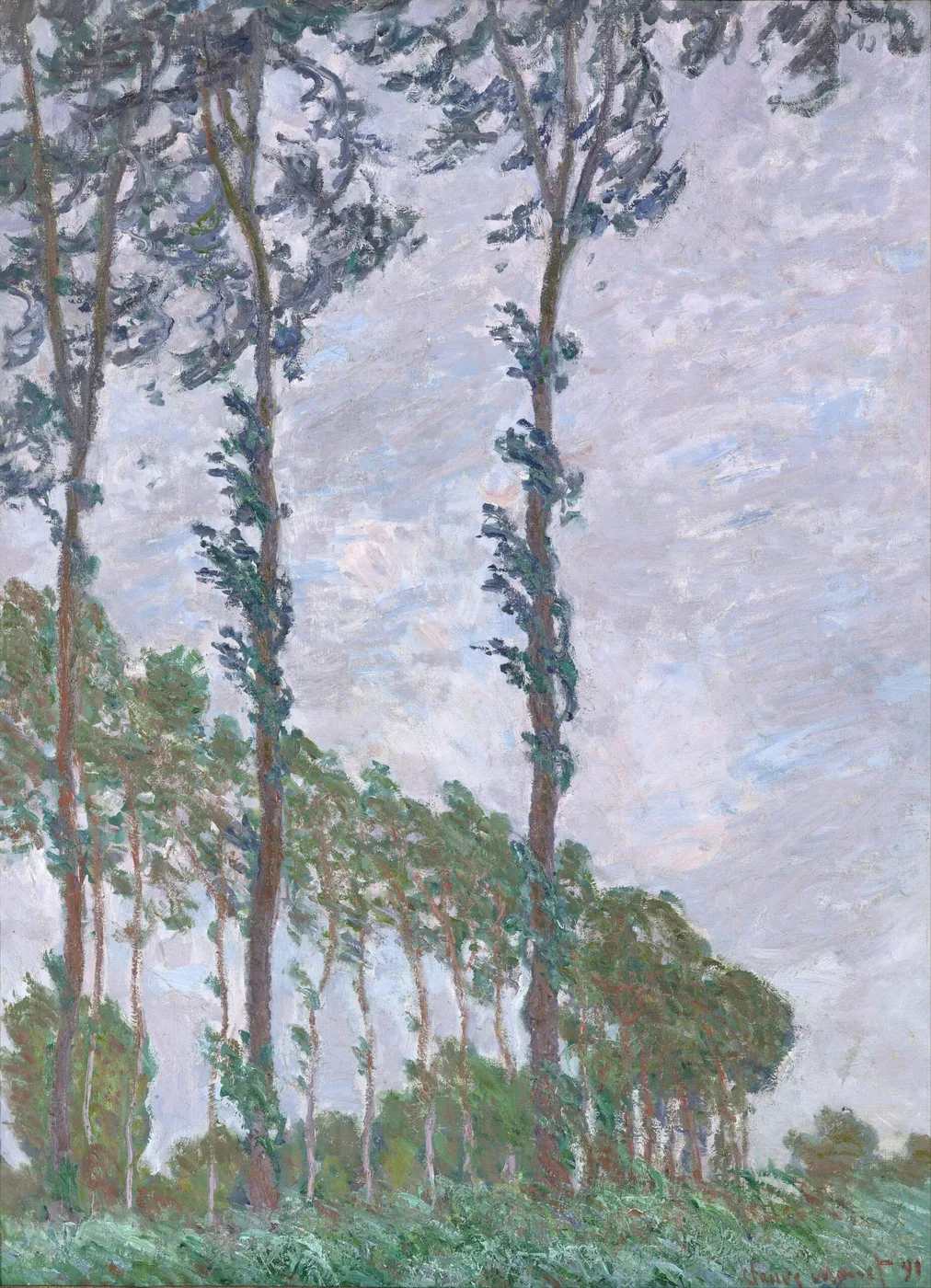
There is a kind of morning on the Epte when the air cannot make up its mind. The river lies flat and slow against the bank, the sky sits high and unsettled, and then a gust comes off the meadow and the whole row of poplars leans over as one body. For a painter standing in front of that with a wet canvas, this is a real problem, not a poetic one. The thing he came out to record has just changed shape. It will change again inside a minute, and it will never change back in quite the same way.
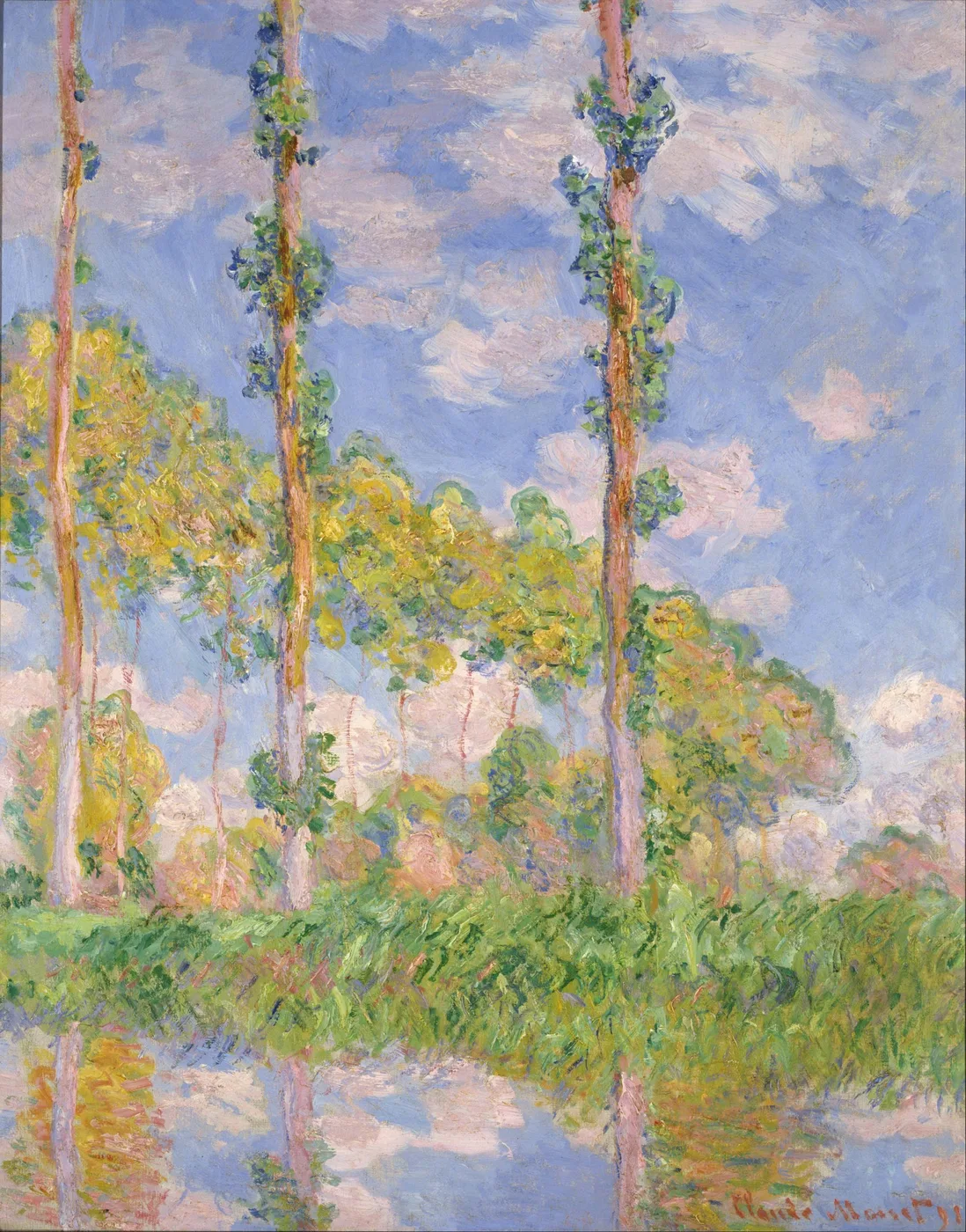
This picture is that problem met head on. The trunks still climb in their orderly rank, still spaced with the strange regularity that only planted trees have. But the crowns have been shoved sideways. The tops bend and stream downwind. The foliage has stopped being a shape and turned into a direction.
The year he had to buy the trees
By 1891 Monet had been at Giverny for eight years, first as a tenant from 1883 and then, from 1890, as the owner of the house and the ground around it. He was past fifty. He had spent most of his working life short of money and most of his reputation arguing with people who thought his pictures were unfinished. That had finally begun to turn. The grainstacks he had painted in the field near the house had sold quickly and well through his dealer Durand-Ruel, and for the first time in his life the demand was running ahead of his hand.
So he went looking for the next motif and found it within walking distance: a line of poplars standing along the Epte, planted in the disciplined way that working timber is planted, rooted in wet ground and doubled in the water beneath them. He began. And then he learned that the trees were about to be sold and felled.
What he did next says more about him than any story about light ever could. He went to the auction and bought them, so that they would still be upright when he was done. It is one thing to be attached to a subject. It is another to purchase a stand of commercial timber in order to hold it in place for a few more months of work. The series exists because he refused to be finished on somebody else’s schedule.
Painting a subject that will not hold still
His working method by this point was already unusual. He did not paint one canvas from start to finish. He carried several, set them up together, and moved between them as the light turned, returning to each one only when the conditions that started it came back around. A morning canvas was worked in the morning. A grey canvas waited for grey. It made him a kind of hostage to the weather, and he complained about it constantly, because the weather does not care that you have eleven half finished pictures and only four hours of usable light.
Wind adds a second axis of trouble. Light changes value and colour, and you can chase that. Wind changes drawing. The mass you carefully placed an hour ago is now displaced, then displaced further, then briefly back where it was. To paint it at all you have to give up the idea of copying a single instant and instead paint the behaviour of the thing: not where the branches are, but what they are doing.
That is why this canvas feels alive rather than accurate. The marks are laid on in short, leaning strokes that all run roughly the same way, so that the surface itself has a current in it. The paint is not describing movement. It is moving.
There is a detail here that only someone who has watched poplars in a strong wind would know to include. The leaves of a poplar are darker on top than underneath, and they are attached in a way that lets them twist. When a gust comes through, the whole crown flickers pale as thousands of undersides turn over at once, and then it darkens again as they settle. The colour of the tree is not a fixed property. It is a function of the wind. In this canvas you can find both states, patches where the foliage has gone silvery and adjacent patches where it has stayed deep green, and the alternation across the row is what makes the movement feel like it is travelling from one end to the other rather than happening everywhere at once.
It is also worth remembering how physically unpleasant this is to do. A stretched canvas on an easel in open ground is a sail. It catches every gust, the easel wants to walk, and the brush arrives at a surface that will not stay still under it. The looseness of the marks is not only a stylistic choice. Some of it is the honest record of a man working fast because the equipment was fighting him.
What to look at once you stop counting trees
Start with the trunks, and notice that they are doing something very deliberate. They are almost the only straight verticals in the picture, and they are spaced like a beat. Your eye reads them as rhythm before it reads them as trees. Cover the crowns with your hand and what is left is close to a piece of abstract measurement, a set of upright intervals across a flat field of colour.
Now let the crowns back in. Everything above the eye line is diagonal, feathered, restless. The picture is built on the collision of those two systems, the ruled and the ragged, and the wind is the thing that separates them.
Look at the gaps next, the sky showing between the trunks. Those slivers are not empty. They are painted with as much attention as the leaves, and their colour shifts along the row, cooler and paler where the trees thin out. In a picture like this the negative shapes carry half the light.
Finally, look down into the water. The reflection is not a mirror. It is broken and stretched by the same wind that is bending the tops, so the doubled trees dissolve into horizontal drag marks. Top half vertical, bottom half horizontal, and the bank stitched between them. That is the whole architecture of the canvas in one sentence.
How it behaves on a real wall
This is a tall subject and it wants a tall space. Anything built on a row of verticals will make a wall feel higher than it is, which makes it unusually good in the places most pictures struggle: a narrow hallway, the run of wall beside a staircase, a chimney breast, the awkward strip between two doorways.
The colour is green and grey and river light, which means it sits quietly against warm neutrals and raw wood, and comes alive against a slightly deeper wall than you would expect. On a pale wall it reads as a window. On a mid tone wall it reads as a piece of woven texture, and the trunk rhythm comes forward.
It also rewards distance. Stand close and the surface is a mess of leaning strokes with no leaves in it at all. Take four steps back and the row snaps into order and starts blowing. If you have a room with a natural long view across it, this is a picture that uses that view.
Why the wind one stays the restless one
Monet painted this row of trees in still air, in pink dusk, in flat afternoon light, and in weather that flattered them. This is the version where nature is uncooperative, and it is better for it. The subject is not the poplars. The subject is a few seconds of moving air made permanent by a man who had bought the trees specifically so he could keep waiting for the right ones.
The canvas is held today by the Musee d’Orsay. Standing in front of it, the thing that surprises people is how little of it is drawing and how much is pressure. Nothing is outlined. Nothing is carefully edged. The entire picture is applied force, and it still, more than a century later, looks like it is about to move again.
Sizes and materials for Wind Effect, Row of Poplars are listed on its product page.
More from this collection
Bring this painting home
Choose a hand-painted oil reproduction for real brushwork, or an archival canvas print for a crisp museum-image edition. Every size preserves the original proportions.
View this work & options
Further reading
Verify the original in the Musée d'Orsay collection record and continue through related works in the catalogue.