
Woman with a Parasol, Facing Left: The Face He Chose Not to Paint
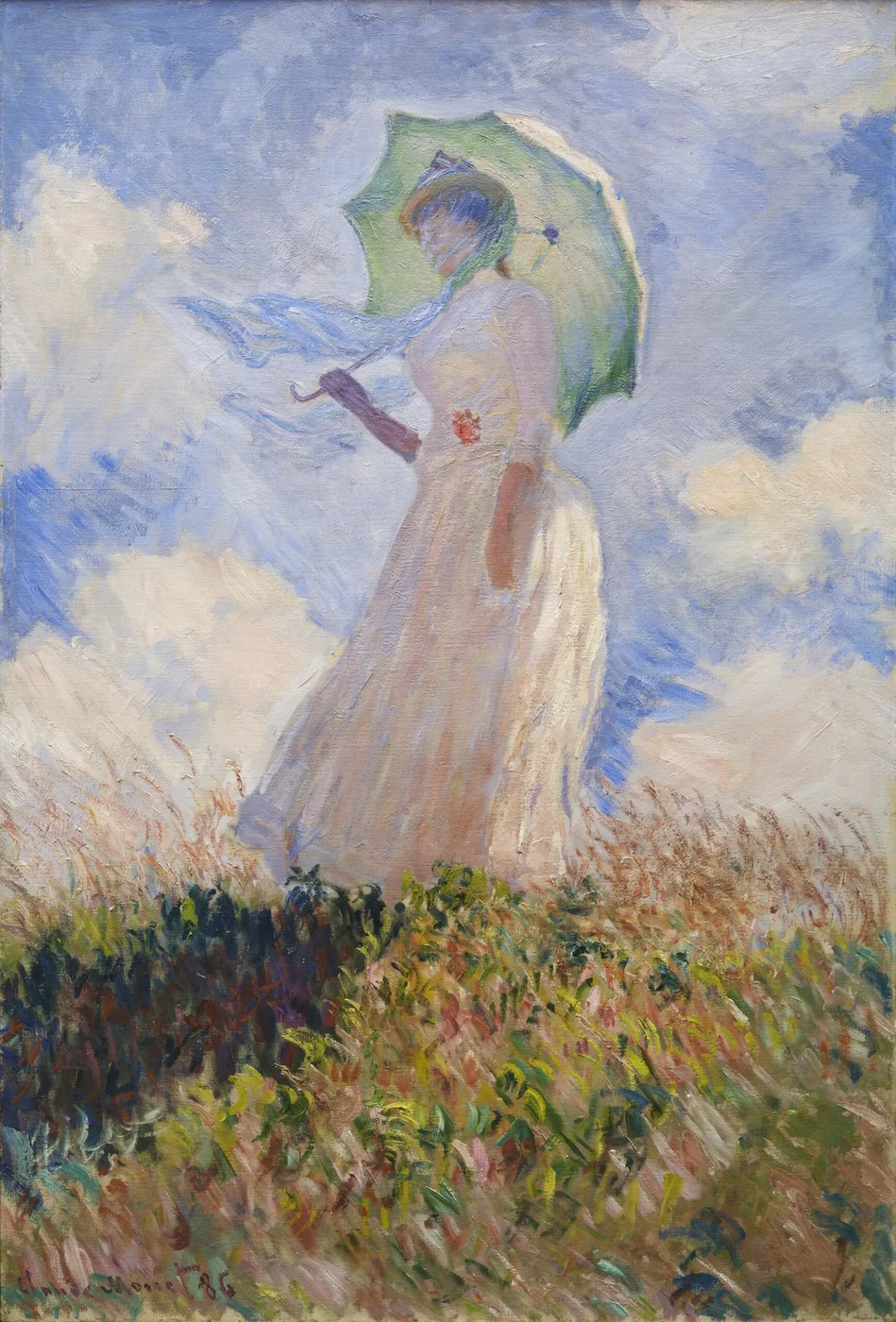
Stand at the bottom of a small rise on a windy day and look up at somebody standing on top of it. You will not see the ground behind them. You will see them against nothing but sky, elevated by the angle, larger than they are, with the wind pulling their clothes into shapes they did not choose. The grass at the top of the slope will be moving. Their outline will not quite hold still.
That is the position this painting puts you in, and it was chosen deliberately in 1886 by a man who had made the same picture once before, eleven years earlier, with a different woman in it.
The pose he had already used
In the mid 1870s, at Argenteuil, he had painted a woman on a rise with a parasol, seen from below, wind in her dress, a child a little way behind her. The woman was Camille, who had been at the centre of his life since he was young and broke, who had been pregnant in Paris while he painted the coast in 1867, and who was already years dead by the time he set up in front of this second version.
In 1886 he returned to that composition. Same low viewpoint, same figure on a bank against open sky, same parasol, same wind. The model was a young woman of his household at Giverny, and the picture is not a portrait of her.
You can see that in one glance, because the face is not painted. There are features suggested under the shadow of the parasol, but nothing you could identify, nothing you could recognise in a street. He did not run out of time. Everything else in the canvas is worked with enormous attention. The face is left open on purpose.
What happens when a face is missing
A painted face is a magnet. Put one in a picture and everything else becomes background, because human beings look at faces first, always, and once we have found one we start asking about the person rather than about the picture.
Take the face away and something strange happens. The figure stops being a specific individual and becomes a presence, a shape with weight and posture and a direction of attention. You cannot ask who she is, so you start noticing how she stands, how the wind is hitting her, how far above you she is, how the light comes through the parasol and stains her upper body with reflected colour.
It also changes the emotional temperature in a way that is hard to name and easy to feel. This is a picture of a woman turned partly away, high up, facing left, with her identity withheld. Whatever else it is doing, it is not offering her to you. It has more in common with the memory of a person seen briefly at a distance than with a portrait, and it is worth knowing that the composition it revives belonged to someone who could not be painted again.
There is a technical reason too, and the two do not cancel each other out. A face painted at this scale, under a parasol, against the sky, would have to be finished to a level of detail that nothing else in the canvas comes close to, and the moment you finish one passage to a higher standard than its neighbours, the picture splits in two. The figure would become a portrait pasted into a landscape sketch. Leaving the head at the same pitch of finish as the grass and the dress keeps the whole surface speaking one language, which is exactly what a painter working outdoors in a wind has to insist on if the thing is going to hold together at all.
The making of it
Outdoor figure painting is far harder than outdoor landscape, and this is one of the reasons the picture is unusual. Landscape at least stays where you put it. A person standing on an exposed bank in the wind is uncomfortable within ten minutes and exhausted within an hour, and every time she shifts her weight the whole silhouette changes.
The lighting problem is worse. The figure is against the sky, which means she is broadly backlit, which means the side facing you is in shade while the edges burn. On top of that a parasol is a translucent coloured filter held directly over her, so it throws colour down onto her head and shoulders. Get any of that wrong and she reads as a cut out pasted onto a landscape.
Look at how the two zones are handled. The dress is not grey, it is full of blue, lilac and pale green picked up from the sky and grass around it. The lit edges are laid in with a few decisive strokes. Where the light passes through the parasol it drops a coloured cast onto her, and that single relationship is what welds the figure to the air around her.
What to look at
- The horizon, or rather its absence. It sits so low, or so far outside the frame, that there is almost no landscape at all. This is a figure in sky.
- The grass at the base. The strokes run upward and slightly diagonally, following the wind, and they get longer and looser near the bottom edge. That directional brushwork is what makes the air in the picture move.
- The scarf or veil. Follow whatever piece of fabric is caught by the wind. It is the picture’s speedometer, and it tells you the day was not calm.
- The parasol’s underside. It is the one place where a strong local colour is allowed, and it acts as a lid over the whole figure.
- The bottom of the dress against the grass. The edge dissolves there, and the figure appears to grow out of the bank rather than stand on it.
Then take three steps back and look at the whole silhouette at once. From a distance it becomes a single elegant shape, a diagonal from the parasol down through the body to the grass, leaning very slightly into the weather.
Where a figure belongs on a wall
A landscape gives a room a view. A figure gives a room a person, and that is a different kind of decision. Once this hangs somewhere, the space is occupied. Rooms that feel slightly empty, a hallway, a stairwell, a bedroom wall, benefit enormously from that, because the eye now has somebody in the house.
The format is upright, so it belongs where vertical space is available and horizontal space is not. Between two doors, on a chimney breast, beside a tall window, at the turn of a staircase where you look up at it. The last of those is the best of all, because it recreates the low viewpoint the painting was built on. Hang it slightly high, so you look up at the figure the way the picture intends, rather than meeting her at eye level like a portrait.
Its palette is soft, cool and light, mostly sky blues, pale greens and off whites, so it works against colour without clashing and against white without disappearing. Keep the lighting even. A hard directional lamp will flatten the modelling of the dress and make the face read as a smudge rather than as a decision. Given ordinary daylight and a little distance, that unpainted face does what it has always done, which is to make you look at everything else for a while, and then come back to it.
Sizes and materials for Woman with a Parasol, facing left are listed on its product page.
More from this collection
Bring this painting home
Choose a hand-painted oil reproduction for real brushwork, or an archival canvas print for a crisp museum-image edition. Every size preserves the original proportions.
View this work & options
Further reading
Verify the original in the Department of Paintings of the Louvre collection record and continue through related works in the catalogue.