
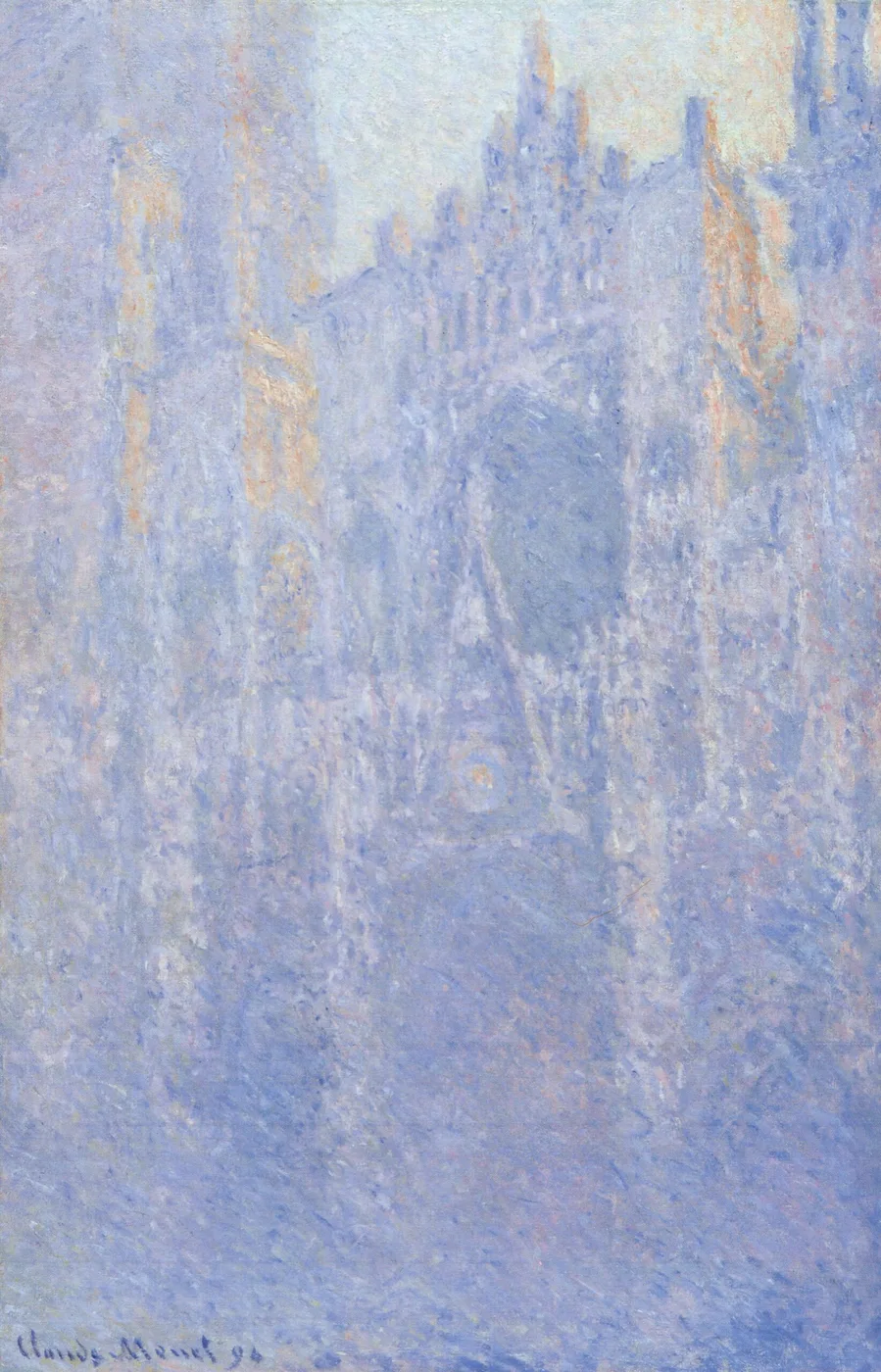
Rouen Cathedral, Portal and Tower d’Albane, Midday
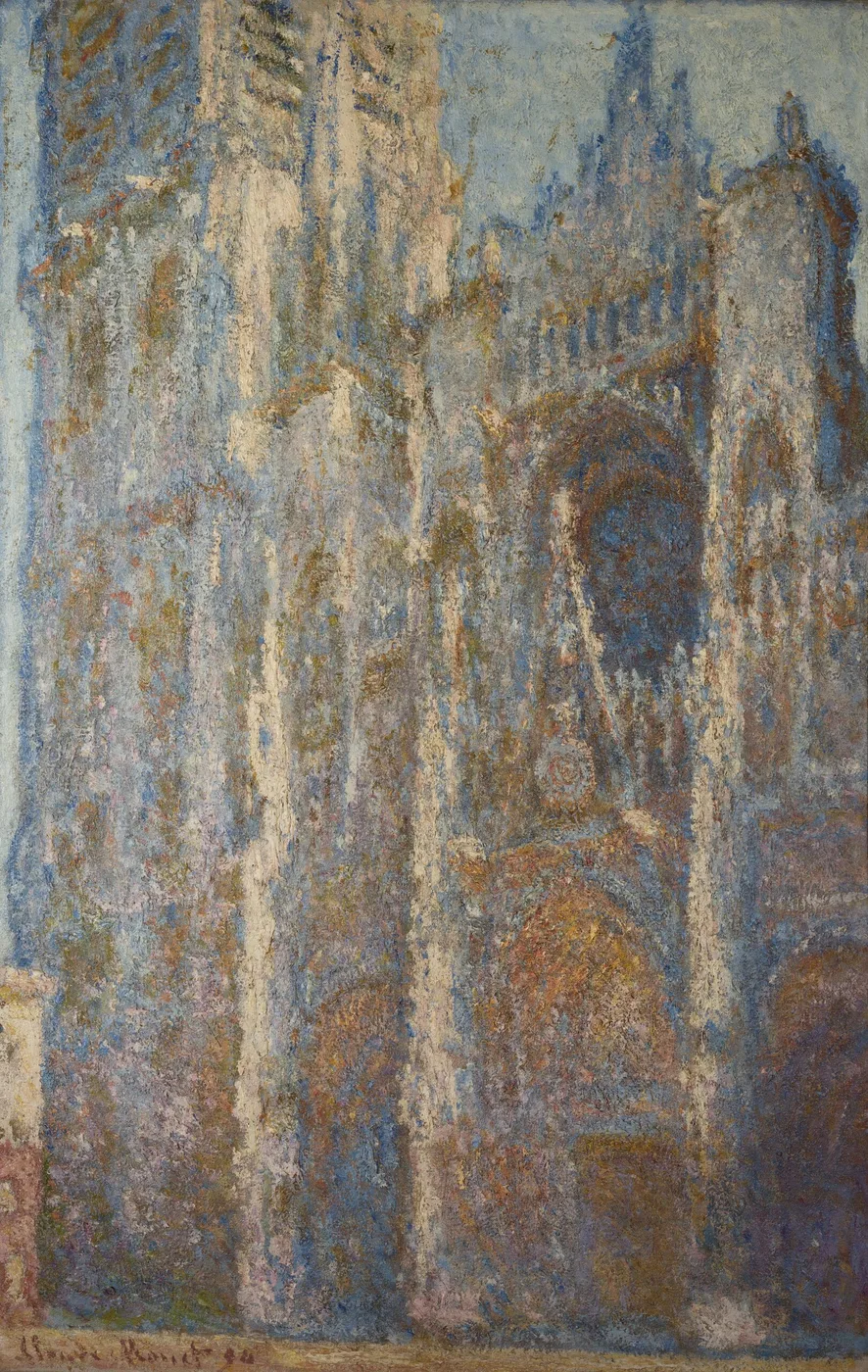
Noon is the enemy of anyone who draws with light. Early and late, the sun stands low and rakes across a building, digging out every moulding and buttress with a long shadow, doing half the artist’s work unpaid. At midday it climbs overhead and stops helping. Shadows shorten to nothing. Relief flattens. A carved Gothic front that looked like a cliff at eight in the morning becomes, by twelve, a bleached screen of pale gold with almost no modelling left in it at all.
That is the hour Monet chose for this canvas, during his second Rouen campaign in 1893. It is the least generous hour in the day and he went at it deliberately, because if the whole point of the series was to prove that light and not architecture was the subject, then he had to paint the moment when the light gives you nothing to hold on to.
Twelve o’clock, and the window is short
He worked from rented rooms across from the west front, with many canvases going at the same time. This is the practical detail that explains everything about the series. He could not paint a day. He could only paint a condition, and each canvas was assigned to one. When the light changed he set that painting down and picked up the one that belonged to the new light, and when the same conditions came round again, sometimes days later, he returned to it.
The midday canvas had a particularly cruel window. High sun does not linger in a fixed state. It swings through its shortest shadows quickly, and the difference between half past eleven and half past twelve is visible on a stone wall. So the working time available for this specific picture, on any given day, was tight, and it depended on cloud, and cloud in a river city is not reliable.
Monet called this work tormenting. He said it gave him nightmares. Read the schedule and you can see why. He had built a machine that required the weather to repeat itself on demand, over weeks, while he ran between canvases like a man tending too many fires.
The room, the window, the street below
The physical setting deserves a moment, because it shaped the pictures. He was not standing in a square with an easel. He was indoors, in rented rooms above a working street, looking out at a building that fills the window like a wall. That is why the facade in these canvases is seen head on, close, cropped, with no square, no passers-by and no picturesque approach. He could not step back. The composition was decided for him by the geometry of somebody else’s window.
It also means the cathedral was never out of his sight. A painter working outdoors packs up and walks away from the motif. This one lived with it, ate in front of it, woke up to it. When he said the work gave him nightmares, the building was thirty metres away on the other side of the glass.
The canvases themselves crowded the room. Working a series this way requires physical space for the whole set, since the point is to be able to reach for the right one within seconds of the light changing. Picture a modest rented room half filled with wet paintings of one facade, arranged so their owner can identify each by its hour at a glance, and you have the working conditions of the most obsessive stretch of his life.
Midday brought the extra difficulty of noise and heat. A city street is at its loudest and busiest in the middle of the day, and a room facing a great stone front takes a lot of reflected glare when the sun is high.
What high light does to stone
Notice first how little dark there is. In an end-of-day picture of the same facade the portals read as deep blue caves and the whole front leans toward violet. Here the shadow has been squeezed almost out of existence. What remains sits in the deepest recesses, in the mouth of the portal and under the projecting courses, and even those are not dark so much as a cooler, denser version of the same warm key.
The tower at the left is the clearest demonstration. Its faces catch the overhead light almost evenly, so the form is stated by very small differences in temperature rather than by contrast. Warm cream turns fractionally green, then fractionally rose, and that half-step of colour is doing the job that a big shadow would do in a lesser painting. This is the hardest kind of painting there is. Almost no value range, all the work carried by hue.
The making
The paint is loaded and dry-brushed, dragged over earlier layers so that the ridges of one pass catch on the crust of another. Stand close and the canvas has genuine physical relief. This is not decoration. He was building an encrusted, pitted, weathered surface to stand in for an encrusted, pitted, weathered surface, and it means the painting responds to the actual light falling on it in your room in a way a smooth picture cannot.
The colour is laid in small distinct touches, blond and cream and pale gold, with cooler blue-greens threaded into the hollows. Nothing is mixed to a flat tone. Even the brightest passages are a weave of several closely related colours, which is why the surface shimmers slightly instead of sitting still.
He did not finish it in Rouen. The Rouen canvases went home with him and were resolved in the studio in 1894, then shown in 1895. What the studio gave them was coherence: each canvas tuned against its neighbours until the set worked as a demonstration rather than a scatter of attempts.
How to look at it
- Do not start at the portal. Start on the flattest, palest stretch of wall and stay there for ten seconds until your eye separates the colours inside what first looked like one cream tone.
- Now find the coolest note in the picture. It will be small and probably tucked in a recess. That single cool touch is what makes everything around it read as sunlit.
- Look at the top edge of the tower against the sky. The contrast there is surprisingly low, because at noon the sky near the sun is bright and the stone is bright, and the two nearly meet. Monet refused to fake a crisp silhouette to make the drawing easier.
- Move sideways, not just backwards. Because the paint is physically raised, viewing it from an angle changes what you see.
How it behaves on a real wall
This is the sunniest and most legible of the cathedral canvases, and it is the one that behaves best in a bright room. Where a dusk version needs lamplight to come alive, this one holds up in strong daylight, because it was made under strong daylight and its whole structure assumes a lot of ambient brightness.
The dominant colour family is cream, blond, pale gold and warm stone, so it disappears unhappily against a beige wall and comes to life against something that gives it a cool counterweight: a chalky blue-grey, a deep green, a mid-tone plaster, or plain white with cool north light. Against a warm cream wall you lose the light in the painting entirely, which is worth knowing before you commit a hook.
The format is tall and the mass fills nearly the whole frame, so it wants a wall taller than it is wide, and it wants to be hung a little high. Looking slightly up at a cathedral front is the natural posture, and the picture assumes it. Give it side light rather than a frontal spot so the built texture reads. Then leave it alone. A canvas painted at noon has a way of quietly setting the temperature of the entire room it hangs in.
Sizes and materials for Rouen Cathedral, Portal and Tower d’Albane, Midday are listed on its product page.
More from this collection
Bring this painting home
Choose a hand-painted oil reproduction for real brushwork, or an archival canvas print for a crisp museum-image edition. Every size preserves the original proportions.
View this work & options
Further reading
Verify the original in the Pushkin Museum of Fine Arts collection record and continue through related works in the catalogue.