
Palm Trees at Bordighera: Fronds Below the Alps
Monet’s View Across the Bay Toward the Mountains
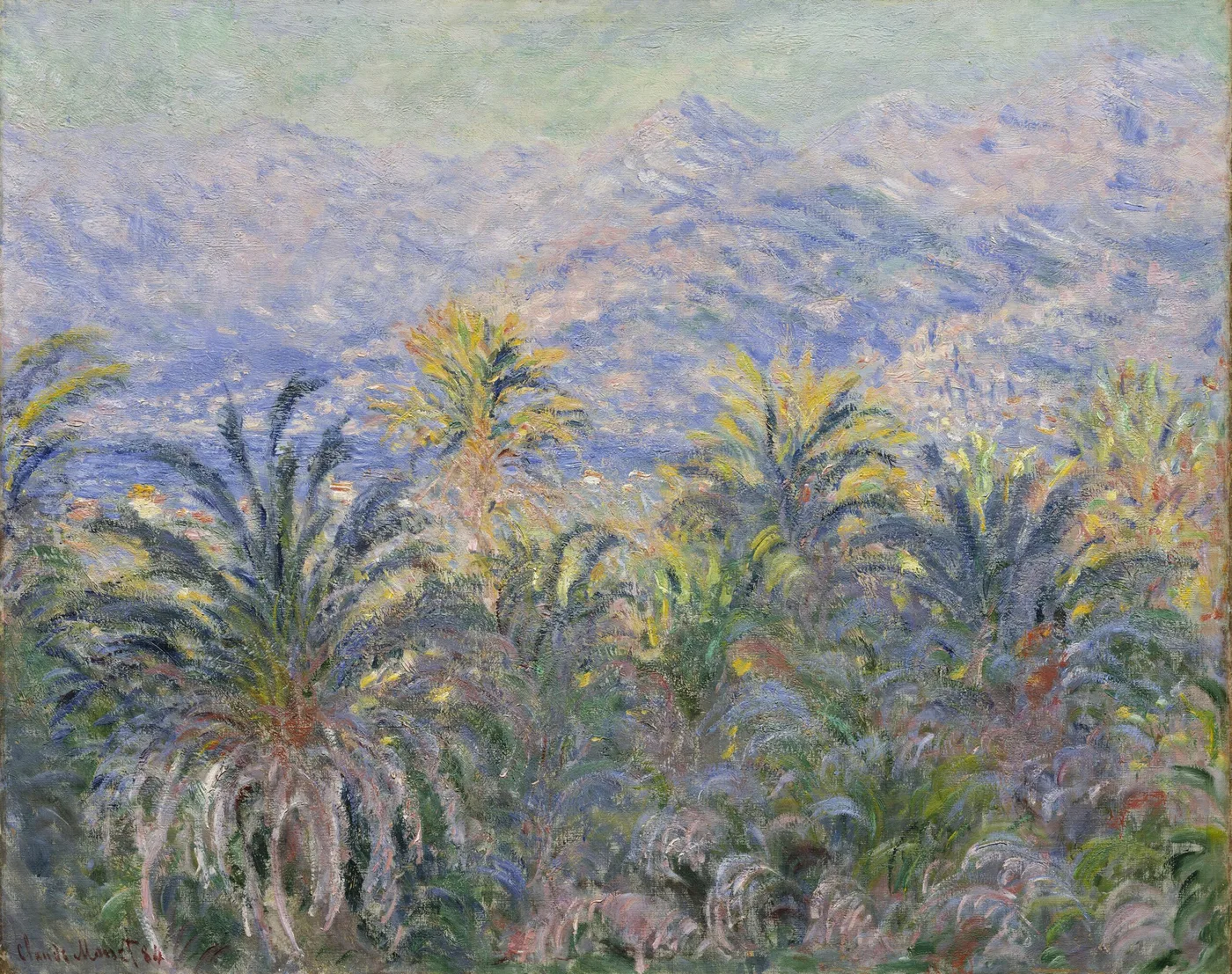
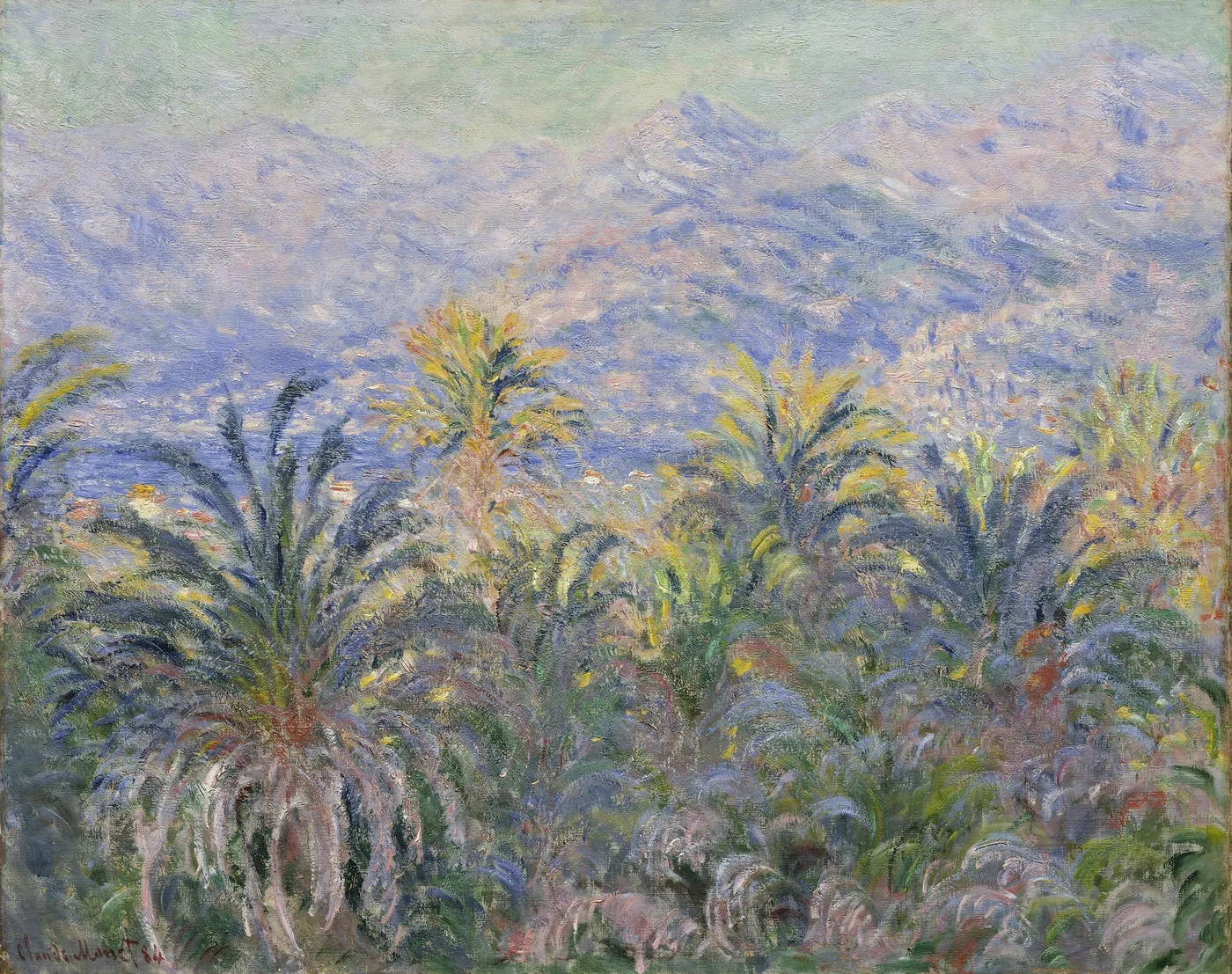
Claude Monet painted Palm Trees at Bordighera in 1884. Dark palm fronds spread across the foreground, with taller crowns rising into a view of blue-violet mountains. Pale buildings appear between the plants farther away. The Metropolitan Museum of Art identifies the direction of the view across the Bay of Ventimiglia toward the Alps on the French border.
The Met explains that Monet first visited this part of the Italian coast with Renoir in December 1883, then returned to paint alone. The palms and mountains gave him subjects different from his northern landscapes. In the museum’s account, the strong colours challenged his palette. The visible result combines blue and violet passages with warm pink and yellow touches.
In this particular canvas, the mountains occupy much of the distance above the palms. It is the layered vegetation and rising slopes that organise the view. A broad, uninterrupted band of bright sea is not visible across the middle. The geographical direction of a view across a bay does not require the water itself to occupy an open strip in the picture.
Overlapping Crowns in Front of the Slopes
At the lower left, a palm has a broad spread of dark leaves around its trunk. Some fronds curve down toward the bottom edge, while others reach upward across the cooler distance. Their separate narrow marks have pale and pink passages beside them, keeping the crown uneven at its edges.
A taller palm rises left of centre, with a lighter crown standing against the mountains. Yellow-green touches collect near its upper fronds. Darker palms spread across the right, overlapping one another so that the spaces between leaves show only fragments of the view beyond. The vegetation forms several layers rather than a single flat silhouette.
Beyond the palms are small pale blocks of buildings, broken by trees and shadows. The slopes rise behind them in bands of blue, violet and pink. A pale sky remains above the mountain crests. The change from near dark foliage to distant lighter slopes gives the image depth without a large empty foreground.
Monet uses short dabs as well as longer curving marks. The wider fronds can be followed along their length, while the buildings and distant surfaces contain smaller touches. Warm colour appears within the cool slopes and among the dark leaves. It repeats across the image instead of belonging only to one sunlit object.
Near Vegetation and a High Distant View
The palm crowns overlap the distant landscape at different heights. Some end below the buildings; others rise against the mountains. That variation helps keep the foreground dense while leaving enough of the farther view visible to understand its scale. The small buildings offer another point of comparison with the nearby trunks and fronds.
The mountains remain a major part of the subject even though the title begins with palm trees. Their pale blue and violet planes fill the upper distance and meet the sky along a high, irregular edge. Looking between the dark leaves reveals how often Monet lets those distant colours show through the nearer planting.
Compare the treatment of vegetation with Bridge over a Pond of Water Lilies, and the distant view with the account of Arrival of the Normandy Train. This Riviera scene has its own arrangement of near palms, scattered buildings and rising mountains, which the full image preserves.
The Bordighera Canvas at the Met
The Metropolitan Museum of Art in New York holds Palm Trees at Bordighera, accession 67.187.87. Its record dates the oil on canvas to 1884 and gives dimensions of 64.8 cm high and 81.3 cm wide (25 1/2 × 32 in.). The painting is horizontal, with vegetation across the foreground and the distant slopes extending toward both sides.
The museum’s record concerns this specific composition. Monet painted other views of the region, so the title and date alone are less useful than checking the arrangement of the palms and mountains together. In this image, the tall lighter palm left of centre rises above darker foreground crowns, with pale buildings scattered beyond.
Consult the current collection page for display information before planning a visit. The dimensions there refer to the original painted canvas. Reproduction sizes and any additional frame width belong to the product selected, and should be measured separately against the available wall space.
Keeping the Mountains Above the Palms
The primary Palm Trees at Bordighera reproduction is painted by hand in oils on canvas. A studio artist paints this Met composition, including the dark foreground crowns and the pale mountain slopes above them. A canvas art print is available as an alternative edition reproducing the image in ink.
On the oil reproduction, the narrow frond marks are painted anew, with natural variation in the brushwork. The print carries the source image’s marks in ink. Both editions follow the complete landscape. Their methods differ, so a visible painted stroke in a printed image should be distinguished from new oil paint on a canvas.
Choose a size that keeps the horizontal proportions and the full height of the mountains. A close crop around the dark palms would remove much of the distant setting; cropping only the upper view would lose the layered crowns below. The product’s size options describe the complete composition rather than a separate detail.
Use the edition and presentation selectors for current sizes and rolled, stretched or framed choices. Oil orders are photographed for approval before dispatch. In that image, review the foreground fronds, pale buildings and mountain skyline together. Rolled canvas arrives without a stretcher and needs preparation for hanging.
Questions About This Riviera View
Which mountains are in the distance?
The Met identifies Monet’s view as looking across the Bay of Ventimiglia toward the Alps on the French border. Blue-violet mountain slopes occupy the distance above the palms. The record does not require identifying an individual summit by name.
Is there a broad strip of sea across the picture?
No broad, open sea band appears in this composition. Palm crowns overlap a view of small buildings and rising mountains. The museum describes the geographical direction across the bay, while the visible image is dominated by vegetation and slopes.
When was the original made and how large is it?
Monet painted it in 1884. The Met records oil on canvas, 64.8 cm high and 81.3 cm wide, accession 67.187.87. Reproduction dimensions and a chosen frame’s outside measurements are separate from those original canvas dimensions.
Can I order the main hand-painted edition?
Yes. The principal edition is painted by hand in oils on canvas, with a canvas art print also available. Oil orders are photographed for approval before shipping. The full arrangement includes both the palms and the mountains.
More from this collection
Bring this painting home
Choose a hand-painted oil reproduction for real brushwork, or an archival canvas print for a crisp museum-image edition. Every size preserves the original proportions.
View this work & options
Further reading
Verify the original in the The Metropolitan Museum of Art, New York collection record and continue through related works in the catalogue.