
Water Lilies (Nympheas)
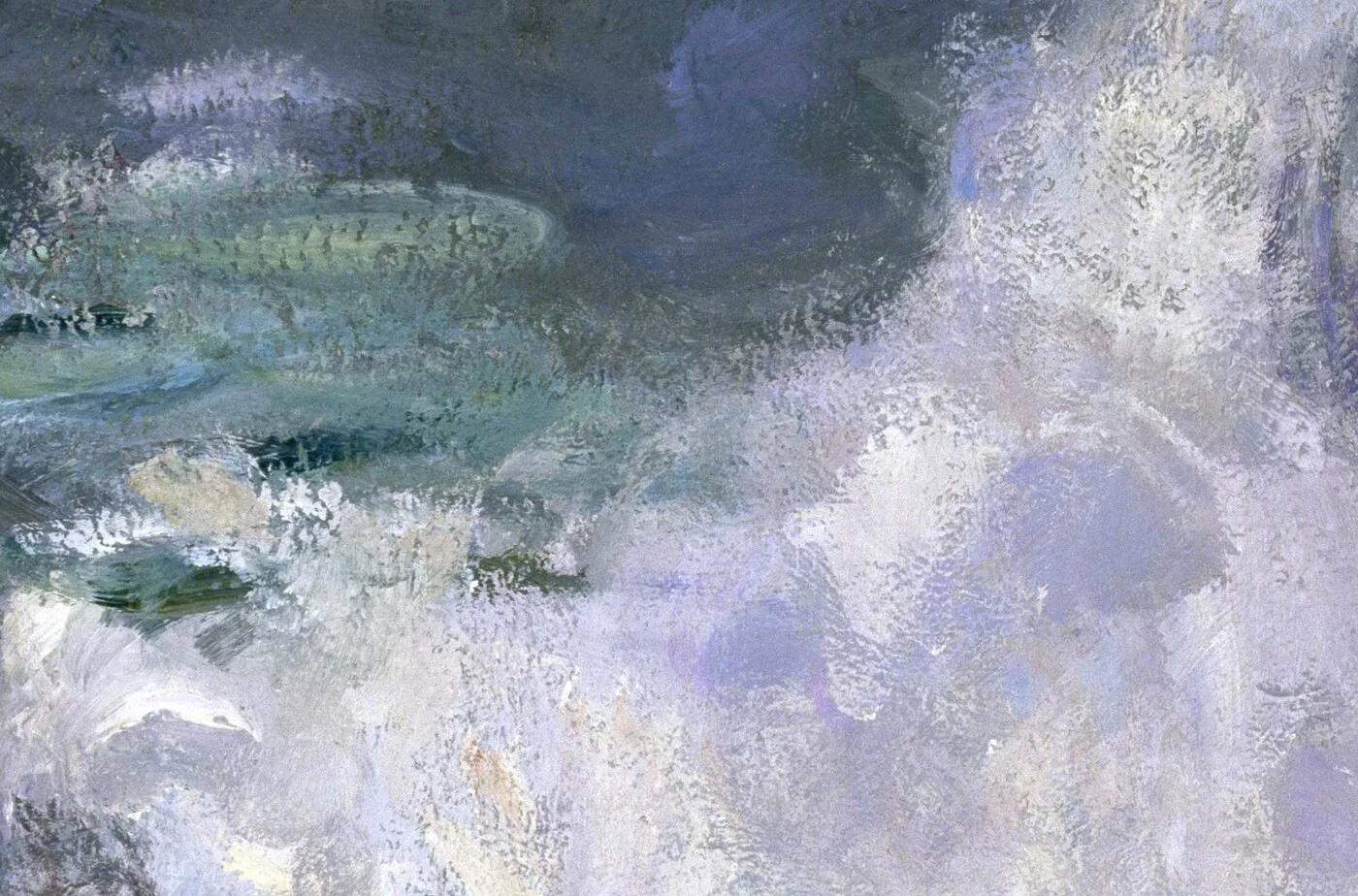
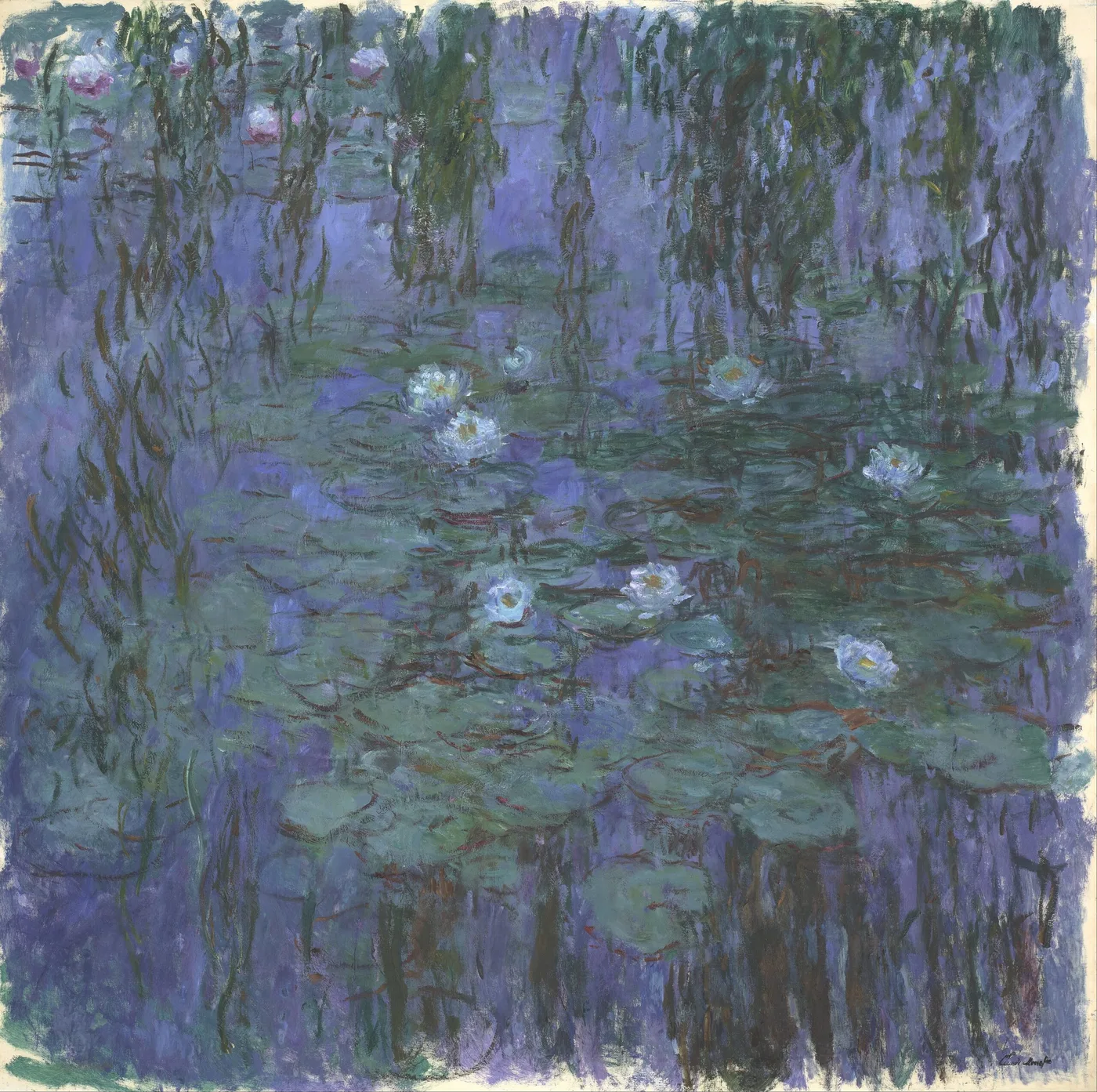
Ask what a pond looks like and most people describe a thing with edges: a bank, some reeds, trees behind, sky above. Now try to remember what a pond actually looks like when you are standing at the edge of one, looking down. No horizon. No sky, except the sky arriving second hand from underneath. Leaves lying flat on a plane that is somehow also a hole. That is the version Monet painted, and by 1907 he had refined it into something close to a private language.
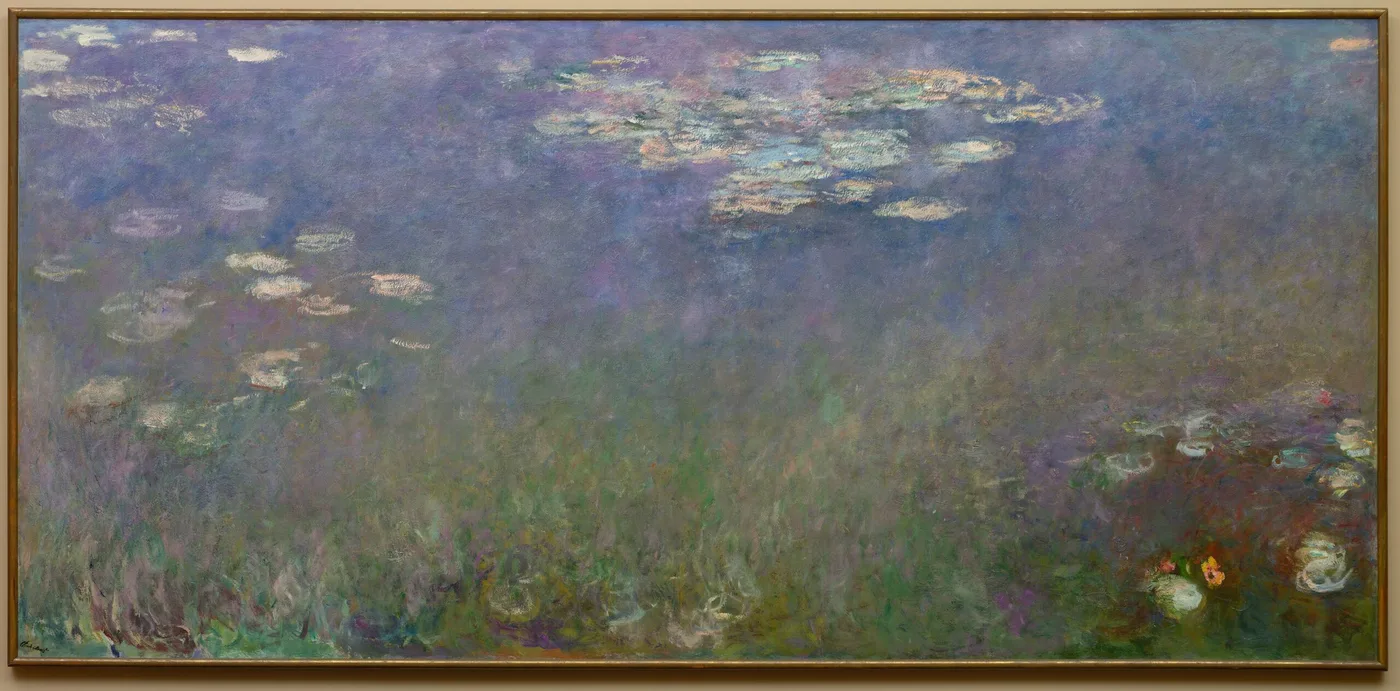
This canvas is one of the violet ones. Not the green summer noon, not the hot orange evening, but the hour when the light has left the water surface and is only reaching it as reflected colour from above. The pads are dark. The water between them is lilac, blue, and in places a deep bruised purple, and the lily flowers sit on top of it as small pale interruptions with a little heat in them.
He built the thing he was painting
The pond was not found. It was commissioned by the painter from himself. Monet rented the Giverny house in 1883 and bought it in 1890. From 1893 he began digging the water garden, and in 1895 he added the Japanese footbridge. By the time of this canvas he had been shaping, planting and tending that stretch of water for fourteen years.
That changes the nature of the work in a way that is easy to underestimate. A landscape painter usually negotiates with a world he did not design. Here he had chosen the plants, decided the shape of the bank, and controlled what would be reflected in the surface by controlling what grew around it. Then he stood in front of it for the rest of his life, roughly three decades, and painted it.
He was in his mid sixties when he made this. He had money and reputation by then, both of which had arrived late. The grainstacks of 1890 and 1891 had sold quickly and well through Durand-Ruel and turned him from a difficult painter into a sought after one. The poplars along the Epte followed, and he had bought that row of trees at auction rather than let them be felled before he had finished with them. What all of that bought him, in the end, was the freedom to stop looking for subjects at all.
The problem of painting a surface with no edges
Take the horizon out of a landscape and you remove the viewer’s anchor. There is no longer a line telling the eye where the world stops, and there is no top or bottom in the usual sense.
What Monet substitutes is the ellipse of the lily pads. Near the top of the canvas they are narrow, squashed almost to slivers, because you are seeing them at a shallow angle across the water. Towards the bottom they open out into rounder shapes, because you are looking more steeply down. That progressive opening is the only perspective in the picture, and it is enough. Follow it and you can feel the plane of the water tipping away from you.
The second device is stroke direction. Horizontal marks lie flat and become surface. Vertical marks stand up and become reflection, plunging down into a space that has no floor. He alternates the two constantly, which is why the picture keeps flipping between flat decoration and infinite depth as you look at it.
The third is what he leaves out. There is no reed bed, no bank, no fixed object to measure against. The picture refuses to tell you how big anything is.
It is worth measuring this canvas against what he had been doing a decade earlier at the same pond. The first water garden pictures kept the Japanese footbridge in them, and the bridge is a piece of architecture: it has a top and a bottom, it spans from one bank to another, it tells you exactly where you are standing and how wide the water is. By 1907 the bridge has gone, the banks have gone, and with them every remaining piece of information about scale and position. He spent those years systematically removing the handrails from his own picture, and this canvas is what was left once they were all gone.
What to look at, in order
Look first at the pads, and specifically at their edges. They are not outlined. Each one is a mass of colour laid next to a different mass of colour, and the edge exists only because the two disagree. That is why they float rather than sit.
Second, look at the palest passages. In a violet canvas like this the lightest areas are usually reflected sky, and they are almost always cooler and less saturated than you first assume. They read as light because everything around them is deeper, not because they are bright.
Third, hunt for the flowers. There are rarely many of them, and they carry the only warm notes in the picture. Cover them with a finger and the whole canvas goes cold and heavy. They are structurally load bearing despite being tiny.
Fourth, look at the paint itself. In these years the handling is loose but still controlled, with layers of broken colour dragged across an underlayer that shows through in gaps. Those gaps are where the vibration comes from. Fill them in and the surface goes dead.
How it behaves in a room
A violet pond picture is a very different roommate from a green one. Cool, deep, and slightly nocturnal, it lowers the temperature of a space and makes it feel quieter. That makes it an unusually good choice for rooms that already get too much sun, or for a bedroom, a study, or a bathroom wall where you want the eye to settle rather than be entertained.
Because it has no horizon, it does not need to relate to your furniture line. It can be hung high, low, off centre, or in a group, and none of those decisions will look like a mistake. It is one of the very few subjects with genuinely no wrong orientation to the room around it.
It responds strongly to lighting. Under cool daylight the blues and lilacs dominate and the picture reads as water. Under warm evening lamplight the violets shift towards rose and the flowers come forward. If you have a picture light or a warm lamp near it, the image will visibly change character between afternoon and evening.
It also likes company of the right kind. Deep painted walls, dark wood, and matt surfaces suit it far better than gloss and high contrast. Against a very white wall it can look like a fragment. Against a mid or deep tone it looks like a window into the ground.
The subject that never closed
Once the pond appeared in his work it never left. He painted it in every light and every mood for the rest of his life, through the years when cataracts, diagnosed around 1912, were steadily taking his colour vision away, and on past the surgery of 1923.
This 1907 canvas belongs to the middle of that long project, when his eyes still worked and the ambition had already gone somewhere very strange: a picture of water with nothing in it but water, its flowers, and everything the sky was doing overhead, arriving upside down. It is held by the Museum of Fine Arts, Houston.
Sizes and materials for Water Lilies (Nymphéas) are listed on its product page.
More from this collection
Bring this painting home
Choose a hand-painted oil reproduction for real brushwork, or an archival canvas print for a crisp museum-image edition. Every size preserves the original proportions.
View this work & options
Further reading
Verify the original in the Museum of Fine Arts, Houston collection record and continue through related works in the catalogue.