




Description
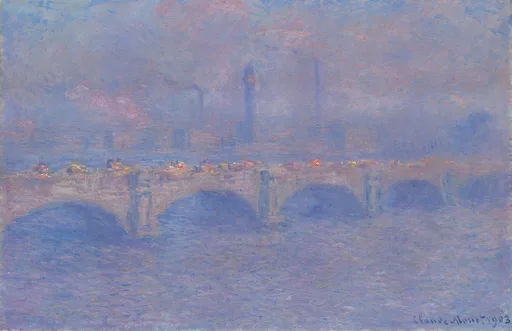
A hazy industrial river fills the lower two thirds of the canvas, painted almost entirely in blue, its surface broken on the right by a shimmering patch of orange, gold and violet where low sun breaks through smoke and fog to strike the water directly. Across the river, the dark silhouette of a factory building with a tall chimney sits low on the horizon, rendered as a nearly flat shape of deep blue-violet against a sky thick with soot and mist.
Above that horizon, the sky is not blue at all but a dense, churning mixture of mauve, salmon pink and rust orange, the colours of coal smoke lit from behind by a sun that never fully appears as a disc, only as diffuse, glowing colour spreading unevenly through the haze. Monet painted this view repeatedly from a room overlooking the river, working the same bridge and factory skyline at different hours to track how the fog changed colour through the day, and this canvas captures one of the warmer, more luminous moments in that campaign, sunlight fighting through pollution rather than being blocked by it.
What separates the picture from his French river paintings is the frank ugliness of its subject matter transformed into something luminous: a smokestack and industrial fog rendered with the same loose, broken brushwork he gave to water lilies, proof that his method depended less on the beauty of the motif than on the behaviour of light passing through atmosphere. The near-total suppression of drawn detail, the bridge itself is barely legible, pushes the painting close to abstraction for its date.
Its dominant blue, warmed by that one band of glowing orange, gives the canvas real presence on a wall without ever tipping into gaudiness, the kind of picture that changes mood with the room’s light, moodier under cool light and warmer under lamplight, and substantial enough in colour to anchor a wall on its own.