
The Water Lilies: Tree Reflections
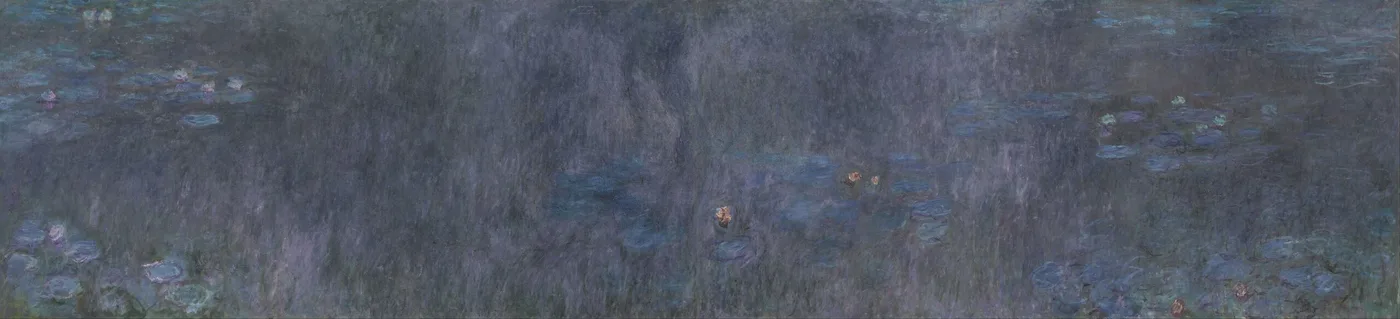
Late in the day, when the sun has dropped behind the trees but the sky above is still bright, a pond does something strange. The water goes almost black. Not empty black; a black with things in it. The reflected trees, which at noon were a pleasant pattern of green, become dense hanging masses, and the few pale gaps between them look less like sky than like holes cut in a dark cloth.
You can stand at that water for a long time before your eyes settle, and when they do, you find you have been looking at an upside-down forest suspended in front of you with nothing underneath it.
This is the panel he made from that. It is the darkest thing in the whole cycle, and in a room of paintings full of light it is the one people fall silent in front of.
The years the light went out
It is impossible to look at this canvas without thinking about what was happening to the man who painted it.
Around 1912 he was diagnosed with cataracts. For anyone that is a nuisance; for a painter whose entire life’s work rested on distinguishing a cool violet shadow from a warm grey one, it was an attack on the foundation. Cataracts do not simply blur. They yellow, they dim, they mute the blue end of the spectrum first. He went on painting for eleven years before submitting to an operation in 1923.
In the same stretch of years he lost his second wife, Alice, in 1911, and his son Jean in 1914. And it was from 1914 to 1916 onward that he committed himself to the large decorations, in a purpose-built third studio put up at Giverny for canvases too big to be worked anywhere else. He gave the finished cycle to the French state. It was installed at the Orangerie in 1927, after his death, in two oval rooms designed so the panels would wrap around whoever stood inside them.
None of that makes this a picture about grief in any literal way. He was not an artist who painted his moods; he painted water, relentlessly, for thirty years. But this canvas is dark in a way that no observed pond quite requires, and a viewer is allowed to notice that the darkest painting he ever made of that water came from the end of a decade that had taken almost everything from him.
Painting a world turned upside down
Technically this is the hardest of the panels, and for a reason most people never think about: dark paintings are far more difficult to keep alive than light ones.
A pale picture has room to move. Every colour can be nudged brighter or duller and still read. A dark picture has a narrow band to work in; go one step too far and the whole area collapses into a hole, and once it collapses the only fix is to scrape it out and start again. He is working here across metres of near-black water and it never once goes dead.
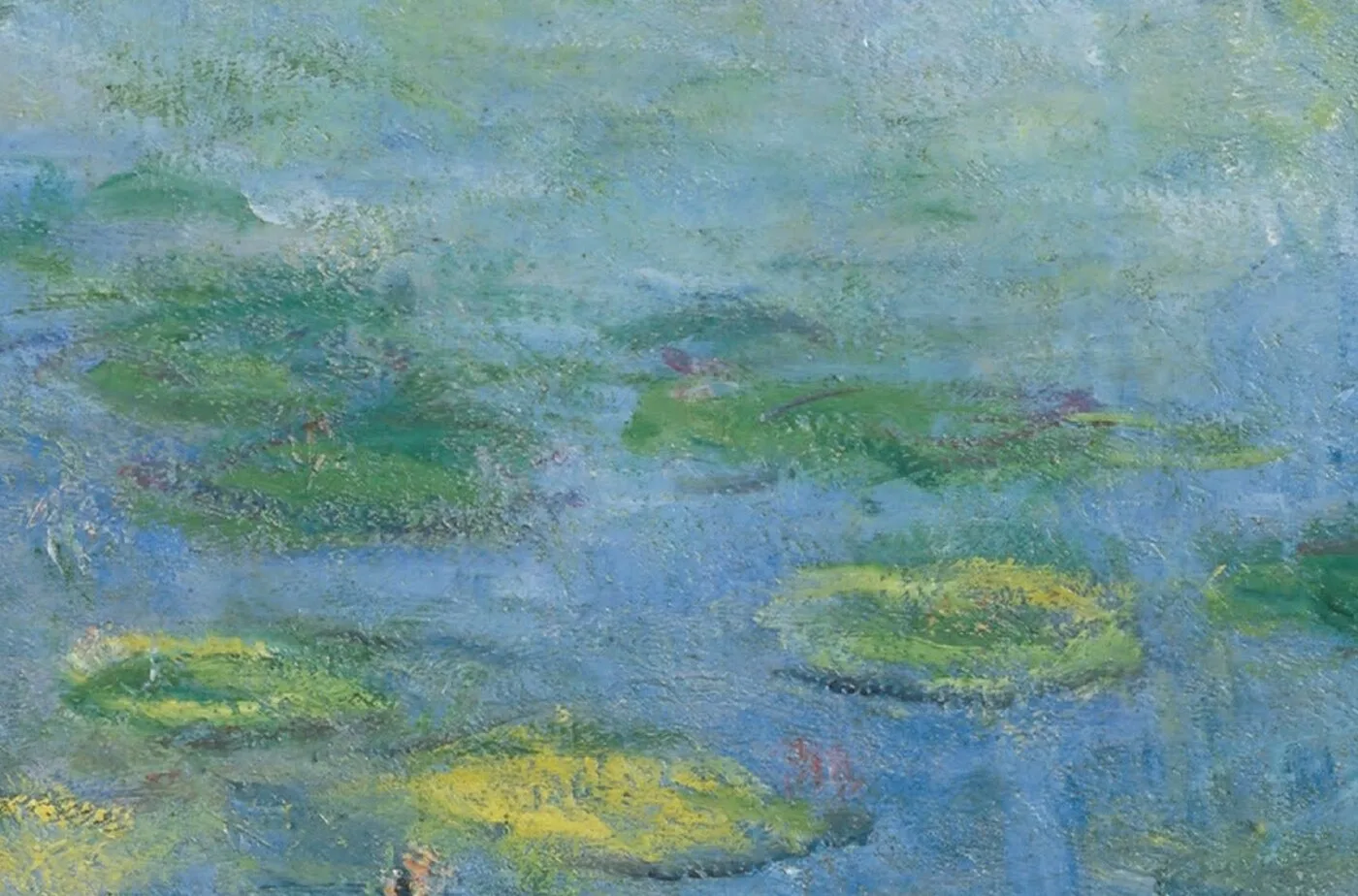
Look at what is actually in the darks. Very little of it is black. There is a deep blue-violet that carries most of the weight. There is a bottle green so dark it reads as brown, a genuine dark red in the heaviest passages of foliage, and, in the depths, strokes of a cold blue that behave like light coming from behind. He is building darkness out of colour rather than out of the absence of it, which is the whole difference between a shadow that has air in it and one that is a smear.
Then look at the orientation of the marks. In the reflected trees the strokes run vertically, long and dragged, because a reflection is stretched by the water. Across the open passages they run horizontally, short and broken, because that is how the surface lies. Where those two directions meet, the painting produces its odd double reading: a thing hanging down and a plane lying flat, in the same square of canvas.
The pond in question was his own work as much as nature’s. Giverny was rented in 1883 and bought in 1890; the water garden was dug from 1893, which required diverting a branch of the Epte and obtaining permission after objections from local farmers. The Japanese bridge came in 1895. By 1920 the trees he had planted were mature enough to fill the water with the dense reflections this panel depends on. He had, in effect, spent twenty-five years growing his own subject.
Learning to see it: give it ten minutes and it opens
This picture does not perform. It waits. In a gallery people give it four seconds and move on, and four seconds is not enough for the eye to adjust, exactly as at a real pond at dusk. Here is how to get more from it.
- Look at the darkest area first, and stay there. Do not scan. Hold your gaze on one mass of reflected tree for thirty seconds and let your eye adapt. Colours will start to separate out of what looked uniform.
- Then find the pale openings. They are sky, reflected. Notice that they are not white; they are a soft grey-blue or a dull rose, and they are the coolest thing in the picture. They tell you the sky above the pond was still bright.
- Find the lily pads. They are hard to spot here, which is deliberate. They sit as small horizontal flecks, often lighter at one edge. They are the only elements telling you there is a surface at all. Without them the picture would read as sky rather than water.
- Now step back and invert it. Deliberately read the dark masses as trees standing up rather than hanging down. The picture will flip, the way an optical figure does. That flip is the experience he was chasing.
The reward for staying is that the canvas gradually gets brighter. Not literally; your eye simply opens. Ten minutes in, a painting that looked almost monochrome is full of blues and greens and reds. It is the same adjustment that happens to anyone standing outdoors as the day goes.
How it behaves in a real room
Dark paintings are frequently misused. They get hung in dim corners on the theory that dark goes with dark, and there they simply vanish.
The opposite is true. This is a picture for a bright wall. Put it where there is good daylight or a decent lamp and it becomes extraordinarily rich; the darks separate, the reflections gain colour, and it holds a room the way a fireplace does. In a genuinely dark room it turns into a rectangle of shadow.
It is a strong choice for a wall you sit facing rather than one you walk past. Behind a sofa it is wasted, because nobody in the room can see it. Opposite a sofa, above a fireplace, at the end of a hallway where you approach it head on, it does its work. It rewards the long slow look, so put it where long slow looks actually happen.
On a white wall it is dramatic and slightly severe, a dark window in a light plane. On a mid-tone wall, warm grey, greige, muted olive, it settles and becomes atmospheric; the edges soften and the picture stops looking like an object. Avoid busy wallpaper entirely. This canvas has enough internal complexity to compete with anything you place near it.
One last practical point: keep the glass or the surface out of direct reflection from windows and lamps opposite. A dark image is effectively a mirror, and a picture built on ten minutes of eye adjustment is ruined by a bright rectangle of window bouncing back at the viewer.
Sizes and materials for The Water Lilies – Tree Reflections are listed on its product page.
More from this collection
Bring this painting home
Choose a hand-painted oil reproduction for real brushwork, or an archival canvas print for a crisp museum-image edition. Every size preserves the original proportions.
View this work & options
Further reading
Verify the original in the Musée de l'Orangerie collection record and continue through related works in the catalogue.