
Water Lilies (Agapanthus): A Pond He Built, Then Painted for Thirty Years
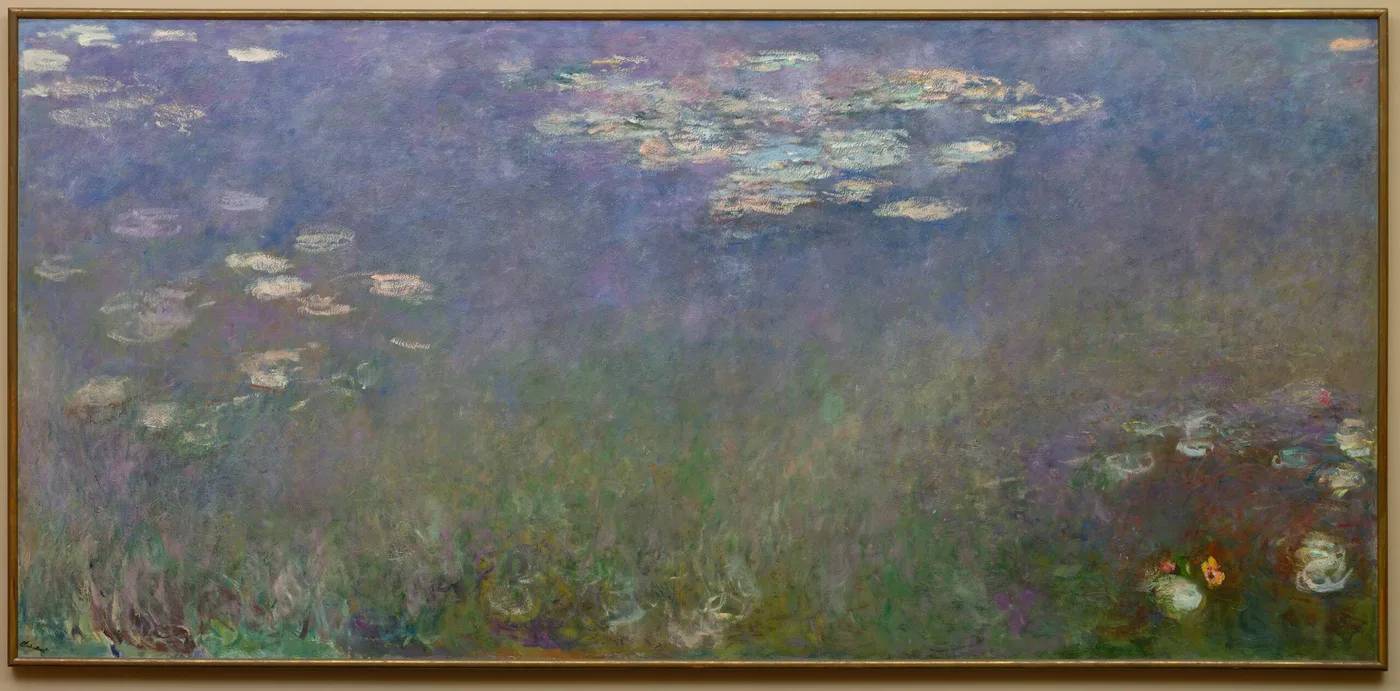
Stand at the edge of a still pond in the middle of the morning and look straight down into it. You lose your footing almost immediately. There is the surface, with leaves lying flat on it. There is the water, brown and green and full of stems going down. And there is the sky, which is also in there, arriving from above and appearing below, so that the same square foot of water contains a leaf, a depth and a cloud all at once. Your eye cannot decide which of the three to believe.
By 1915 an old man had been looking into that particular water for over twenty years, and had begun making pictures of it larger than the pond deserved.
He built the subject before he painted it
This is the part that gets skipped. The pond was not found. He settled at Giverny in 1883 and had the water garden made from 1893, and then spent decades altering it, planting it, and having it maintained. The lilies were chosen. The bank was shaped. The reflections that fill these canvases exist because someone decided where the willows and the agapanthus would stand.
So the motif was manufactured, over years, by the man who then spent the rest of his life claiming he was simply recording what was in front of him. Both things are true. He was painting from nature, and the nature had been arranged. It is one of the odder facts in art, an artist who spent thirty years constructing a subject slowly enough that by the end he could no longer tell where the garden ended and the painting began.
The second fact is harder. Around 1912 he was found to have cataracts. A cataract does not simply blur. It yellows and it dims, so that blues go grey and violets go brown and the whole world takes on a warm haze that gets thicker every year. For a man whose entire life’s work rested on discriminating between two closely related colours at a glance, that diagnosis was the beginning of a fight he could not win. The large decorations, including the agapanthus and water lily paintings begun around 1914 in the big third studio, were made in the shadow of it.
It is worth knowing what an agapanthus is, since it gives the group its name. It is a bank plant, not a water plant, with long strap shaped leaves that arch outward and tall bare stems carrying a rounded head of blue or white flowers. Planted along a pond edge it does something very specific to the view. The leaves fall in curves toward the water and the flower heads float above them on stems too thin to see clearly at a distance, so the whole plant reads as a loose blue cloud sitting between you and the surface. That is the shape that drifts through these paintings, sometimes present as a plant and sometimes only present as its reflection, and it is what gives the water its vertical rhythm.
Indoors, at scale
These late canvases were not carried down to the water. They were painted in a purpose built studio large enough to hold them, from a pond he could reach in a minute’s walk but which is not, physically, in front of the easel. That changes everything about how they were made.
Working at that size means you cannot see the whole picture while you are touching it. You stand close to make a mark and then you must retreat to find out what it did. A day’s work becomes a series of advances and withdrawals, and at seventy odd years of age, that is a physical undertaking as much as an artistic one.
It also means the paintings could be worked and reworked over long periods, layer over dried layer, and revised in relation to each other. Look closely at the surface of a late lily picture and you will find earlier states showing through the top layer, cooler colours buried under warmer ones, strokes going one direction with strokes going the opposite way laid across them later. These are not quick pictures pretending to be quick. They are slow pictures pretending to be a moment.
How to look at a painting with no horizon
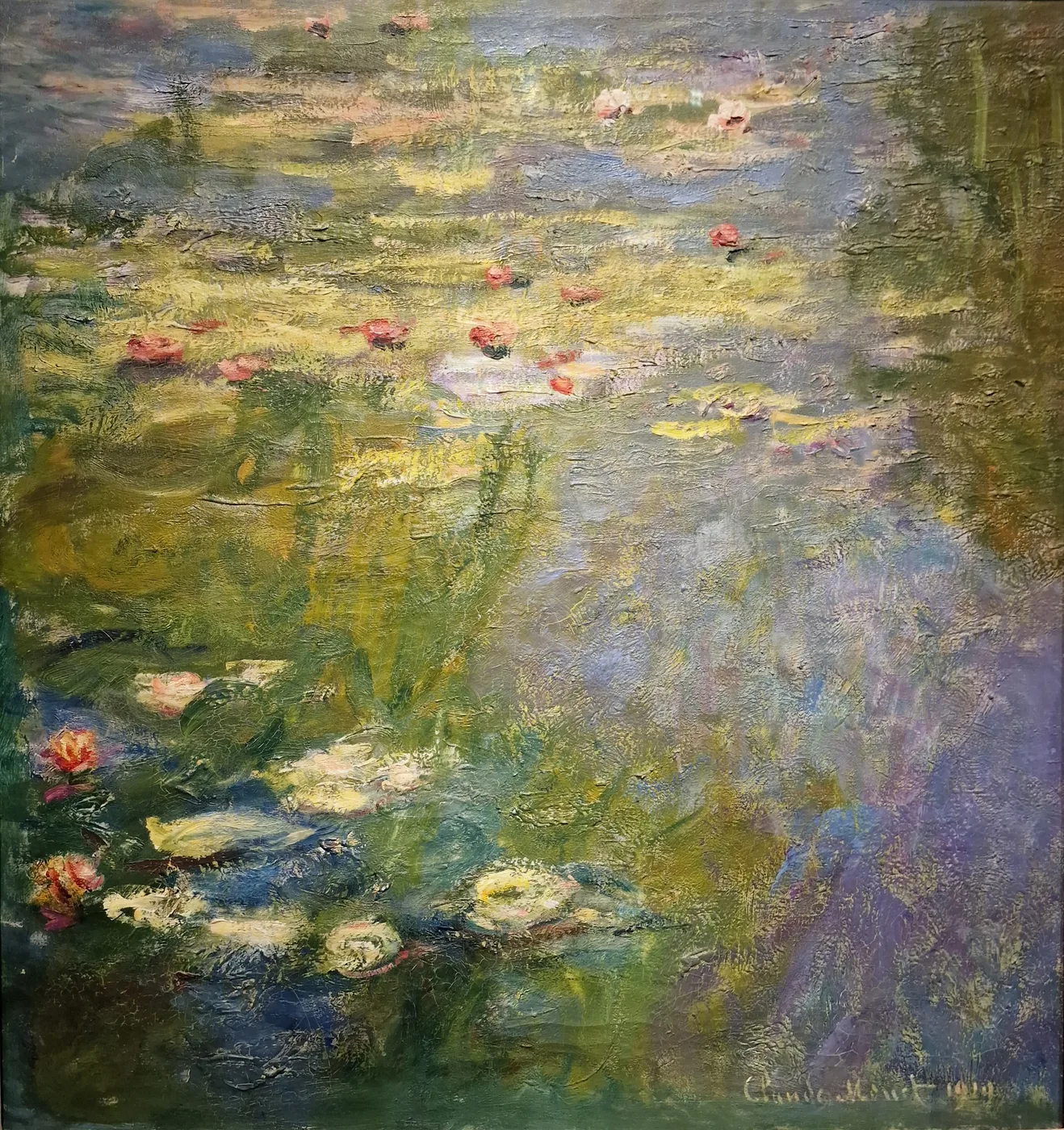
The first thing to notice is what is missing. There is no horizon line, no sky at the top, no bank at the bottom, no path leading in and no fixed viewpoint telling you how far away anything is. He removed the entire scaffolding that landscape painting had used for four hundred years. What is left is a surface, looked at from above, that goes both up and down at once.
Try reading it in this order:
- Find the lily pads first. They are the only elements lying flat, and their ellipses are the one clue to the plane of the water. They also shrink as they go back, which is the only perspective the picture allows itself.
- Then find the reflections. They run vertically, downward into the canvas, and they are made of the sky and the plants on the bank. Where a reflection crosses a lily pad, you are looking at two different depths occupying one spot.
- Then find the dark passages, the ones that read as water rather than as anything reflected in it. These are the deepest notes and they push everything else forward.
- Finally the flowers themselves, small blunt touches of pink and white sitting on top of everything, applied last and left alone.
Once you have those four registers separated, look at how the paint changes between them. The reflections are dragged and streaked, the pads are patted flat, the flowers are single loaded strokes. The touch does the describing that drawing normally would.
Then let it go out of focus. These paintings are not built to be solved. Beyond a certain distance the four layers fuse into one shifting field, which is exactly the experience of actually staring into water until you stop identifying things.
What it does to a room
A water surface with no horizon behaves differently from a landscape on a wall. A landscape opens a hole in the room and sends you through it. This one spreads a field of colour across the wall and leaves you where you are. The effect is closer to ambient light than to a view, and it is remarkably calming for that reason.
Scale matters more here than with almost any other subject. These pictures were conceived big, and they lose their argument at postcard size, because the whole point is that the image exceeds the edge of your attention. Choose the largest format the wall can carry, and then hang it lower than usual, so that the water sits below your eye line the way it does when you look into a pond.
Give it empty wall on both sides. Anything hung close will supply the horizontal reference the painting deliberately removed, and the illusion goes. A blank wall is not a waste of space here, it is part of the work.
It is also the rare picture that improves in low light. At dusk, or under a single lamp, the greens and blues sink and the pink flowers stay visible longest, which is precisely what happens at a real pond as the light goes. Hang it where you will see it in the evening and you get that for free, every day, from a garden that a stubborn old man planted and replanted until it agreed to be a painting.
Sizes and materials for Water Lilies (Agapanthus) are listed on its product page.
More from this collection
Bring this painting home
Choose a hand-painted oil reproduction for real brushwork, or an archival canvas print for a crisp museum-image edition. Every size preserves the original proportions.
View this work & options
Further reading
Verify the original in the Cleveland Museum of Art collection record and continue through related works in the catalogue.