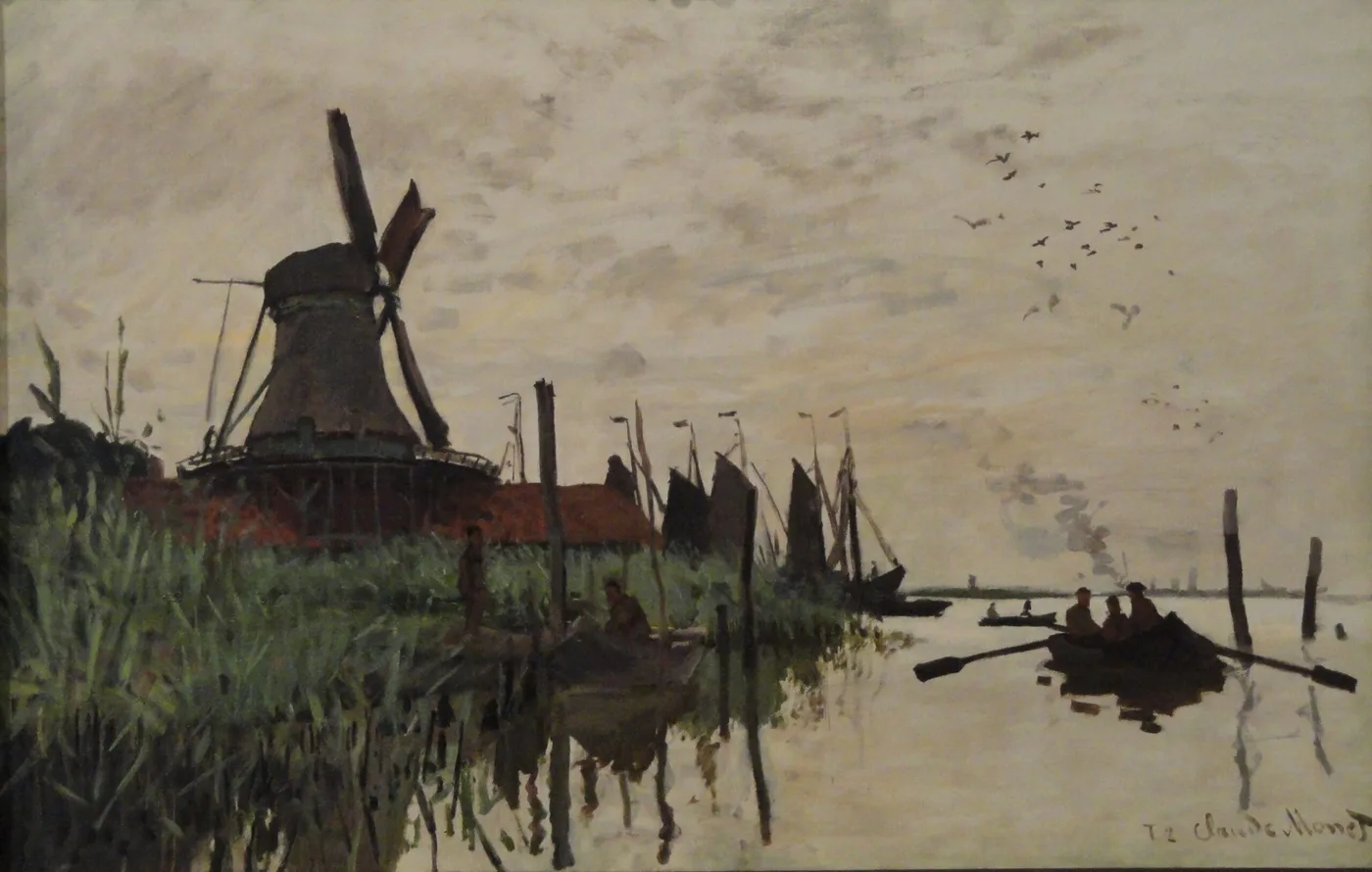
Windmills near Zaandam
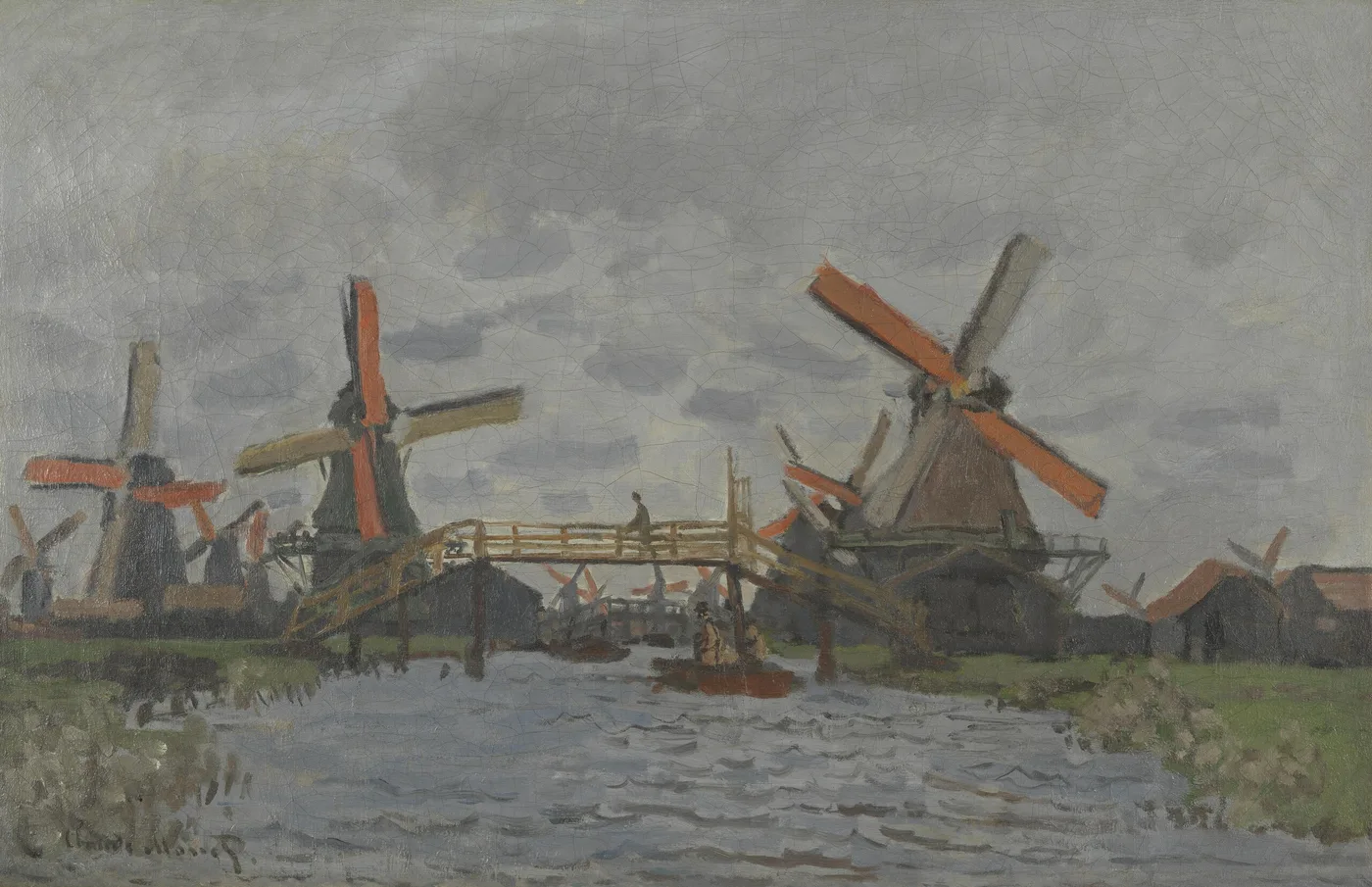
Imagine arriving in a country where the horizon is a ruled line. No hills to interrupt it, no valley to close it off, nothing between you and the edge of the world except water, a few roofs, and the tall dark machines standing over them. For a painter raised on the cliffs and estuaries of the French coast, Holland must have looked at first like a place with most of its scenery removed. It took very little time for Monet to work out that the missing scenery was the point.
This canvas is built on that discovery. The land occupies almost nothing. A low band across the middle carries the mills, the houses, the moored boats, and the entire business of human life. Everything above is sky and everything below is a repetition of the sky in slightly darker paint. The mills stand at the join like posts driven through the seam of the picture.
How he came to be there at all
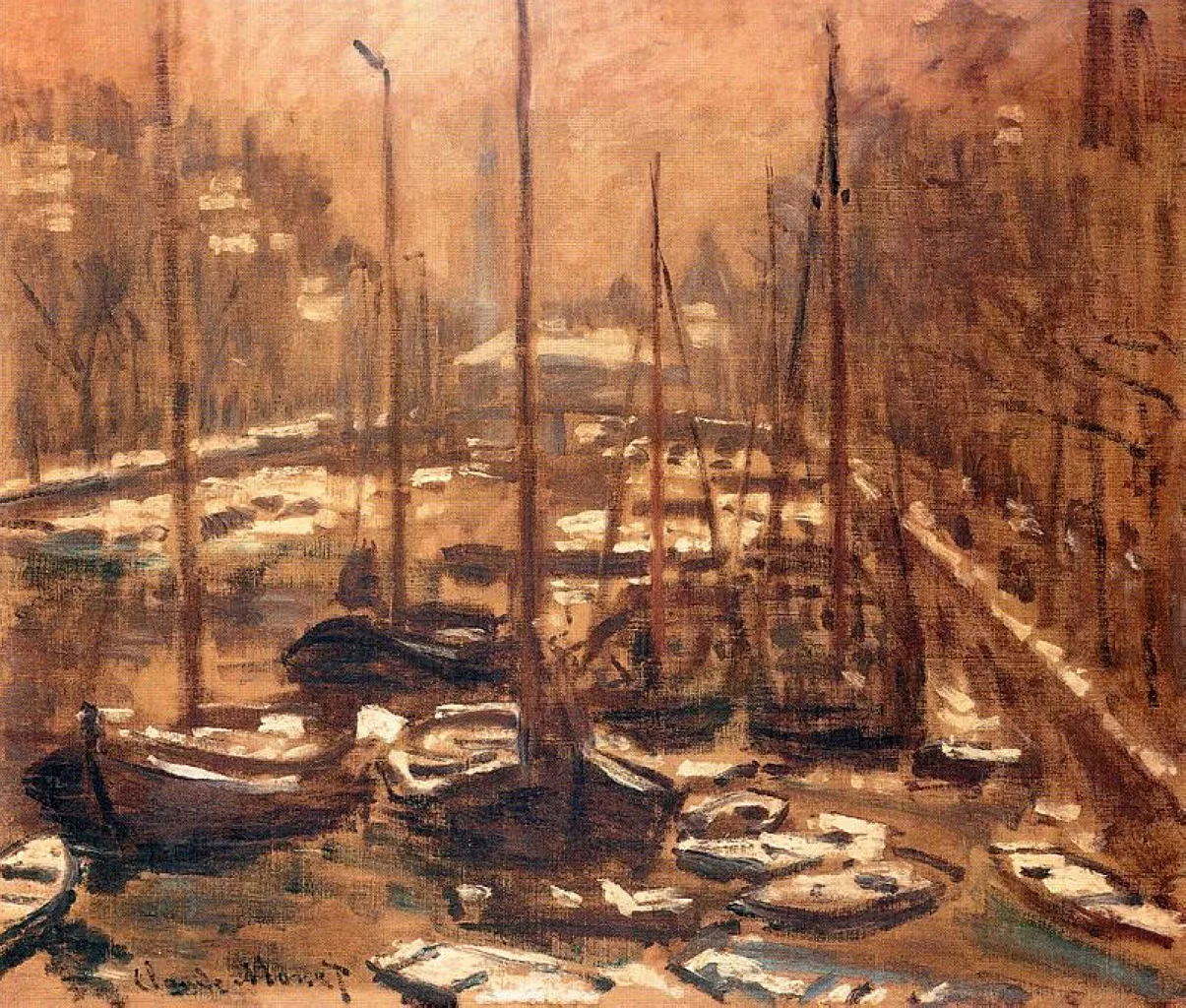
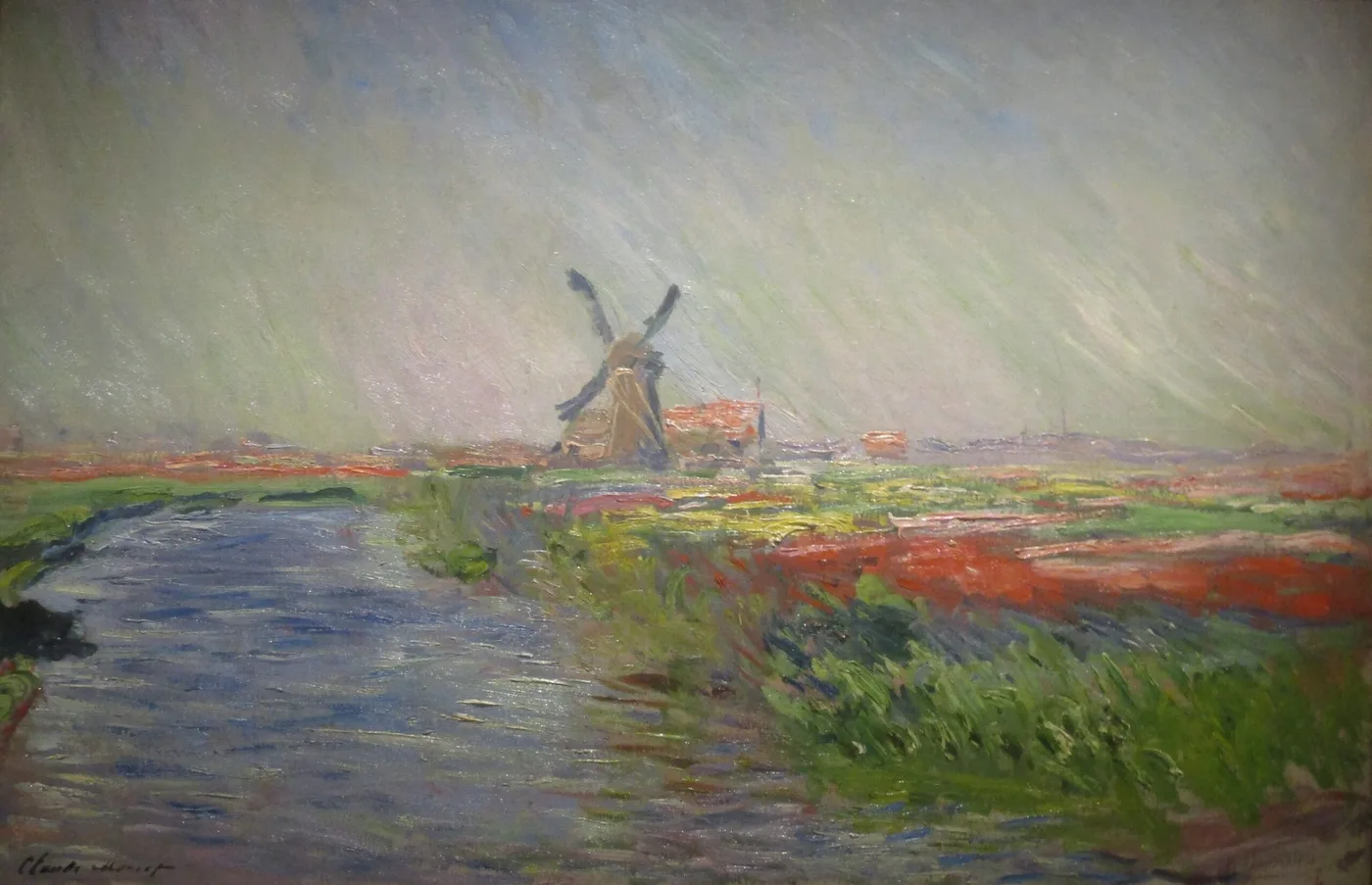
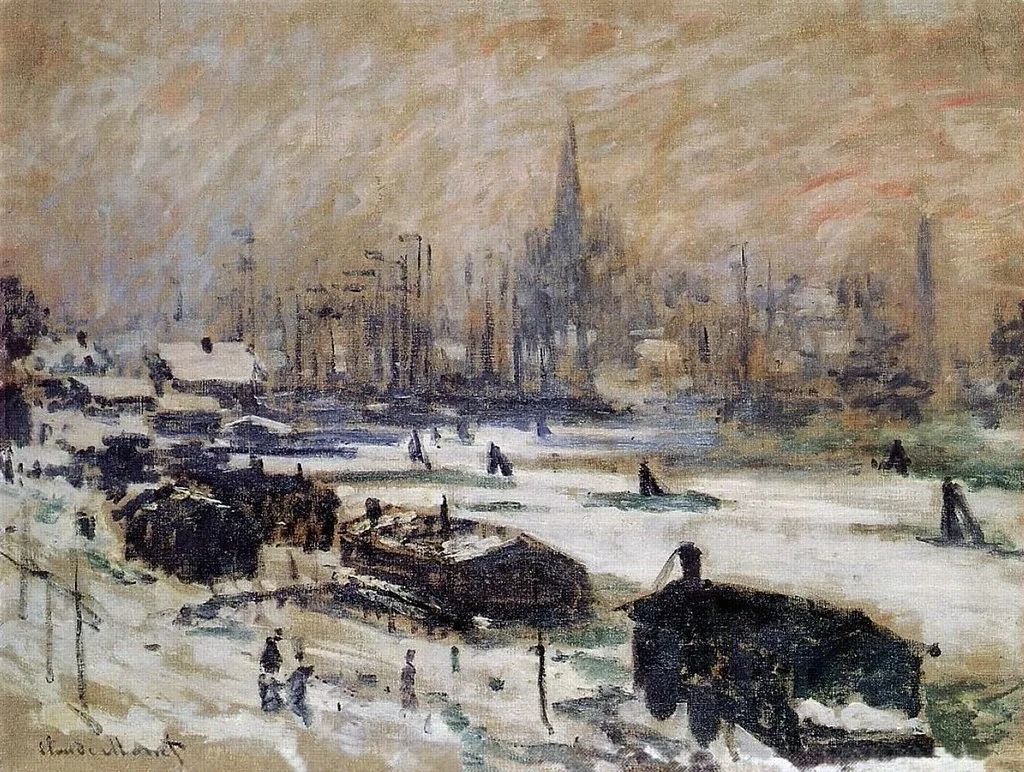
He was thirty years old and had spent the previous year running. The Franco-Prussian war had scattered his generation, and he had gone to London, painting the Thames in the fog and living the awkward life of a foreign artist with no market. Then, in 1871, he crossed to Holland with Camille and stayed at Zaandam, where the waterways carried working traffic and the mills turned as industrial equipment rather than as picturesque ornaments.
It is worth holding on to what that meant in practice. He was in his early thirties with a wife and a small son, no reputation to speak of, no reliable income, and a country he could not yet safely go home to. The pictures from this stay are often described as cheerful, and they do have a real lightness, but the lightness was made by a man in an unstable position who had found, for a few months, a subject that would sit still and a quality of light he had never worked in before.
Later that year the family settled at Argenteuil on the Seine, where they would stay until 1878. The Dutch canvases sit right on the join between the displaced years and the settled ones.
What flat country does to a painting
Take away hills and you take away the painter’s easiest tool, which is overlap. In hilly country you build depth by stacking things in front of each other. In a flat landscape nothing overlaps. Everything sits side by side on a single line, and depth has to be manufactured entirely from scale, colour temperature and the softening of edges.
Watch him do it here. The nearest mill is dark, warm and specific, with its sails drawn as real structures and its body catching a defined edge of light. The further ones lose weight step by step. Their darks turn bluer, their outlines get less certain, and by the far end of the row they are barely more than upright smudges of grey. There is no perspective grid doing this work. It is done purely with colour getting cooler and edges getting softer as things retreat.
The water does the second half of the job. A Dutch canal on a moderate day is not a mirror, it is a slightly disturbed mirror, and that disturbance is a gift to a painter. The reflected mills are broken into horizontal bars that stretch and wobble, which lets him repeat every shape in the picture in a looser, freer version directly underneath it. Half of the canvas is a rehearsal of the other half.
The light itself is the third difference, and it is the one that is hardest to describe and easiest to feel. In a country made largely of water, a great deal of the light reaching any object has bounced off a wet surface first. That gives everything a cool silvery cast and fills the shadows from below, so nothing goes properly black. Coming from a coastline where the sun hits stone and chalk and throws hard shade, Monet had arrived somewhere with almost no strong darks available. You can see him adjusting. The mill bodies, which ought to be the heaviest note in the picture, are lighter and bluer than the same structures would be in French sunlight.
Things to look for that most people miss
Look first at the sails. They are not all set the same way. Windmills are machinery, and the angle of the sails records how the miller has trimmed them, which means each one has a slightly different attitude. That variation is why the row reads as a working landscape rather than a decorative frieze.
Next, find the horizon and measure where it sits. It is low, usually well below the halfway mark, which hands the majority of the surface to the sky. Then check how much work that sky is doing. It is not one blue. It is streaked, banded, warmer near the land and cooler at the top, with clouds laid in as broad dragged strokes rather than modelled forms.
Look for the small human evidence. A moored boat, a fence, the pitch of a roof. They are tiny, and their smallness is what makes the mills look enormous. Remove those details and the scale collapses.
Finally, look at how thin the paint is in places and how loaded it is in others. The sky is often lean and dragged. The dark of a mill body can be a single thick stroke laid down once and left alone. That contrast between thin air and heavy structure is doing as much as the drawing.
And look at the colour of the water compared with the colour of the sky it is reflecting. It is never identical. Water always reads a little deeper and a little greener than the sky above it, because you are seeing the sky through a layer that has its own colour. Get that relationship wrong and the picture folds flat. Get it right, as here, and the canal has depth in it even though nothing in it is drawn.
How it hangs
Wide, low horizon pictures behave in a very particular way on a wall. They push a room sideways. Hung over a sofa, a long sideboard or a bed, they extend the furniture line rather than interrupting it, and they make a low ceiling feel less low because the eye travels horizontally instead of stopping.
The palette is quiet, dominated by grey blue, cool green and the earth colours of the mill bodies, with the sky as the brightest area. That makes it easy to live with in rooms that already have a lot going on, and it means it does not compete with strong furniture. In a room with plenty of daylight the sky area reads almost silver. In lamplight the warm browns of the structures come forward and the picture gets heavier and calmer.
It also suits pairing. Long horizontal images sit well beside another work of similar width, or above a run of shelving, because the horizon line gives you a natural alignment to hang to.
Why this one matters more than it looks
It would be easy to file this as a pleasant travel picture from a difficult year. It is more useful than that. Zaandam gave Monet a landscape with no scaffolding in it, where the only available subjects were light, air, water and the reflection of all three. Take away everything a landscape painter normally leans on and you are left with the problem he would spend the rest of his life on. Twenty years later he would be standing in a field at Giverny painting the same stack of straw over and over, and thirty years after that he would be painting a pond with no horizon at all. The training for both is here, on a flat Dutch waterway, with the sails turning.
The painting is held by the Van Gogh Museum.
Sizes and materials for Windmills near Zaandam are listed on its product page.