
Autumn on the Seine, Argenteuil
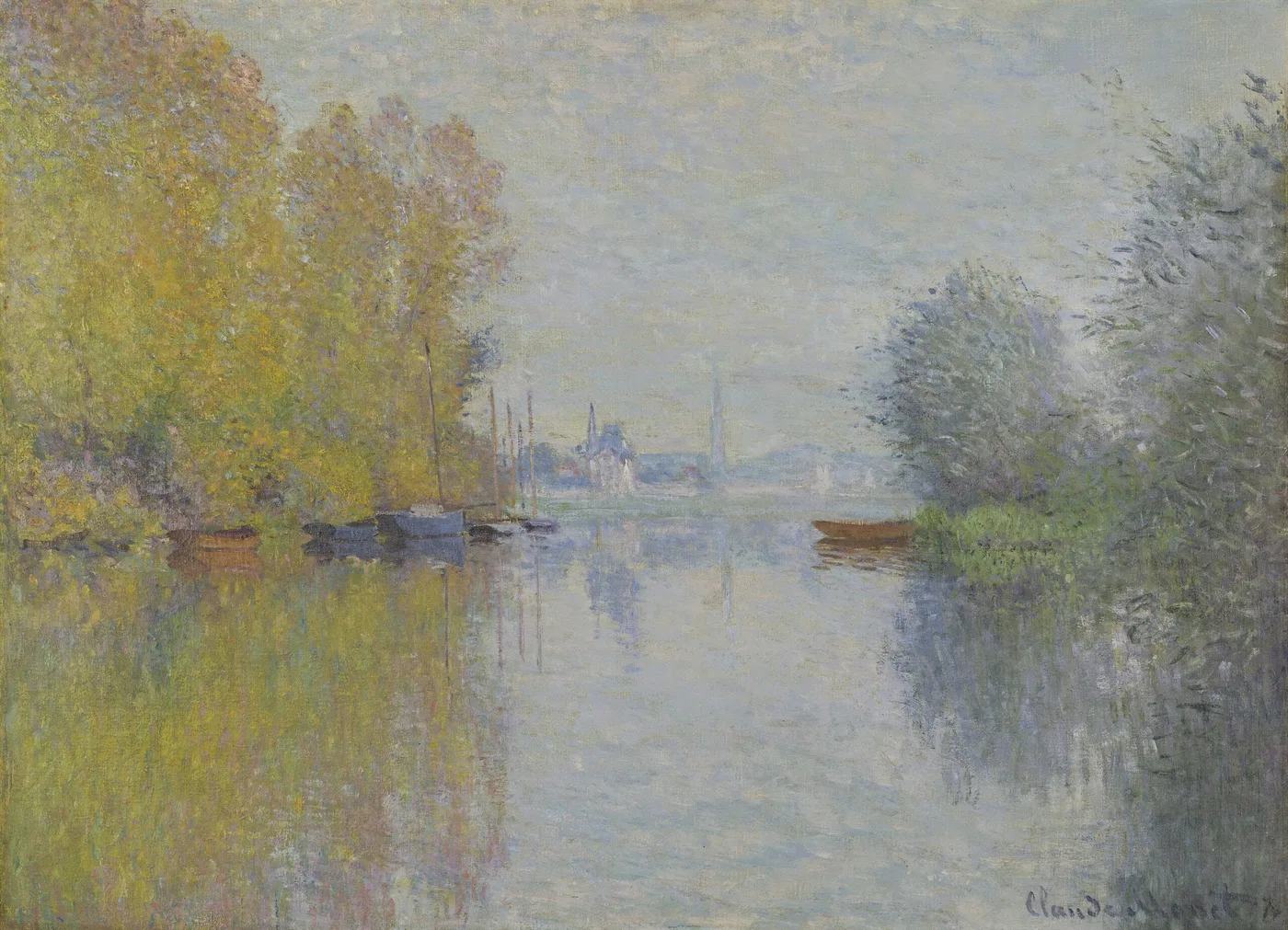
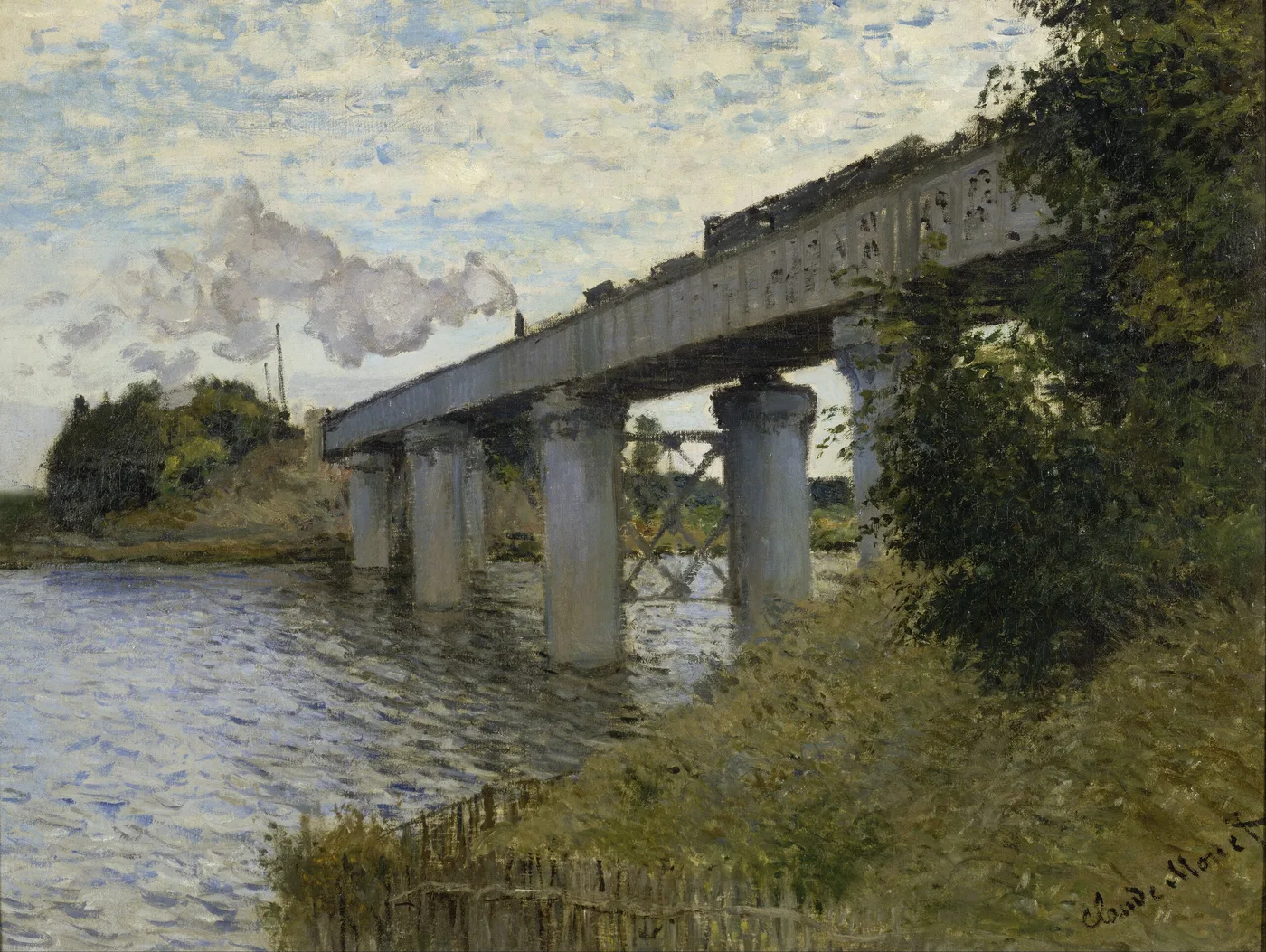
Autumn on a river lasts about three weeks. The leaves turn, and for a short stretch the bank runs gold and rust and copper, and the water underneath doubles all of it and darkens it by a couple of tones. Then a gale comes through, or a week of rain, and it is over. A painter who wants that light has to be out on the water while it is happening, every workable day, because there is no second attempt until next year.
Monet was thirty-three, living at Argenteuil, in his second full autumn there. He had a studio boat, a flat craft fitted for work, which let him place himself in the middle of the river instead of on the edge of it. Sit in that position and the composition changes completely. The bank stops being a foreground and becomes a far edge. The water comes up around you and takes over the bottom half of everything you see.
The years before the loss
He lived at Argenteuil from 1871 to 1878. Those years produced an enormous run of river paintings, and this canvas belongs near the start of them. Camille, his first wife, was alive. The household was young. The town was a place people came to on weekends to sail, and the river carried both pleasure boats and working traffic.
Camille died in 1879, aged thirty-two. Everything in Monet’s story is unofficially divided by that date, and it changes how a picture like this reads. Painted in the moment, it is simply a good autumn afternoon on a stretch of water. Looked at afterwards, knowing what the next decade held, it becomes a picture of a settled life that had a fixed and quite short expiry.
None of that is in the paint. There is no melancholy in the handling, no symbolism in the trees. It is a bright, quick, confident canvas by a man in the middle of the most fluent stretch of his early career. The weight it now carries came later, from the outside, the way weight usually does.
Working from the water
Painting afloat imposes conditions. The support moves. The light comes at you off the surface as well as from the sky, which means the underside of everything gets lit, and the whole scene is brighter than it would be from a bank. There is nowhere to put anything down. And you are committed: once you have positioned the boat and started, changing viewpoint means moving the entire studio.
What you get in exchange is the reflection. From a bank you see the water at a shallow angle and the reflections are compressed. From the middle, low to the surface, they open out into long vertical columns that mirror the bank almost stroke for stroke. That is the real reason the boat existed.
Watch how the reflections are painted. The bank itself is built from dabbed, clustered touches for foliage. The reflection of the bank is built from longer vertical strokes of the same colours, slightly darker, slightly duller, interrupted here and there where the surface breaks. That interruption is the whole illusion. A perfect mirror would look like glass; a broken one looks like water.
How autumn colour actually works in paint
Beginners paint autumn with orange, and it never looks right. The reason is that autumn foliage only reads as gold if it is surrounded by the correct cool notes. Look into the tree masses here and you will find green still holding on in the shadowed parts, blue in the gaps where sky shows through, violet in the deepest recesses. The warm colour is not everywhere. It is placed where the light hits, and it is made to burn by everything cool sitting next to it.
The same logic runs in the water. The reflected gold is broken by strokes of blue-grey sky and by the local colour of the river itself, which is greenish and dulled. Take those interruptions away and the reflection would look like a stain rather than a surface.
The same water, again and again
There is a habit forming in this canvas that would eventually define him. He is painting a stretch of river he has already painted, and will paint again, and again after that, in different weather and different seasons and from slightly different positions on the water.
At the time this looked like a limitation. A painter was expected to travel, to gather motifs, to bring back variety. Staying put and repeating yourself was not obviously a career. But repetition on one motif does something no amount of travel can. It removes novelty from the equation. When you have painted a bend of river forty times, you are no longer interested in the bend. You are interested in the difference between today and the last time, which is to say you are interested in light, which is the only thing that changed.
Seventeen or eighteen years later he would formalise this into the grainstack canvases and then the cathedral campaigns, working several paintings at once and rotating them as conditions shifted. The formal method was still in the future in 1873. The instinct behind it is already here: come back, look again, notice what is different.
Autumn is the ideal season for that instinct, because autumn is the one time of year when a familiar place becomes temporarily unrecognisable. The same trees he had painted green in July are burning. The same water is carrying a different colour. Nothing has moved and everything has changed, which is exactly the discovery his whole later career was built on.
Reading the canvas
- Locate the waterline, then compare the bank with its reflection. The reflection is darker in value and lower in saturation. That relationship is consistent and it is what your eye uses to tell the real from the mirrored.
- Look for the strokes that break the reflection horizontally. They mark where the river was moving, and they were almost certainly painted last, from a boat that was moving too.
- Find the sky. There is usually less of it than you remember, because the composition gives most of the canvas to the bank and its double.
- Step back until the individual dabs of foliage merge. The distance at which the trees become trees is the distance the painting was designed to be seen from.
How it behaves on a real wall
Warm-dominant landscapes are the friendliest paintings to live with, and this one is unusually well balanced: gold and copper in the upper half, cool green and blue-grey water below, so it is warm without being sweet.
It is at its best on a wall that gets real daylight for part of the day, because the warm passages need light to stay luminous. In a dim room the golds go brown. Under warm evening lamps it becomes richer and more autumnal still, so it is one of those pictures that people notice more in the evening than at noon.
Horizontal format with a strong central band means it wants width. Over a sofa, a long sideboard or a bed it will look natural; on a narrow pier of wall it will feel cramped. Hang it at seated eye level and give the horizon line a chance to align with where people’s eyes are when they are in the room. Rivers work best when you appear to be sitting on them.
For surroundings, it likes warm wood, brass, wool, and walls in cream, clay, olive or soft grey-green. Against a cool white it becomes noticeably more vivid; against a strong blue wall it turns almost theatrical. Whatever the wall, keep the space around it fairly quiet. It is a painting of a short season, and short seasons deserve attention.
Sizes and materials for Autumn on the Seine, Argenteuil are listed on its product page.
More from this collection
Bring this painting home
Choose a hand-painted oil reproduction for real brushwork, or an archival canvas print for a crisp museum-image edition. Every size preserves the original proportions.
View this work & options
Further reading
Verify the original in the High Museum of Art collection record and continue through related works in the catalogue.