
The Water Lilies: Clear Morning with Willows
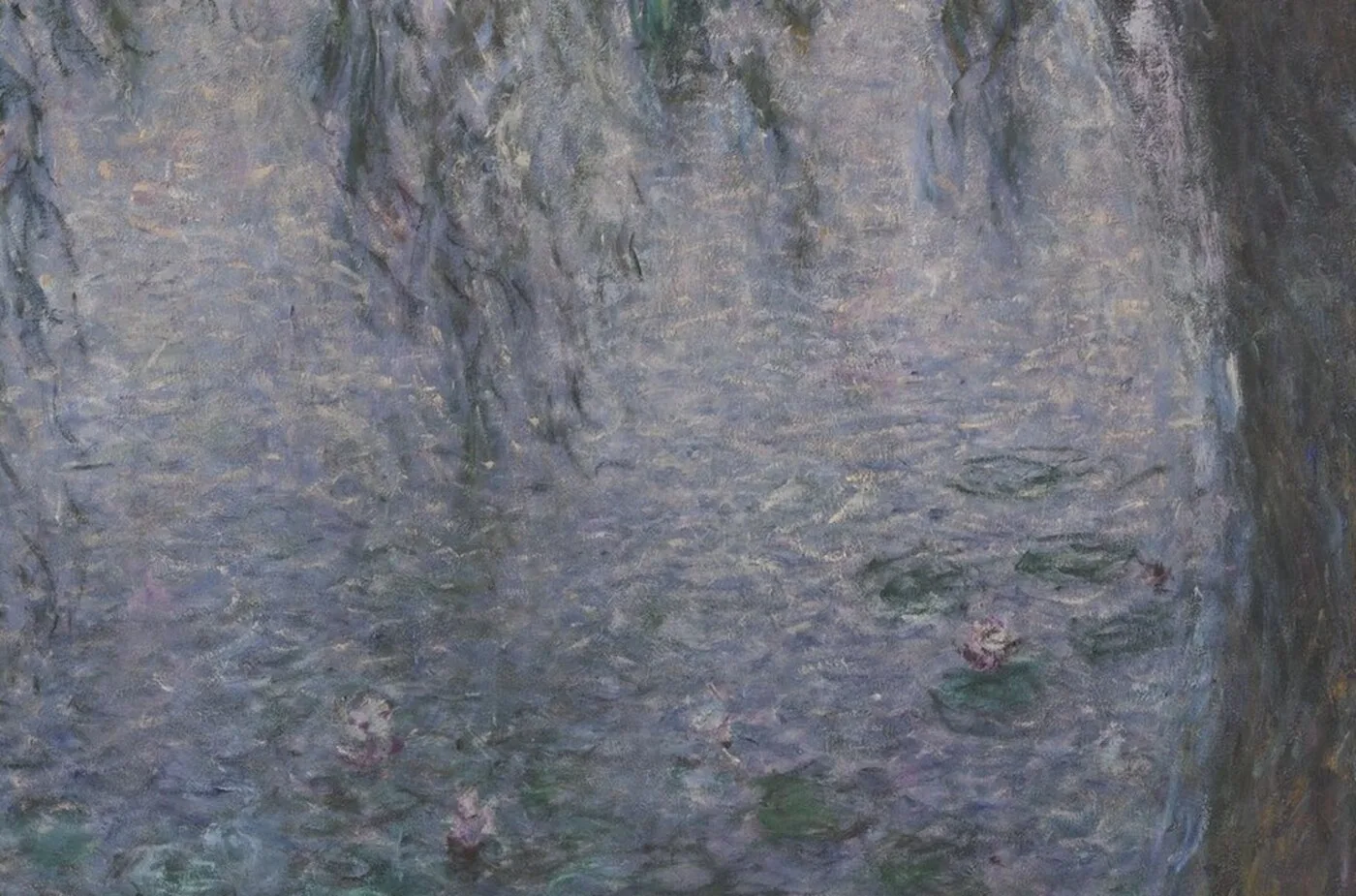
The first hour of light at Giverny is cold. Mist sits on the surface of the pond in a low sheet, the willows drip from the night, and the water is the colour of nothing in particular until the sun clears the trees to the east. Then it turns. Not gold, which comes later, but a thin clean blue with green underneath it, the blue of air rather than of sky.
That hour is short. Anyone who has tried to sit outside and watch it knows the problem: by the time you have looked properly, it has gone. A painter who wanted to record it had perhaps forty minutes a day, in the right season, in the right weather, and then the light thickened and the picture he was making no longer described what was in front of him.
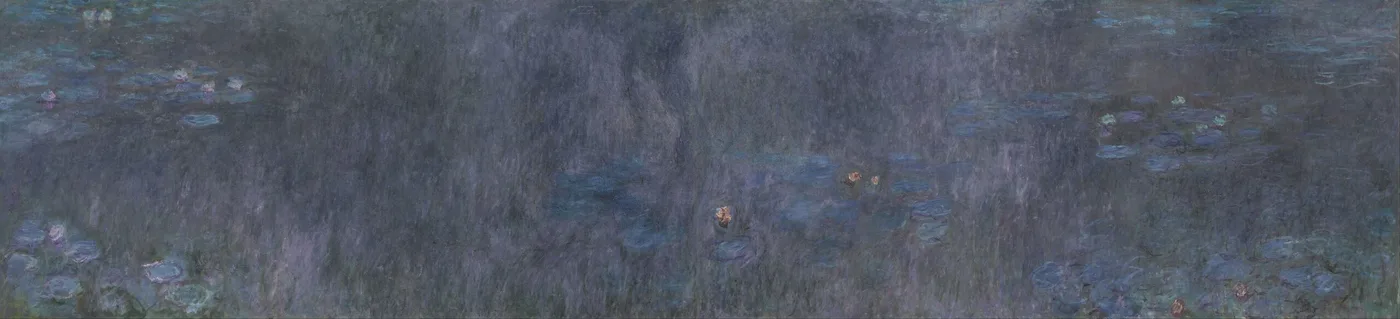
This panel is that hour, held still and stretched to the width of a wall.
Why morning was the hardest thing he ever tried to keep
He had been chasing changing light his whole working life, and by the time of the large decorations he had a method for it. At Rouen in the 1890s he worked from rented rooms opposite the cathedral with many canvases going at once, swapping from one to the next as the light moved, then swapping back the following day when the same light returned. He later wrote of that work giving him nightmares.
The water garden was worse, because water does not hold still even when the light does. A morning breeze crosses the pond and the reflections dissolve; the surface goes opaque; the lilies swing on their stalks. Add mist, which is not weather so much as an argument between air and water, and you are trying to paint a subject that has no fixed edges at all.
His answer, over the last decade of his life, was to stop competing. Rather than fixing one instant, he built these panels slowly, over years, in the studio, from a memory of the pond so worn in that he could reconstruct its behaviour without it in front of him. The morning in this canvas is not one morning. It is the distilled idea of every clear morning he ever stood at that water.
A garden that had to be dug before it could be painted
The pond is not a natural feature and this matters more than it sounds.
He rented the property at Giverny in 1883 and bought it in 1890, once the pictures were selling well enough to make that possible. From 1893 he began the water garden, which required diverting a branch of the river Epte through the land. It also required permission, because local farmers objected; the fear was what a painter’s ornamental plantings might do to water that other people depended on. The Japanese footbridge went up in 1895, and the willows were placed rather than found.
So the subject of this enormous panel is a piece of landscape he designed, planted, engineered and argued for. He spent thirty years painting a thing he had made. That is not a small fact about a picture of a pond at dawn; it is the reason the composition works at all. He knew where every reflection would fall because he had decided where every tree would stand.
The making: cool light, thin paint, and no shore
The large decorations were painted in a purpose-built third studio at Giverny, put up so that canvases of this size could be worked on indoors, on wheeled supports, from 1914 to 1916 onward. Everything about that arrangement shows in the paint here.
Look at the density of the surface. The middle of the picture is thin, brushed out, almost drawn rather than painted; you can see the direction of the strokes running horizontally, following the lie of the water. Toward the edges, where the willow foliage falls in, the paint piles up into short vertical marks in darker green and slate. The contrast is deliberate. The centre is air, the edges are matter.
Note also what he leaves out. There is no bank in this picture. No sky either, except as reflection. The pond has been cropped so hard that the viewer is given no shore to stand on and no upper limit to look toward. That decision made the whole cycle possible: without a horizon line there is no natural size to a painting, so it can run as wide as a wall and still make sense.
The palette is the specific signature of this panel among its neighbours. Where other canvases in the cycle go green, or dark, or hot, this one stays cool. Pale blue, silvered lilac, a green that is closer to grey than to leaf. It is a picture of temperature as much as of a place.
Learning to see it: three passes
People walk past pictures like this too quickly because there is no story on the surface to arrest them. There is one; it is just slow. Try it in three passes.
- First pass, from a distance. Take in the shape of the light. Notice that the brightest area is not at the centre but sits slightly off, and that the willow foliage at the sides is what makes it read as bright at all. Cover one edge with your hand and the whole thing goes flat. The dark edges are the picture’s power supply.
- Second pass, close. Find the lily pads and count the colours in a single one. There will rarely be fewer than four: a pink, a yellow-green, a blue in the shadow beneath, a stroke of white on the upper lip where the light catches. None of them is the colour of a lily pad.
- Third pass, sideways. Stand off to one side and look along the surface. The horizontal strokes in the open water start to behave like actual water, and the vertical strokes at the edges start to hang like branches. The picture only fully assembles when you move.
The last thing to notice is the absence of drama. Nothing happens here. No boat, no figure, no incident. He removed every element that would let a viewer look at the picture and then be finished with it. What is left is a surface that keeps rewarding attention because it never resolves into a single statement.
How it behaves in a real room
This is the coolest and lightest of the pond panels, and that makes it the most forgiving to live with.
It suits rooms that get morning light, obviously, but the more useful point is that it suits rooms that do not get much light at all. Pale blue-green with high internal brightness acts on a dim wall the way a mirror does; it lifts the whole plane and gives a windowless room the suggestion of an opening. North-facing studies, corridors, stairwells and bedrooms that never see direct sun all gain from it.
Against cool white walls it is crisp and restful. Against a deep colour, ink blue or forest green or charcoal, the pale water becomes far more dramatic and the dark willow edges lock into the wall so the picture appears to float. Both readings are legitimate; they are simply different pictures.
Because the composition is horizontal and edge-weighted, it wants width. A bed, a low sofa, a long console, a bath. It is a poor choice for a narrow strip of wall between two doors, where the willow edges get cramped and the open centre has nowhere to go.
Hang it at seated eye level in a room where people sit and at standing eye level in a room where people pass through. And be patient with it. This is a picture that does very little on the first day and then, some grey afternoon three months later, stops you on your way through the room because the water has done something you had not noticed before.
Sizes and materials for The Water Lilies – Clear Morning with Willows are listed on its product page.
More from this collection
Bring this painting home
Choose a hand-painted oil reproduction for real brushwork, or an archival canvas print for a crisp museum-image edition. Every size preserves the original proportions.
View this work & options
Further reading
Verify the original in the Musée de l'Orangerie collection record and continue through related works in the catalogue.