
Haystack near Giverny
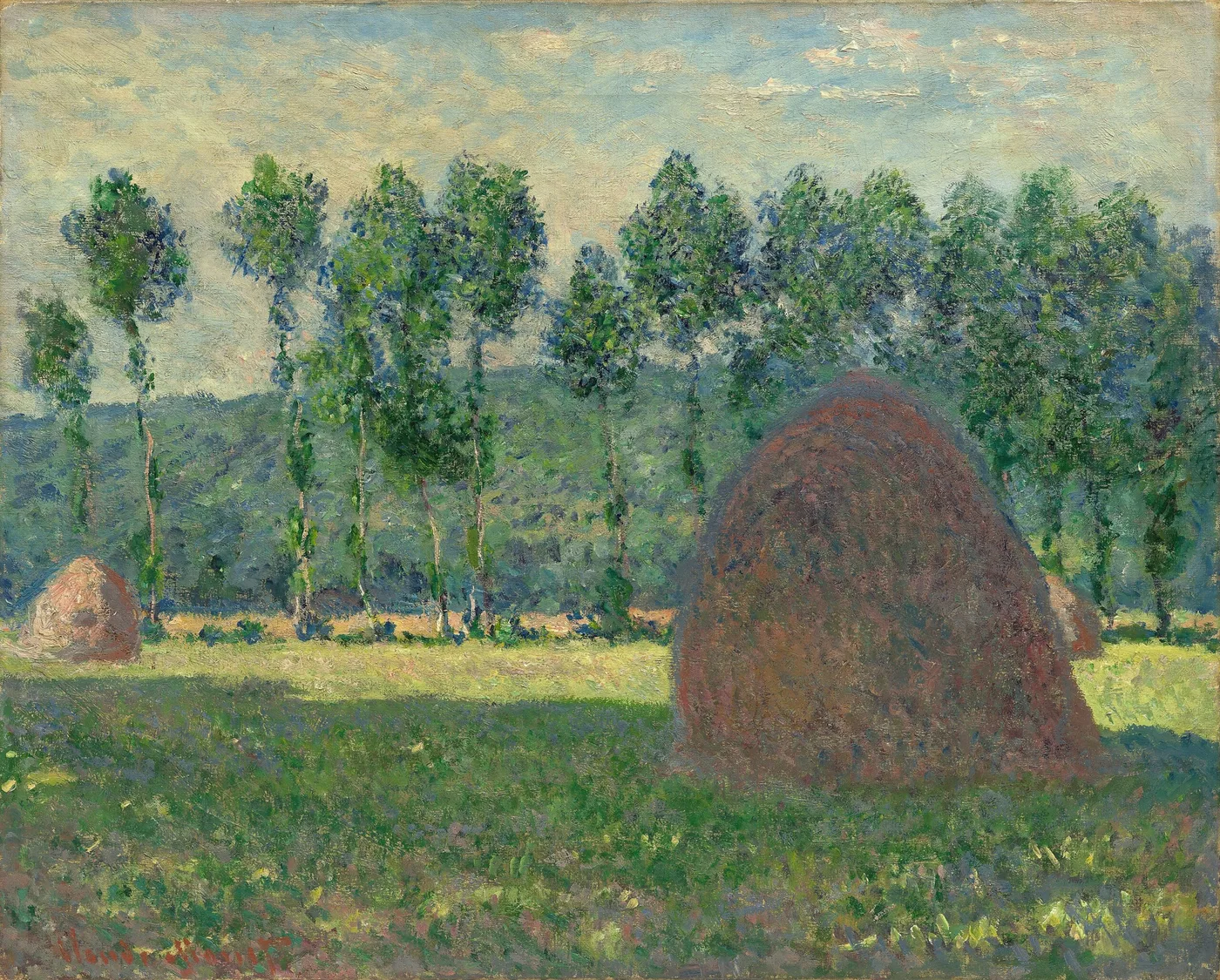
Wet grass at seven in the morning soaks a man to the knee within twenty paces. Add the weight of a canvas, a box of paint and a folding easel with legs that sink into soft ground, and you have the actual physical business of the picture: a middle-aged man walking out of a rented house into a flat river valley to stand in a field that belongs to someone else, in front of a heap of cut wheat that is nobody’s idea of a subject.
Monet had rented the house at Giverny in 1883. This canvas comes from the year after, when he was still a newcomer in a farming village, still working out what the country around him could be made to do. It is worth saying plainly what this painting is not. It is not one of the famous grainstack canvases. Those came later, around 1890 and 1891, when he finally understood what the object could carry. In 1884 he was simply looking at a stack in a field, without a system, without a plan for a series, without any idea that this shape would eventually become the thing his name is attached to.
Somebody else’s property, somebody else’s year
A stack like this is not scenery. It is stored labour. Wheat is cut, gathered and built into a weatherproof mound with a shaped crown so that rain runs off the outside and the grain inside stays dry until it can be threshed. A farmer looking at that shape sees a season of work and a winter of money standing in a field. It is closer to a bank than a haystack.
So the painter carrying his easel into the field is doing something faintly absurd, and he would have known it. The people who built the thing were working. He was looking. There is a long history of city painters going to the country in search of picturesque peasants, and the notable feature of this canvas is that Monet did not do that. There is no anecdote in it. No figure leaning on a pitchfork to tell you how to feel. Just the object, the ground it stands on, and the air around it.
Grief came later. Camille, his first wife, had died in 1879 at thirty-two, and the years that followed were the hardest of his life, professionally and personally. By 1884 he was rebuilding something: a household, a working routine, a place. A man who paints the same field for the next thirty years is a man who has decided to stop moving.
The making
This is single-session weather painting, or close to it. The picture had to be caught while the conditions held, which is why the handling is quick and directional and the paint is thin in places where the ground still shows through.
Watch how the stack is built. Short, curved, following strokes that ride the form, so the brush marks themselves report the roundness of the thatch. Now compare that with the field. The ground is painted in a different rhythm, flatter and more horizontal, laid in strokes that run across the picture rather than around a form. Two kinds of mark for two kinds of thing. That is the whole grammar of outdoor painting in one canvas.
The colour of the shadow is where the real work is. The shadowed side of the stack is not brown, and it is not the local colour of straw made darker. It carries blue and violet borrowed from the sky above it and green bounced up from the grass beneath it. Shadow, in this way of working, is not an absence of light. It is light arriving from a different direction, with a different colour.
A field is a workshop without walls
The practical conditions of this kind of painting are rarely described, and they explain a great deal about how the picture looks. There is no shelter. The light changes continuously, which means the shadow you began painting has moved by the time you reach the other side of the canvas. Wind lifts dust and seed onto wet paint. Insects land in it and stay there. The ground is soft, so the easel settles unevenly over the course of an hour and has to be reset.
Then there is the question of when to stop. A studio painting can be worked for weeks. A field painting has a natural deadline, because when the sun has moved far enough the subject you came for no longer exists, and continuing means painting a different day onto the same canvas. Every experienced outdoor painter knows the specific misery of a session that has gone on too long, where the picture is being slowly destroyed by conscientiousness.
You can see the discipline in the paint. Passages are laid down once and left. There is very little scraping back, very little correction, almost no fussing at edges. Where an area is thin, it stayed thin. That is not casualness. It is a man working at speed and knowing that the first statement of a colour relationship, made while looking, is usually more truthful than the third one, made while thinking.
And then there is the walk home carrying a wet canvas and a loaded box across a field, which is its own argument for painting quickly.
What to look at now
- Find the base of the stack. Notice that it does not sit on the field with a clean cut line. It is bedded into the grass, its edge broken and interrupted, which is what makes the mass feel heavy rather than pasted on.
- Compare the lit side and the shaded side and try to name the actual hues. Most people say gold and brown. Look again and you will find rose, green and lilac doing most of the labour.
- Trace the horizon. It is low, quiet and softly stated, so the stack is allowed to dominate a very large amount of empty sky and field. Almost nothing else in the picture competes.
- Stand back and check the silhouette. The stack reads as a single clean shape at any distance. That legibility is why Monet came back to this motif for years afterwards.
The picture that taught him what to do next
There is a reason this canvas is more interesting than its modest subject suggests. Six or seven years after it, Monet would take exactly this shape and use it to prove that light, not objects, is the real content of a painting. He would set up several canvases at once and swap between them as the sun moved, and he would do that with a stack, not a cathedral or a person, because a stack is stupidly simple. A simple shape lets everything else be about light.
You can see the discovery being made here, before he knew he was making it. The stack is already reduced. The story is already gone. What is left is the ordinary miracle that a heap of dried grass, lit from one side, is a small event of colour.
How it behaves on a real wall
Landscape format, low horizon and one strong central mass make this one of the easiest of Monet’s motifs to live with. The composition is calm and the eye settles quickly, which means it works in rooms where you do not want the art to raise its voice: a bedroom, a dining wall, a corridor with a long approach.
The palette is warm and earthy with cool shadow notes, so it sits well with oak, wool, terracotta, stone and any wall colour in the cream to clay range. On a cold blue-grey wall it becomes noticeably more golden by contrast, which is a genuinely different picture and worth trying if you have the option.
Give it good general light rather than a hard spot. The subtleties in this canvas live in the shadowed half of the stack, and a bright directional beam will flatten exactly the part you want to be able to read. And hang it low enough that the horizon sits near your own eye line when standing. Field paintings work best when the ground appears to run out of the frame toward your feet, which is, after all, how it looked to the man standing in the wet grass.
Sizes and materials for Haystack near Giverny are listed on its product page.
More from this collection
Bring this painting home
Choose a hand-painted oil reproduction for real brushwork, or an archival canvas print for a crisp museum-image edition. Every size preserves the original proportions.
View this work & options
Further reading
Verify the original in the Pushkin Museum of Fine Arts collection record and continue through related works in the catalogue.