
Water Lilies
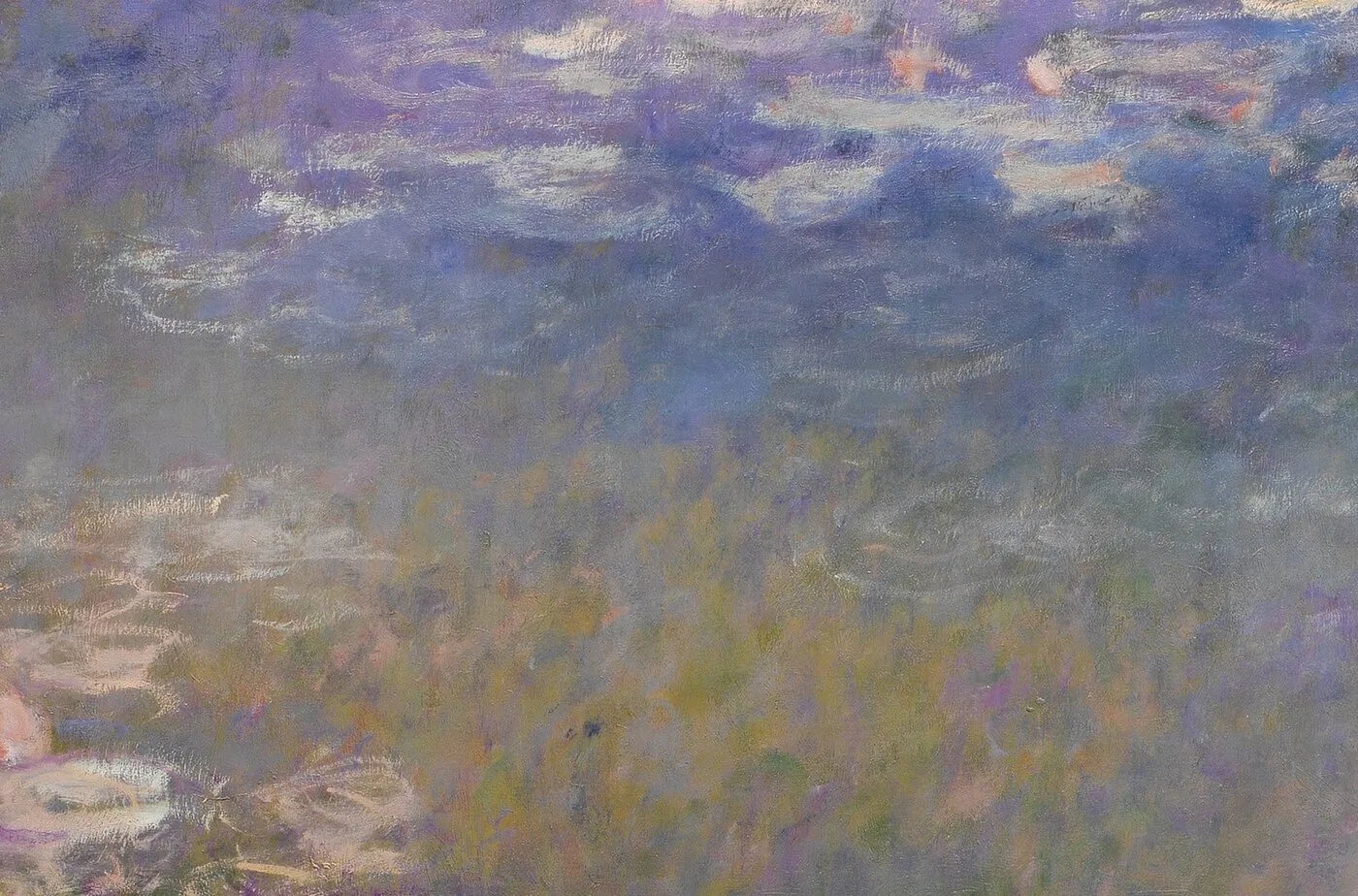
Stand in front of this canvas and try to work out where you are standing. There is no bank. There is no far shore, no sky above the water, no tree line, no boat, no horizon. You are not looking across a pond. You are looking down into one, close enough that the surface fills your entire field of vision, and the only thing telling you which way is up is the way the lily pads lie flat while the reflected clouds fall away into depth.
That disorientation is not an accident of composition. It is the destination of thirty years of work, and it was reached by a man approaching eighty who could no longer trust his own eyes.
The pond was his own doing
Monet rented the house at Giverny in 1883 and bought it in 1890. From 1893 he began digging the water garden, diverting water to make a pond, and in 1895 he put a Japanese footbridge across it. Everything in this picture, every lily, every reflection, every dark under the leaves, is growing in a body of water that would not exist if he had not ordered it dug.
That is a strange position for a landscape painter. Most of his life he had gone out and found subjects: coastlines, harbours, a field of grainstacks, a row of poplars he ended up buying at auction to stop them being felled. The pond was different. He made the motif, then spent the remaining decades of his life painting it. By 1920 he had been at it for a quarter of a century and had still not exhausted it.
Painting with unreliable eyes
Cataracts were diagnosed around 1912. He did not have surgery until 1923. That is roughly eleven years of watching his own instrument fail, and this canvas sits near the middle of that period.
What cataracts do is not simple blurring. They yellow and thicken the lens, so cool colours die first. Blues and violets drain away, everything shifts warm, and fine distinctions in the darks collapse. A painter who had spent fifty years building his entire method on the exact temperature of a shadow was now being fed corrupted information by his own eyes, and he knew it.
He kept working. He painted very large, in broad sweeping runs of loaded brush, on canvases scaled so that the marks needed to be big and confident rather than small and exact. Where an earlier version of him would have placed a precise cool note against a precise warm one, the late work moves in long tangled skeins of colour laid over and into each other, correcting as it goes.
You can read that as decline. It is more honest to read it as adaptation. The late pond pictures are not the work of a man failing to do what he used to do. They are the work of a man changing his scale, his handling and his ambitions to match what he could still reliably see, which was mass, movement and heat, rather than detail.
There is also a purely physical dimension to this that gets left out of the romantic version. Painting large is hard labour. A big canvas has to be moved, propped, reached across. Working the upper half means standing on something. Working the lower half means bending, or sitting, and holding the arm out at full stretch for hours at a time. Monet was approaching eighty when he made pictures at this scale, and the marks in them are long, continuous, whole arm gestures rather than the small wrist movements of a man being careful. Every one of those strokes was a physical commitment from a body that was old. That is part of what you are looking at, and it is why the paint has the quality of something driven rather than applied.
How to actually look at it
Start with the lily pads, because they are the only literal objects in the picture. They lie flat. They are drawn as ellipses, more circular near the top of the canvas and more compressed lower down, and that compression is the only perspective cue in the entire image. Follow those ellipses and you can feel the water plane tilting away from you.
Now do the opposite and look at the darkest passages between the pads. Those are not shadows on a surface. They are depth, the reflected undersides of things above the pond, and they read as holes. The picture is constantly asking your eye to accept two contradictory things at once: a flat surface covered in floating discs, and a bottomless vertical space full of reflected sky.
Look at the direction of the strokes. Horizontal marks lie down and become water. Vertical and diagonal marks stand up and become reflection. He is using the angle of the brush itself as a depth instruction, and once you notice it you cannot stop seeing it.
Then step back until the individual marks dissolve. From two metres the tangle resolves into light on water. From thirty centimetres it is a field of separate coloured gestures with bare canvas occasionally showing between them. Most paintings look best from one distance. This kind is built to be two different pictures depending on where you stand.
One last exercise. Try to find the top of the pond, meaning the point where the water would meet the bank if the bank were included. It is not there. He has cropped the motif so that water fills the frame edge to edge, which means the picture presents itself as a fragment of something continuing beyond it in all four directions. That single decision is why these late canvases feel less like views and more like environments.
What it does to a room
A picture with no horizon does something no landscape can do: it does not tell the room which way to face. There is no sky at the top demanding to be level with the ceiling, no ground line arguing with your furniture. It functions as a field of colour that happens to be readable as water.
That makes it exceptionally forgiving to hang. It works above a bed, over a low console, at the end of a corridor, or in a room where the wall is not quite square, because there is no strong internal geometry to expose the flaws in the architecture around it.
It also behaves like a mood regulator. The late pond palette runs through green, violet, deep blue and small hot notes for the flowers, and in changing daylight the balance between them genuinely shifts. Morning light lifts the greens. Evening lamplight brings the violets and the warm undertones forward. A room with this in it looks slightly different at four in the afternoon than it does at nine at night.
Give it size if you can. These images were conceived at scale, and a small reproduction turns the marks into texture rather than gesture. The larger it is, the closer you can stand, and standing close is where the picture stops being a pond and becomes pure paint.
The last subject
The water garden held him for the rest of his life. He had the pond dug, planted it, put a bridge over it, watched it mature, and then painted it through his own gradual blinding, through the war years, into extreme old age. There is something stubborn in that which the serenity of the surface tends to hide. This is not a peaceful picture made by a peaceful man. It is a peaceful picture made by someone who would not stop.
The canvas is held by The Nelson-Atkins Museum of Art. What people notice standing in front of it is how physical it is: ridges of paint, dragged edges, places where a colour was put down and immediately dragged through with another. The calm is on the surface. Underneath it, the whole thing is effort.
Sizes and materials for Water Lilies are listed on its product page.
More from this collection

Bring this painting home
Choose a hand-painted oil reproduction for real brushwork, or an archival canvas print for a crisp museum-image edition. Every size preserves the original proportions.
View this work & options
Further reading
Verify the original in the The Nelson-Atkins Museum of Art collection record and continue through related works in the catalogue.