
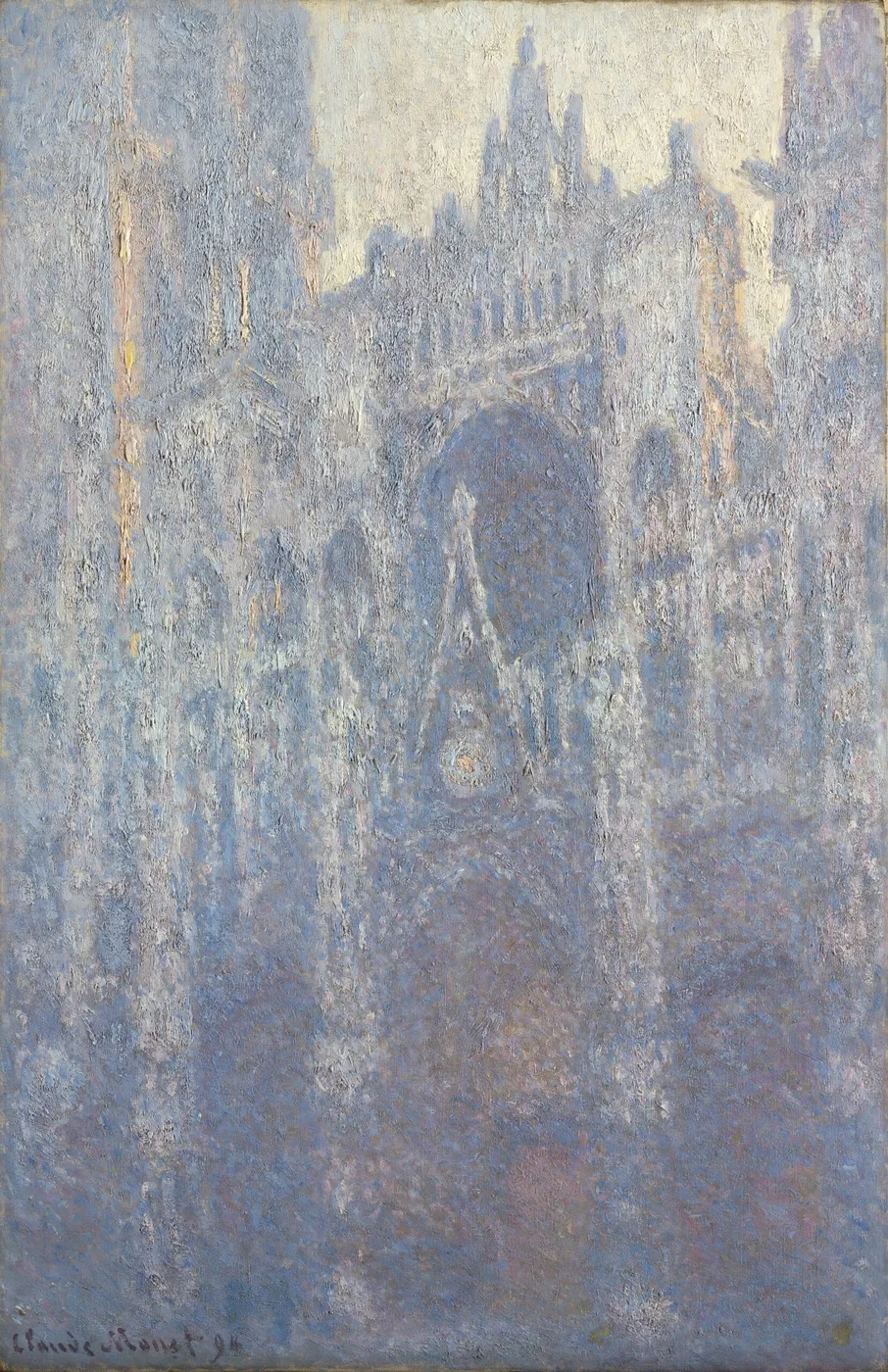
Rouen Cathedral, Portal, Morning Light
Picture the studio rather than the cathedral. It is 1894, and the walls of the room are lined with paintings of the same building. Twenty and more of them, one facade repeated at every hour a facade can be seen, propped on chairs and ledges and against the skirting. A man in his fifties walks along the row with a brush, adding a touch here, cooling a passage there, standing back, moving on. He is not painting Rouen any more. He is tuning it.
This is the part of the story that gets left out. The Rouen campaigns happened in 1892 and 1893, in rented rooms facing the west front, with many canvases running at once so that each could be matched to a returning condition of light. But the pictures were not finished there. They came home unresolved and spent a year being brought into agreement with one another before they were shown in 1895. A morning canvas like this one is therefore two things at once: a record of a specific cold hour in front of the stone, and a considered object made long afterwards by a man with all the other hours in front of him.
The hour before the sun arrives
Early morning on a west-facing facade is a peculiar situation, because the sun is rising behind the building. The sky above and past the towers is already bright and rapidly warming. The stone itself is still in its own shade, holding the blue of the night that has not yet been burned off.
So the facade in this painting is not lit in the way people expect a sunny picture to be lit. It is cool, luminous, faintly pearled, and the light appears to be soaking through it rather than striking it. The portal is a well of blue. The upper stonework catches the first thin warmth, and there is a moment of pale rose where the tower reaches into open sky.
Anyone who has been out early knows the feeling of that half hour. The air is cold enough to notice, the street below is quieter than it will be all day, and the building looks like a thing that has been standing there all night, which it has.
Why he said it gave him nightmares
The enterprise had a design flaw at its heart, and Monet knew it. He had made a fugitive event the subject of a slow medium. Oil paint takes time. Light does not give you any. On top of that, he had committed to a set, which meant that no single canvas could be judged alone. Each one had to be true to its hour and also correct relative to twenty others.
He described the work as tormenting and said it gave him nightmares, and the morning canvases are where you feel the difficulty most, because morning light is the least stable light of the day. It changes character in minutes, not hours. The cold blue phase this picture sits in is over almost as soon as it starts.
The studio year in 1894 was the resolution of that impossible position. Not cheating, exactly. Rather an admission that a picture of a moment cannot actually be finished inside the moment, and that memory, comparison and judgement have to finish what observation began.
What a series is actually for
People sometimes assume a series is a commercial device, a way of making several paintings out of one idea. The opposite is true here, and it cost him more than a scattering of separate pictures ever would have.
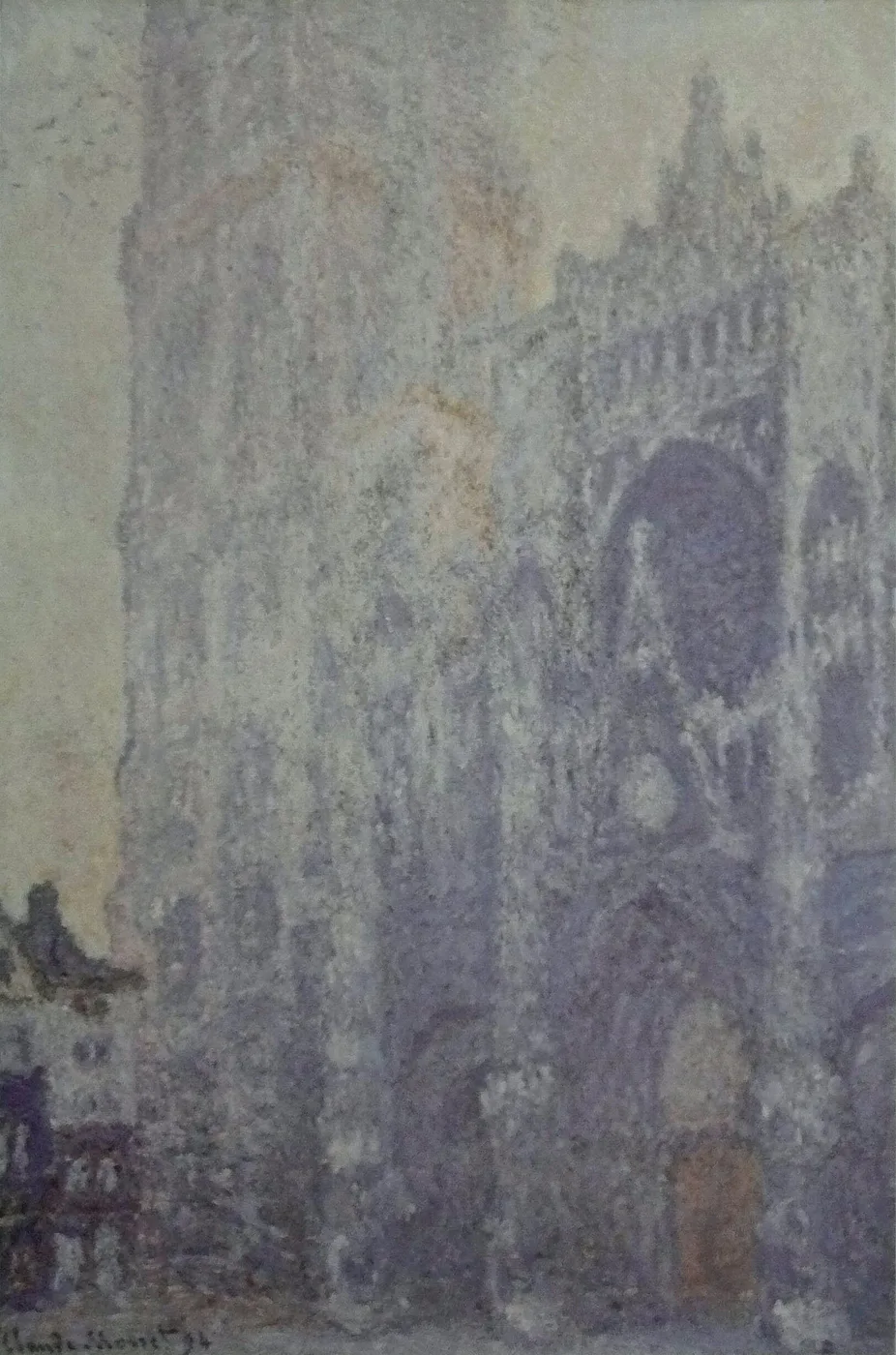
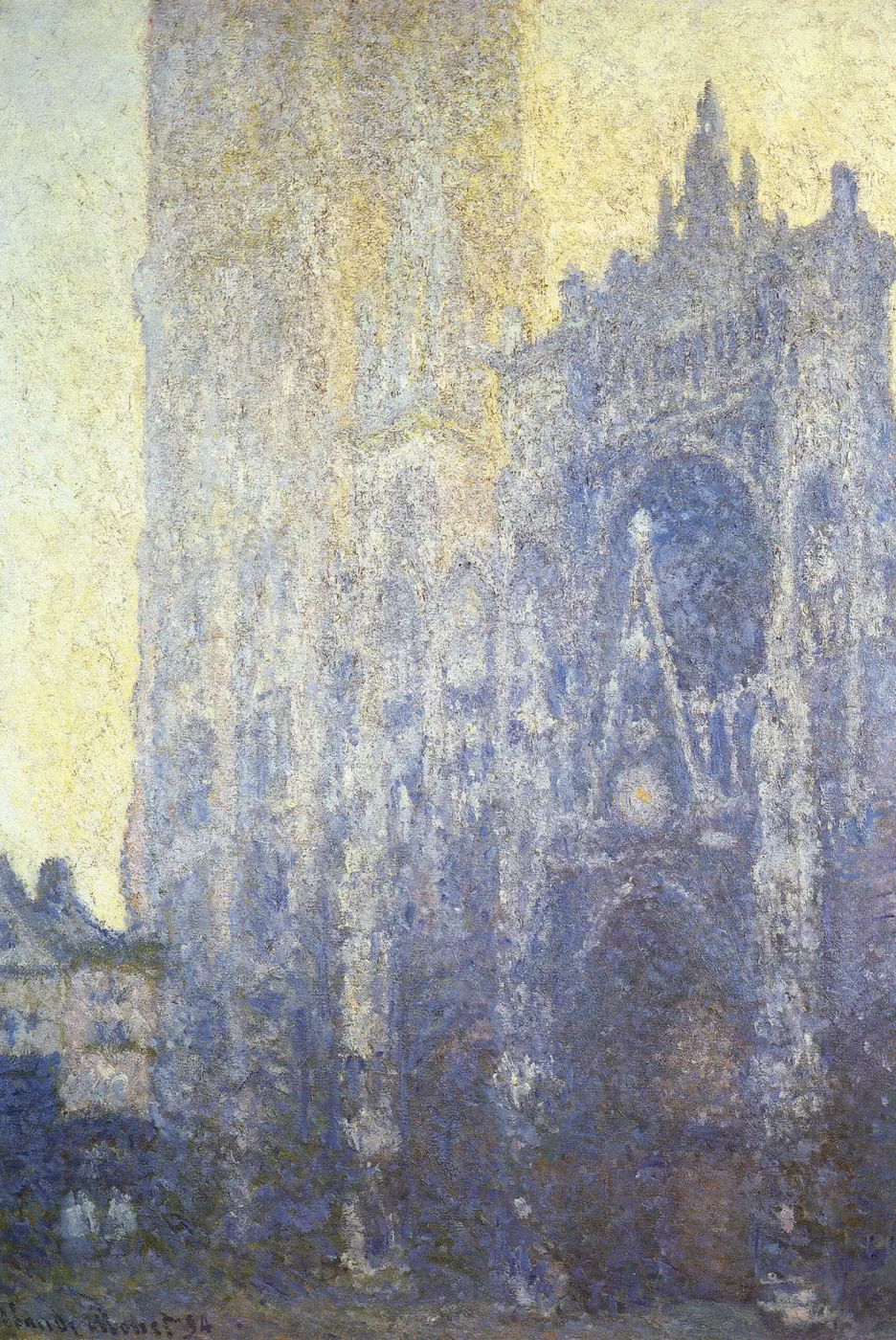
A single canvas of a cathedral at dawn is a nice picture of a building in the morning. Twenty canvases of the same building at twenty hours is a demonstration, and what it demonstrates is that the appearance of a thing is not a property of the thing. Put the morning version beside the noon version and you cannot pretend they show the same object. The stone is a constant. Everything you actually see is a variable.
That is why the year of studio work in 1894 was not optional. A series has to be internally consistent to make the point. If one canvas is pitched slightly wrong, the argument leaks. So the pictures were adjusted against each other, hour by hour, until the set behaved like a scale.
The consequence for this particular canvas is that it is both a solitary painting and a member of a family. It works alone, as a cool blue front lit from behind, and it is also the note struck at one end of a sequence. When people saw the series shown in 1895, it was the first time many of them had experienced a wall of one subject repeated. Nothing in painting had trained an audience to look that way. You are, in a sense, still doing something novel when you look carefully at one of these.
The surface, and what it is imitating
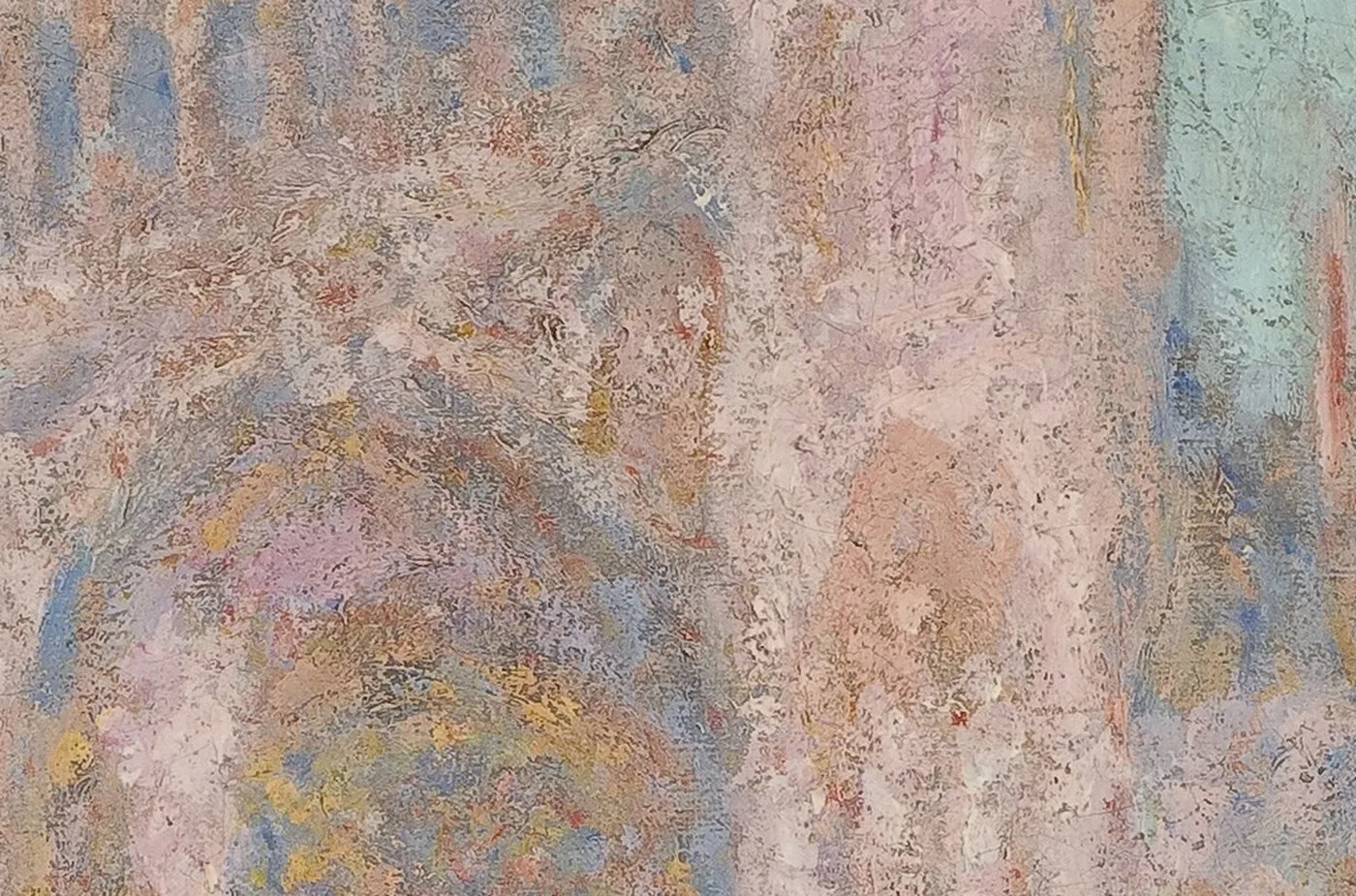
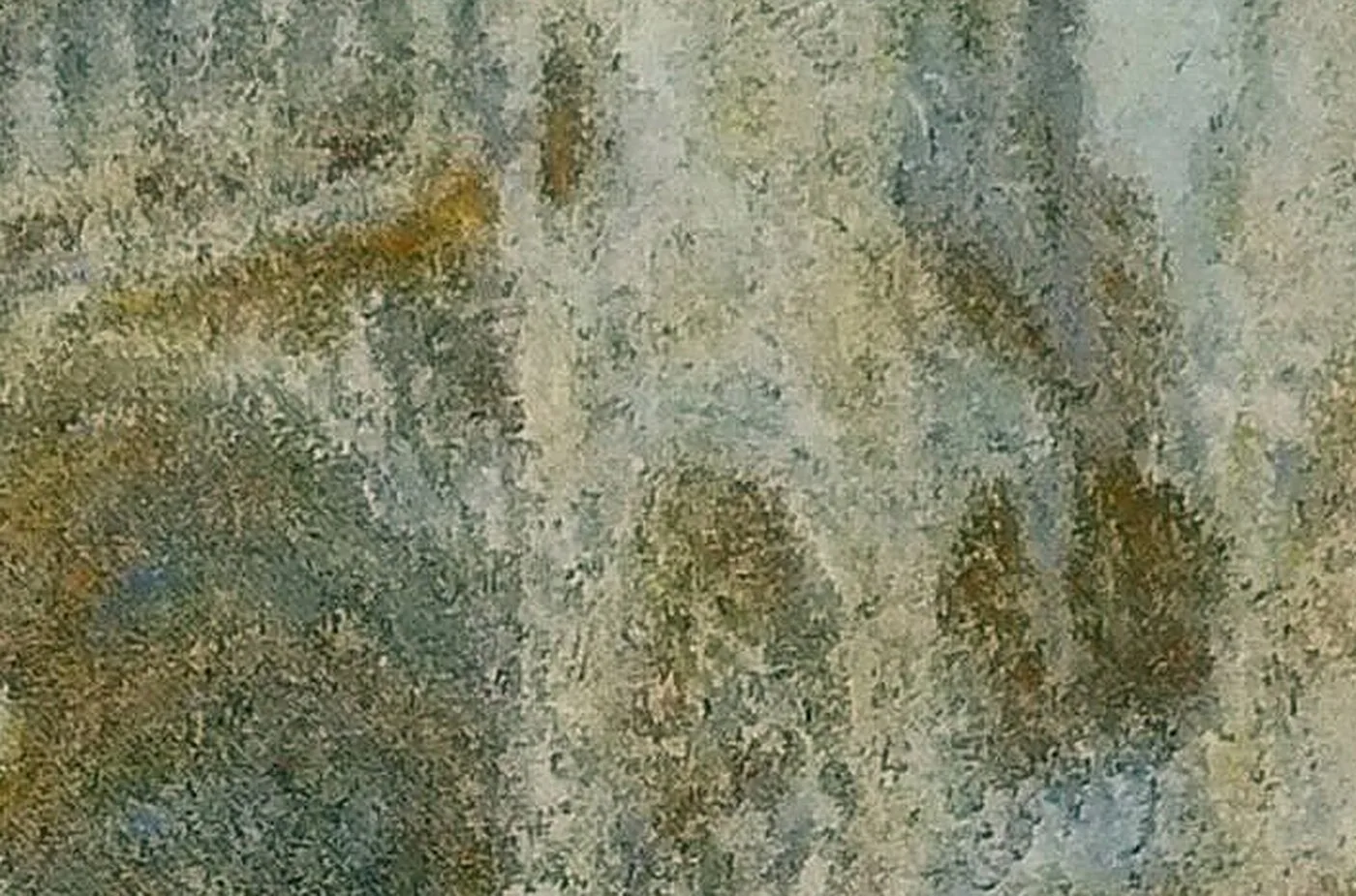
Get close. The paint is thick, crusted, laid in clotted touches that stand up off the canvas. Gothic stone at close range is pitted, weathered and rough, and Monet gave his picture of it an equivalent skin. That decision does two things. It makes the painting a physical object that catches raking light in a real room, and it dissolves the drawing, so that no line in the picture is ever crisp.
The colour method is consistent throughout the series and it is easiest to see in a morning canvas. Shadows are made of blue and violet rather than brown. Highlights are made of pale rose, cream and green rather than white. Nothing is a single mixed tone. Every square inch is a weave of neighbouring colours that resolve at distance.
Reading the picture
- Find the coldest blue and the warmest note in the painting and note how far apart they are on the canvas. In this version the warmth is high and the cold is low, which is the signature of a sun still climbing behind the building.
- Look into the portal arch and let your eye settle. What reads as a dark hollow separates, after a moment, into several distinct cool colours.
- Check the edges against the sky. They are soft and broken. At this hour, with strong light behind a mass, the outline genuinely does dissolve.
- Find the viewing distance where the stone snaps into architecture. It is usually two or three paces further back than you expect.
How it behaves on a real wall
Morning canvases are the coolest members of the series and the easiest to live with in a modern interior. The dominant blues, pearl greys and pale roses read almost as a neutral from across a room, and the picture holds its composure in daylight instead of demanding a spotlight.
It is at its best in a room with north or east light, which flatters the cool half of the palette. In a very warm lamp-lit room the blues turn slightly grey and the picture loses some of its dawn quality, so if the room is warm at night, aim the lighting cooler or accept that you own an evening version and a morning version of the same object.
Vertical format, heavy central mass, very few incidents: this wants a clear wall with margins on both sides and nothing hung beside it. It pairs well with cool plaster, pale grey-green, dark wood and any wall that leans blue. It fights with strong yellows and with busy pattern. Hang it slightly above eye level and light it from one side so the built paint catches, and it does something few pictures manage. It makes a room feel like early morning at any hour you happen to walk in.
Sizes and materials for Rouen Cathedral, Portal, Morning Light are listed on its product page.
More from this collection
Bring this painting home
Choose a hand-painted oil reproduction for real brushwork, or an archival canvas print for a crisp museum-image edition. Every size preserves the original proportions.
View this work & options
Further reading
Verify the original in the J. Paul Getty Museum collection record and continue through related works in the catalogue.