
The Manneporte (Etretat), 1883: Two Figures Beneath the Arch
Two Figures Beneath the Arch
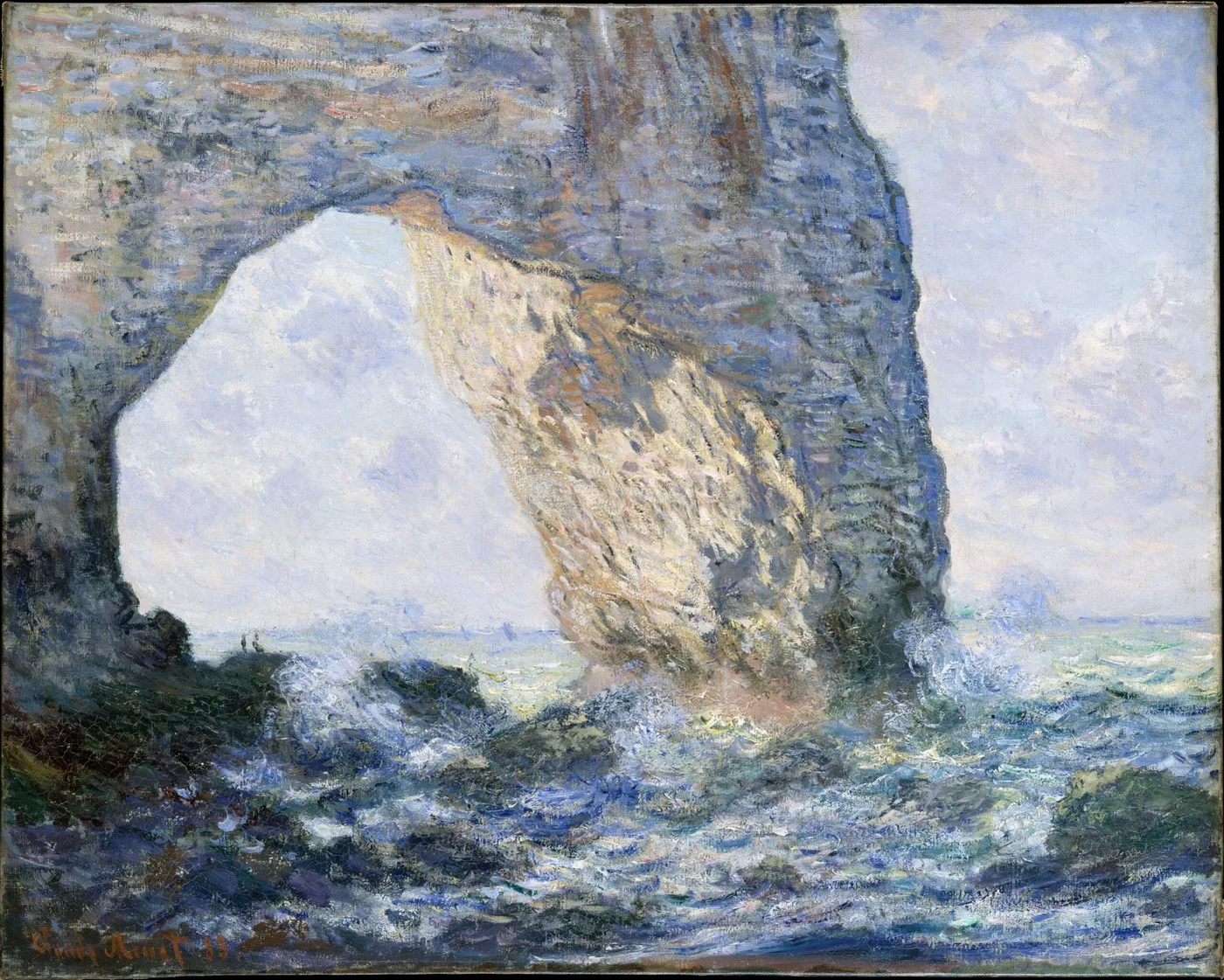
Two tiny figures appear on the rocks beneath the left side of the arch in Claude Monet’s The Manneporte (Etretat). They are easy to miss among the dark ledges and pale spray. Once noticed, they give the cliff a human scale: the opening rises far above them, while broken waves fill the foreground.
The rock enters from the top and left edges of the canvas. Its broad outer face curves down towards the sea on the right. Through the opening, a pale stretch of sky meets the distant water. Another expanse of sky lies beyond the cliff’s outer edge. The arch divides these two light areas.
Monet painted this canvas in 1883. The Metropolitan Museum of Art places his visit to Étretat mainly in February and records twenty views of the beach and nearby rock formations. The Manneporte was one of several subjects in that coastal campaign. This canvas presents it from close enough for the upper rock to continue beyond the frame.
Start with the curve above the two figures, then follow it towards the massive supporting rock at the right. The lower outline becomes difficult to separate from foam and scattered rocks. That change from a clear opening to a broken waterline is one of the picture’s most useful details to examine.
Warm Rock, Violet Shadows and Broken Water
The cliff is made from many small passages of colour. Cream and pale yellow sit beside pink, grey and blue. Across the upper face, rows of short marks suggest layers in the rock. Towards the underside of the opening, those marks become darker and bluer. The curved edge remains legible even where individual strokes interrupt it.
A warmer band descends diagonally through the central face. Beside it, the outer edge of the supporting rock is cooler and darker. These adjoining passages help the rock turn from the sunlit face towards the shadowed side. Narrow pale marks follow the sloping surface, crossed by shorter blue and grey touches.
The sea has a different pattern. Blue and green strokes run across the foreground, crossed by pale ribbons of foam. Near the central rocks, the marks bend and climb. Farther away, the water settles into a thinner horizontal strip. The changes in direction distinguish the breaking water from the distant sea.
At the lower left, the dark shore is interrupted by reddish-brown and blue marks. It joins the shadowed base of the arch and the ledge beneath the two small figures. Monet’s orange signature appears nearby, across the dark foreground rocks.
Finding the Scale Without Losing the Surface
The figures’ small size lets the eye compare a person with a ledge, then the ledge with the arch above it. They remain a minor detail in a composition largely occupied by rock and water. Follow the dark ledge towards the left edge to see how little space the pair occupies beneath the opening.
The two areas of sky also deserve attention. Seen through the arch, the pale background makes the inner curve easy to trace. Beyond the right edge, a larger light area meets the cliff’s uneven silhouette. The same pale atmosphere therefore borders the rock on both sides of its supporting mass. The gaps between fronds in Palm Trees at Bordighera offer another place to follow light areas between darker shapes.
Move between those broad shapes and the smaller marks. The opening can be followed as one continuous curve, but its boundary contains separate blue, grey and cream touches. The sea can be read as a band across the bottom, then examined as overlapping strokes. Both ways of looking are available in the same image.
A comparison with Monet’s sunlit Rouen Cathedral offers another way to follow patches of colour across a solid subject. Here, the curved opening and the water breaking at the base give the cliff its particular structure. Keep those features in view when comparing it with other Monet landscapes.
Identifying the Met Canvas
The Met’s collection record identifies this oil on canvas as accession 51.30.5. The recorded dimensions are 25 3/4 x 32 in. (65.4 x 81.3 cm), with height given before width. These are the original painting’s dimensions, separate from the outside measurements of a frame or the sizes offered for a reproduction.
The title and year help distinguish this work from other views of Étretat. When comparing images, check the placement of the opening, the small figures on the left-hand rocks and the broad supporting face towards the right. A coastal landmark can appear in several paintings without their arrangements or dimensions being interchangeable.
Keeping the Whole Coastal Composition
The Manneporte reproduction page offers the hand-painted oil edition as the main option, with a canvas art print also available. The product page sets out the current sizes and presentations. Use those options when choosing a piece; the museum measurements describe the original canvas.
The complete arrangement includes the dark rocks at the left, the tiny figures, the pale opening and the foreground water. A close crop of the central cliff would leave out part of that relationship. Before choosing a size, compare the whole composition with the space available on the wall.
A hand-painted oil reproduction is made with new strokes of paint. The print reproduces the appearance of the original marks within the printed image. Both versions keep the arch, the figures and the water in the same arrangement; the chosen medium changes how that image is made.
Questions About This View of Étretat
Are there people in The Manneporte?
Yes. Two very small figures appear on the rocks beneath the arch towards the left. They help establish the scale of the cliff. Look just above the dark ledge where the pale opening meets the sea.
Which painting does this page describe?
It describes the 1883 Met canvas, accession 51.30.5. Its opening, supporting rock, foreground waves and small figures identify this particular composition among Monet’s views of the Étretat coast.
What colours should I look for?
Look for cream, pale yellow and pink across the brighter cliff face, with blue-grey and violet passages around the shadowed arch. Blue-green water and pale foam cross the foreground. The sky is visible through the opening and to the right.
Is a hand-painted oil reproduction available?
Yes. The main product option is a reproduction painted by hand in oils, and a canvas art print is available as an alternative. The product page gives the current sizes and presentation choices for each option.
More from this collection
Bring this painting home
Choose a hand-painted oil reproduction for real brushwork, or an archival canvas print for a crisp museum-image edition. Every size preserves the original proportions.
View this work & options
Further reading
Verify the original in the The Metropolitan Museum of Art, New York collection record and continue through related works in the catalogue.