
Grainstacks, in Bright Sunlight
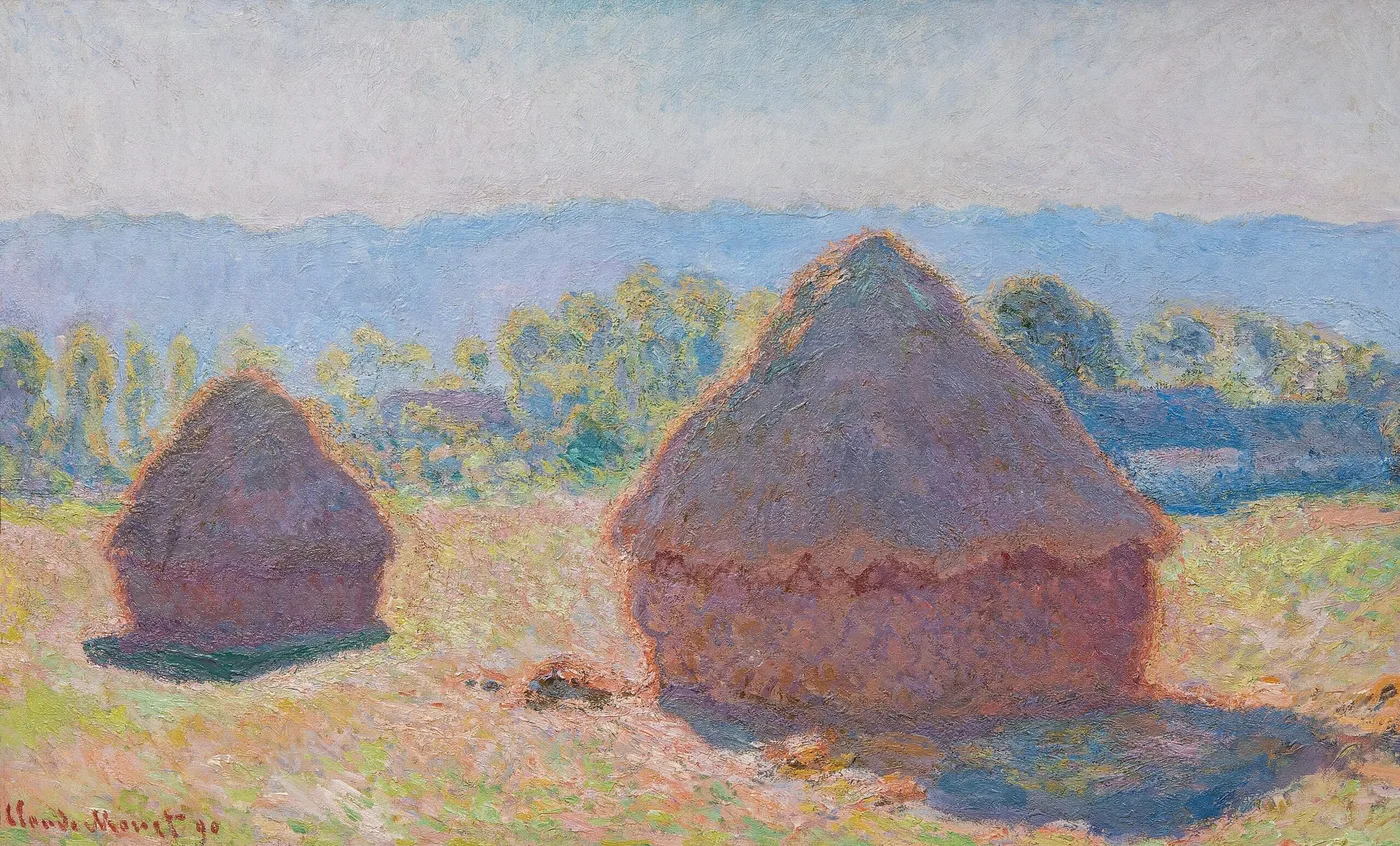
Midday is supposed to be the worst possible hour for a landscape painter. The sun is overhead, shadows shrink to almost nothing, form flattens out, and everything looks bleached and characterless. Every piece of conventional advice says wait for the morning or the evening.
This canvas is what happens when someone goes out at exactly the wrong hour on purpose.
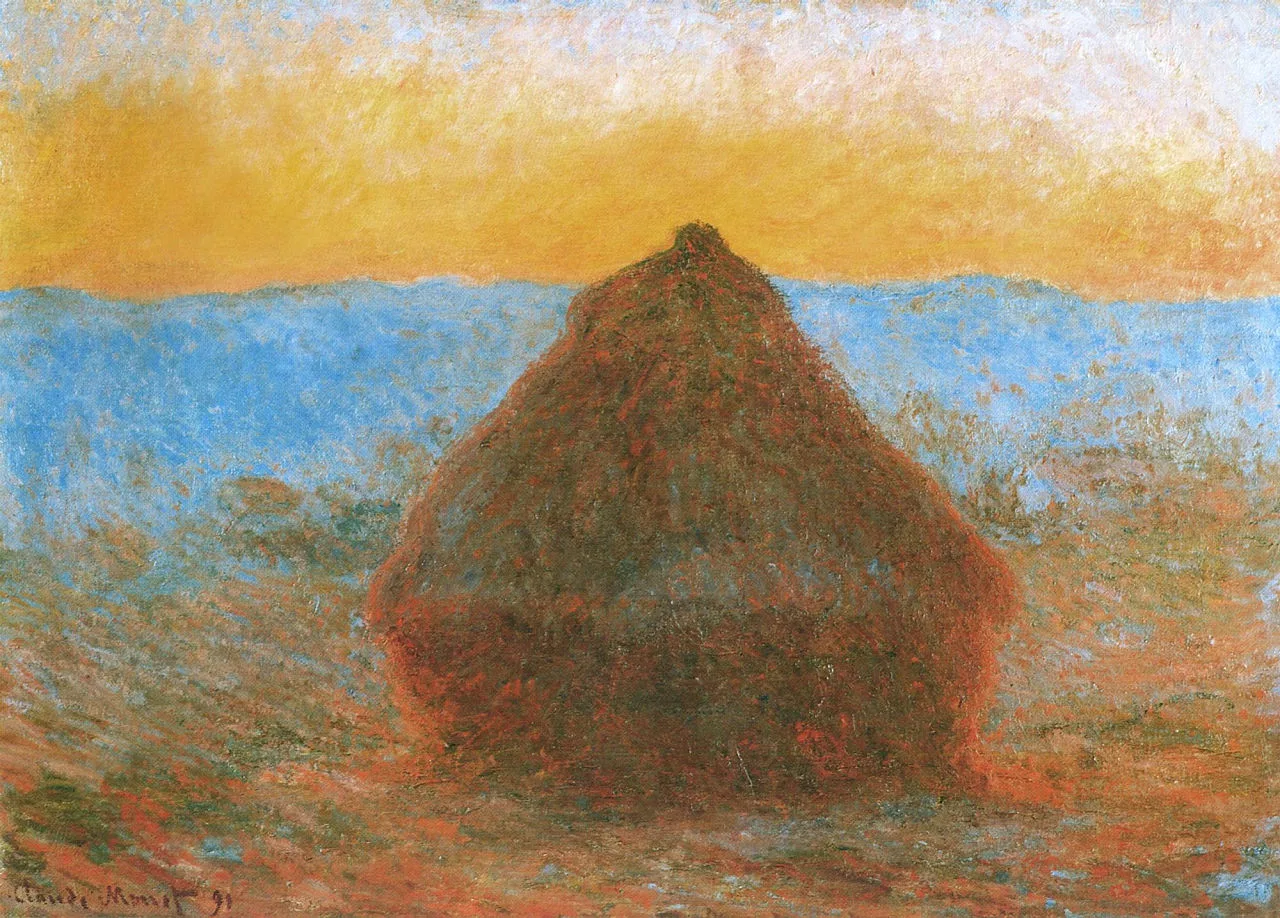
The light here is high and hard. The shadows are short and sit close under the stacks rather than stretching across the field. Colour has been driven to its extremes: the lit straw is almost aggressively hot, the shadow beneath is a dense cold note, and there is very little polite middle ground between them. It is not a gentle picture. It is a picture about glare.
The year he realised one canvas would not do
1890 was the year Monet bought the house at Giverny that he had been renting since 1883, and it was the year the grainstacks in the field near it began to take him over. What started as a subject became, over that year and the next, a campaign.
The story that always gets told is that he went out to paint a stack, found the light had moved before he was done, sent for a second canvas, then a third, and never really stopped. Whether or not it happened in exactly that order, the logic of it is visible in the paintings themselves. He ended up carrying several canvases into the field at once, setting them up together, and rotating between them as the conditions changed, returning to each only when the light that started it came back.
What that method admits is something the entire tradition of landscape painting had been quietly avoiding: that a picture painted over four days is not a picture of a moment, it is an average. If you actually want the truth of one hour, you have to paint only in that hour, which means you need one canvas per hour, which means the subject stops being the stack and becomes time itself.
The pictures sold quickly and successfully through his dealer Durand-Ruel. After decades of being the painter whose work looked unfinished to people with money, he had finally made something that a market wanted faster than he could produce it. The security that followed is what funded everything afterwards: the poplars along the Epte that he bought at auction in 1891 to keep them from being felled, and eventually the water garden he dug from 1893 and painted for the rest of his life.
What bright sunlight actually does
Strong overhead light does three specific things, and all three are on this canvas.
First, it compresses the shadow. A grainstack in raking evening light throws a shadow several times its own length. At midday it throws a small, dark, concentrated pool that hugs the base. That anchors the stack to the ground hard, and it makes the whole picture feel heavier and more planted than the evening versions.
Second, it raises the key of the ground. A stubble field under full sun becomes almost blinding, a pale scorched surface with very little visible texture, because the light is so strong it washes out the small variations. He paints that as broad areas of hot pale colour with fewer distinguishing strokes than you would find in the same field at dusk.
Third, it intensifies contrast at the boundaries. Where lit meets unlit on the cone of the stack, the transition is quick. In the evening canvases that turn is slow and colourful. Here it is abrupt, and the abruptness is what tells your eye the sun is fierce.
What none of that conveys is how uncomfortable the hour is. There is no shade in a cut field. The stubble throws heat back up at you, the palette gets hot enough that the paint handles differently, and the glare off a pale ground is genuinely painful to look into for any length of time. Squinting is the natural response, and squinting simplifies what you see into large masses of light and dark. It is not far fetched to say that the broad, blunt handling of this canvas is partly the record of a man looking at something too bright to examine carefully.
What to look at
Go straight to the shadow under the stack and look for its colour. In this light it is unusually saturated, often deep blue or violet with a green edge where light bounces back into it off the field. Its smallness makes it more concentrated, like a chord played on fewer strings.
Then look at the lit side of the stack and count how many different colours are in it. It is never one orange. It will run from near cream where the light strikes most directly, through gold, into a rust or brick tone as the surface turns away, and there will usually be a cool note right at the edge where the turn completes.
Look at the horizon line and the strip of trees or hillside behind. Under harsh sun that band tends to go blue and slightly hazy, because there is more heat shimmer in the air. That haze is what keeps the background from crowding the stack.
Look at the sky. In the bright canvases it is usually the least worked part of the picture, thin and quickly laid in, and that is deliberate: he wants nothing up there competing with the field.
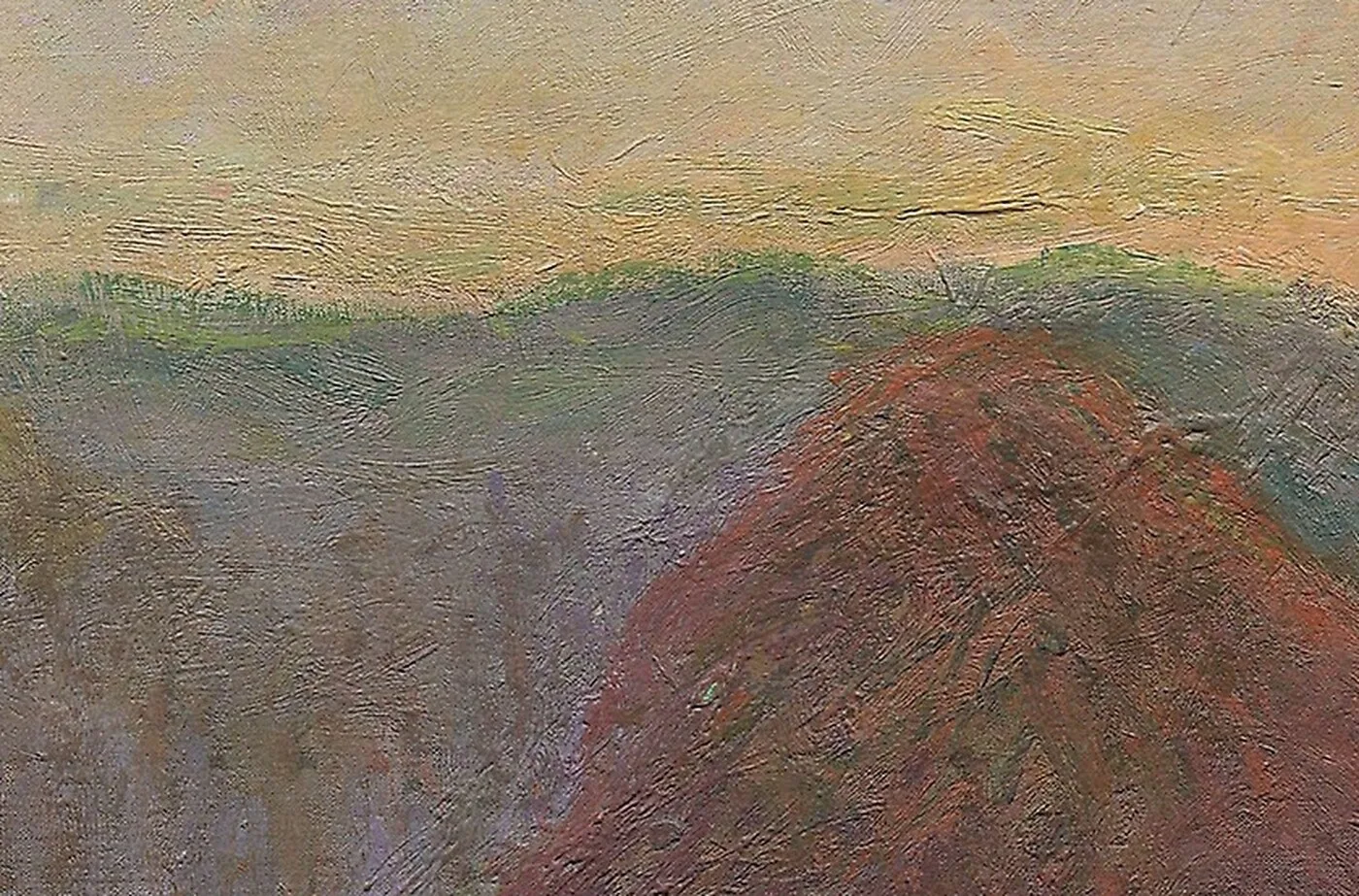
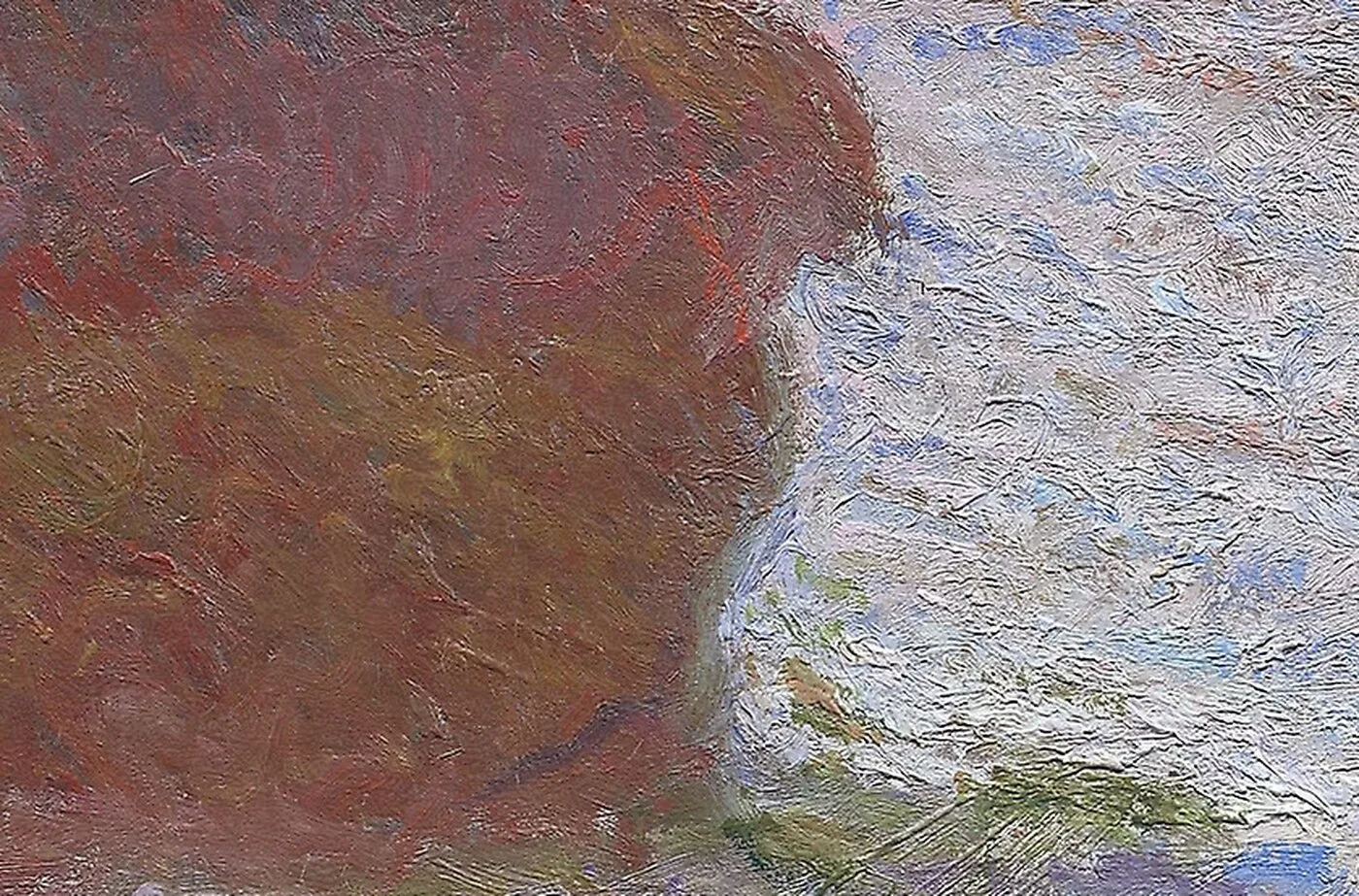
And look at the paint thickness. The hottest, most lit areas usually carry the heaviest load of pigment, sitting up off the surface. Physical thickness and optical brightness are doing the same job.
How it behaves in a room
This is the most assertive of the grainstack images and it needs to be treated as such. It is a high energy picture with strong colour contrast, and it will dominate a wall rather than blend into it.
That is a virtue in the right place. In a large room with plenty of light and mostly neutral surfaces, it functions as the single point of colour that organises everything around it. Over a fireplace, in a stairwell with height, or on the long wall of an open plan space, it can carry a lot of empty wall on its own.
It is less suited to small, busy rooms with a lot of competing pattern, where its contrast turns into noise.
Colour wise it is friendly to warm neutrals, natural wood, brass, terracotta and unbleached textiles, and it looks unexpectedly strong against a deep green or a dark blue wall, where the hot straw colours are pushed to their limit.
It is also the picture in the series that holds up best in a brightly lit room. Softer, lower contrast images can look washed out under strong daylight or downlights. This one was made in glare and does not mind it.
The beginning of everything after
Every later obsession in Monet’s life is prefigured here: the willingness to repeat a subject until the subject disappears, the acceptance that a painting can only be true to a narrow slice of time, the readiness to stand in a field in conditions nobody else wanted. The stacks were the proof of concept. The poplars, the cathedrals, and thirty years of a pond he dug himself all follow from a decision made in this field, under a high sun, in 1890.
The painting is held by the Hill-Stead Museum, a private house that became a museum, which means it hangs in domestic rooms rather than a gallery hall. There is something fitting about that. It was made in a working field, about ordinary farm property, at the hour when everyone else had gone in for lunch.
Sizes and materials for Grainstacks, in Bright Sunlight are listed on its product page.
More from this collection
Bring this painting home
Choose a hand-painted oil reproduction for real brushwork, or an archival canvas print for a crisp museum-image edition. Every size preserves the original proportions.
View this work & options
Further reading
Verify the original in the Hill-Stead Museum collection record and continue through related works in the catalogue.