
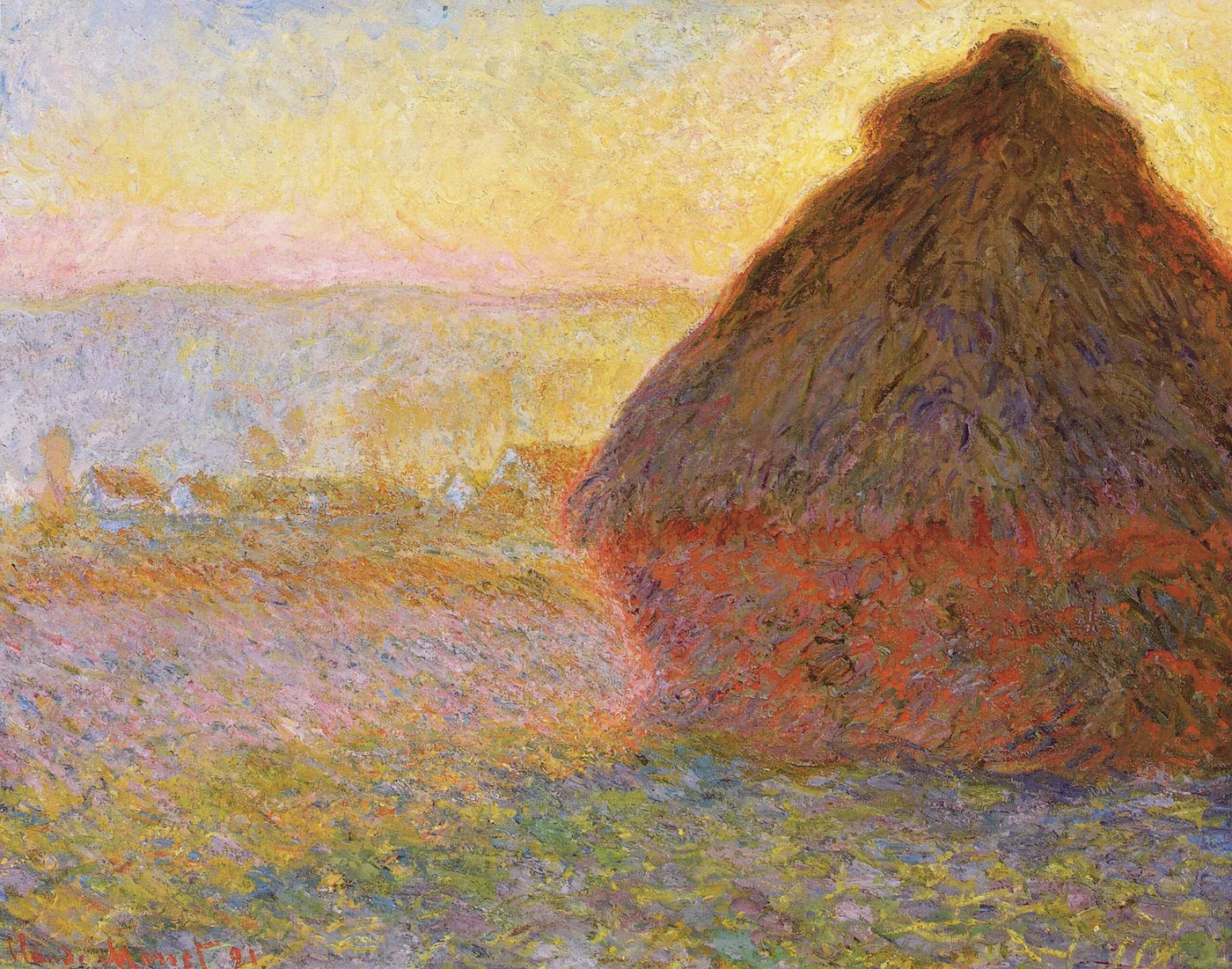
Haystacks, End of Summer
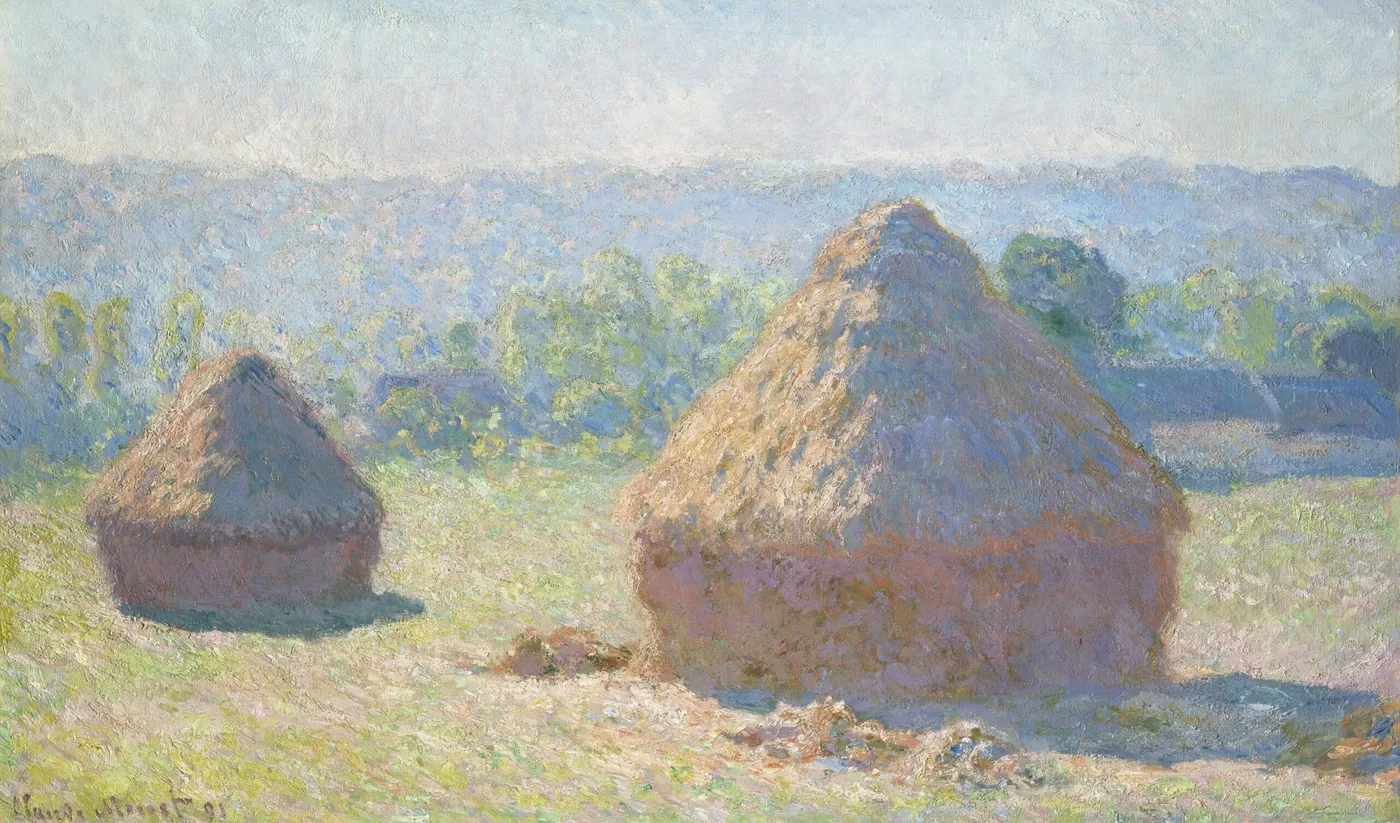
Go and stand next to one of these things and the first surprise is the size. A grainstack of this kind is not a bale. It is a built structure, taller than a person, thatched at the top against the rain, packed tight enough to shed water and stand for months. It has a smell, dry and dusty and slightly sweet. Push a hand into the side of it and the straw resists, then gives. It is not scenery. It is a year’s food and a year’s income, standing in a field waiting to be threshed.
That is what Monet was painting. Not a picturesque motif. Somebody’s property, in the field near his own house at Giverny, at the point in the year when the harvest is in, the stubble is going gold and grey, and the light has started to lengthen but has not yet lost its heat.
End of summer is a specific hour, not a season
The whole series works in every light and every season, but this canvas belongs to a very particular moment: late summer, late in the day, when the sun has dropped enough that everything it touches has turned warm and everything it misses has turned surprisingly cool.
You can date it by the shadow. It is long, and it lies across the stubble as a solid coloured mass rather than a dark smear. And you can date it by the field. The crop is off. What is left is cut stubble, dry and blond, with the tone of a field that has been baked for three months and is about to be turned.
The temperature split is the point. The lit side of the stack is orange, ochre, a hot straw colour with real weight of pigment on it. The shaded side goes violet and blue green. On a real stack, at that hour, that is exactly what happens: the direct sun is warm and everything else is being lit only by the blue of the open sky. Monet is not stylising. He is being unusually literal.
There is also a smell to this time of year that the picture somehow carries. Cut stubble in early September is dry and dusty and gives off heat it stored during the day, and the field is full of small movement: insects, birds working the ground for spilled grain, the sound of dry stalks under a boot. It is the most comfortable moment of the whole agricultural year to be standing in a field, and it shows. The paint is relaxed here in a way it simply is not in the winter canvases, where every mark was made by cold hands in a hurry.
The series that finally paid
He worked the stacks in the field near his house through roughly 1890 and 1891, and it changed his life. The pictures sold quickly and successfully through his dealer Durand-Ruel, and after decades of financial anxiety he was suddenly a painter people were competing to buy from. He had rented the Giverny house in 1883 and bought it in 1890. The stacks arrived at exactly the moment he needed them to.
The working method was already strange and would get stranger. He did not paint one canvas at a time. He would carry several out to the field at once and set them up together, moving from one to the next as the light changed, working each only in the conditions that started it. If the light shifted, he changed canvas. If the weather that a particular picture needed did not come back for four days, that picture waited four days.
It sounds obsessive and it was. It also produced something nobody had really done before: a set of pictures in which the object is deliberately constant and everything else is the subject. The stack is a control. Change nothing but the light, and the light becomes visible.
What to look at in this one
Start with the cone of the stack and follow the edge where lit meets unlit. There is no line. The transition happens through colour, warm sliding to cool over several centimetres of broken strokes, and it is that soft coloured turn that makes the stack read as a solid round mass rather than a flat triangle.
Then look at the shadow on the ground. Ask yourself what colour it actually is. Most people say grey until they look properly and find blue, violet, green, and in places a warm note where light has bounced back into it off the stubble. It is the most colourful area in the picture and it is the part representing the absence of light.
Look at the top of the stack, the thatched cap. It usually carries the strongest single note of colour in the whole canvas, because it is the part angled most directly at the sky.
Look at the ground plane and how he builds distance across it. Near the bottom edge, the stubble is painted with distinct separate strokes you can count. Halfway up, the strokes merge. By the far side of the field they are a single dragged tone. Nothing else is doing the perspective work.
Finally, look at the background, which will be a low band of trees, roofs or hillside. It is almost always cooler and lighter than you expect, and it is deliberately underpainted so that the stack stays the only fully realised object.
Living with a warm picture
End of summer light is the warmest end of the entire series, and that has practical consequences. This is a picture that raises the perceived temperature of a room. In a north facing space that always feels a little cold, it does more work than a lamp.
The palette is gold, ochre, straw, violet shadow and a low cool sky. It is friendly to wood, to leather, to warm neutrals, to terracotta and to unbleached linen. It is harder to place against cold grey blue schemes, where the orange can look like it is arguing.
Compositionally it is simple, which makes it strong at a distance and easy to hang. One large mass, one long shadow, a horizon. That simplicity means it does not become visual noise in a busy room and it does not look empty in a bare one.
It also pairs unusually well, because it was made as part of a series. Two or three stack pictures in different light hung together do exactly what Monet intended: they turn the constant object into a measuring device and let you read the difference in the light between them at a glance.
Why a pile of straw
People still ask why a serious painter spent two years on farm equipment. The answer is in the choice itself. He needed a subject with no story in it, no drama, no historical weight, nothing for the eye to be distracted by. A stack of grain has one virtue above all others: it does not change. Everything that changes in these pictures is atmosphere, hour, season and weather, and that was the only thing he was ever really interested in.
This canvas is held by the Musee d’Orsay. It records maybe forty minutes of a warm evening at the end of a summer more than a century ago, in a field a few minutes’ walk from a house a painter had just managed to buy.
Sizes and materials for Haystacks, end of Summer are listed on its product page.
More from this collection
Bring this painting home
Choose a hand-painted oil reproduction for real brushwork, or an archival canvas print for a crisp museum-image edition. Every size preserves the original proportions.
View this work & options
Further reading
Verify the original in the Musée d'Orsay collection record and continue through related works in the catalogue.