
The Bodmer Oak, 1865: Branches Above a Russet Forest Floor
A Named Oak in Fontainebleau
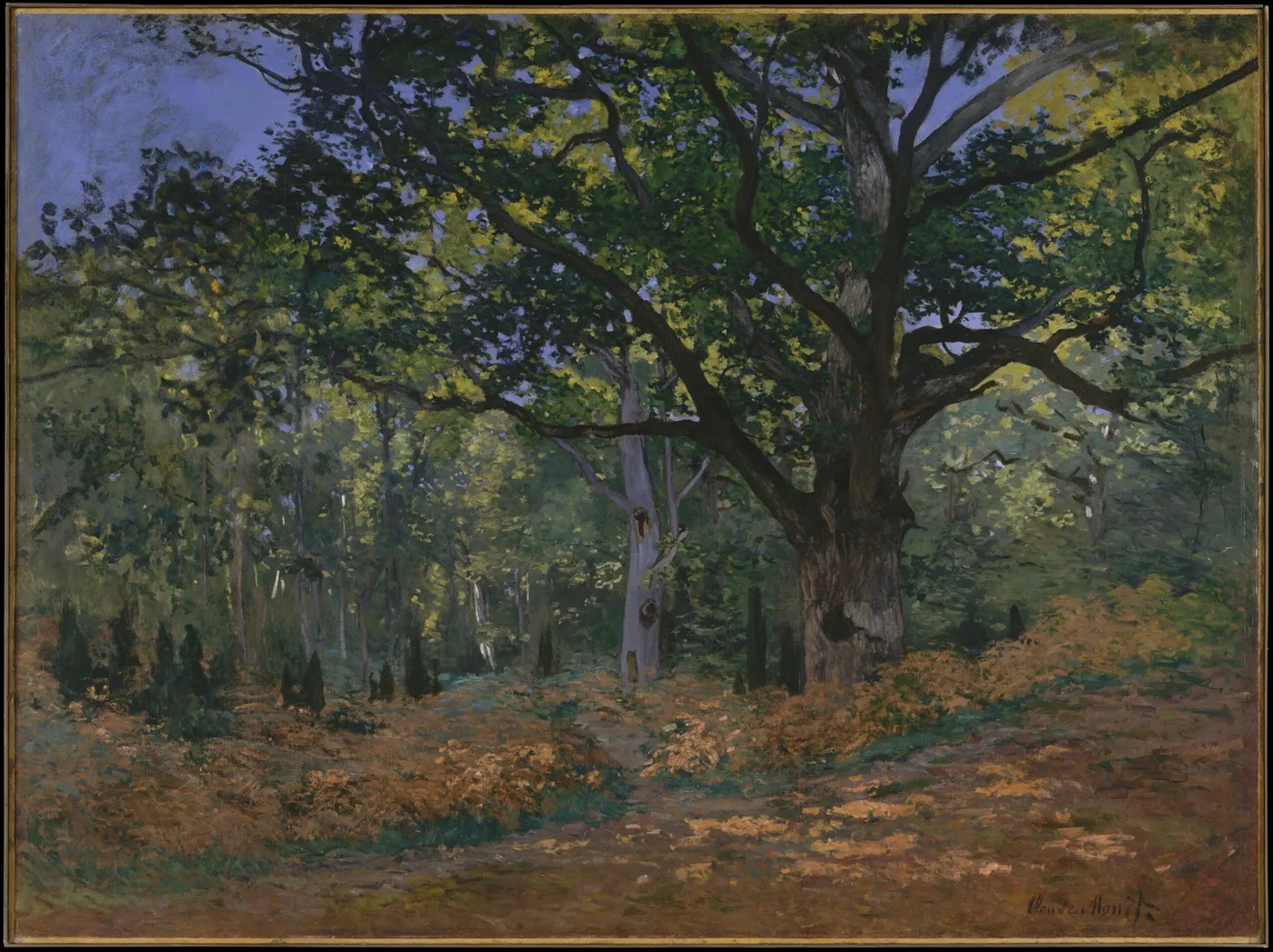
A broad oak spreads across Claude Monet’s The Bodmer Oak, Fontainebleau Forest. Its trunk stands to the right of centre, dividing into limbs that reach across much of the upper canvas. Beneath it, fallen leaves cover the ground in rusty orange and brown. Smaller trees form a screen behind the oak.
Monet painted the landscape in 1865 during a stay in Fontainebleau. The Metropolitan Museum of Art connects the autumn leaves with the end of that visit in October. That account gives a documented season for the picture; the canvas itself supplies the warm ground and remaining green foliage.
The tree’s name came from the Swiss artist Karl Bodmer, who had exhibited a painting of it at the Salon of 1850. Monet was therefore depicting an established subject in a forest already frequented by painters. This history explains the title without turning the work into an imagined personal contest.
The Met considers this probably the last landscape associated with Monet’s large Luncheon on the Grass project. The qualification matters. The woodland setting provides a useful connection, but this particular canvas is a view of trees and ground, with the branching oak carrying the composition.
Dark Limbs and Openings of Sky
Begin where the trunk forks. A thick limb runs diagonally towards the left before breaking into finer branches. Other limbs spread towards the upper right edge. Their dark undersides stand against lighter foliage and sky. Following each branch is a practical way to separate the oak from the trees behind it.
The trunk combines grey, brown and muted pink passages. Near its base, a dark hollow interrupts the lighter bark. Shorter marks turn around the surface rather than filling it with one even brown. The trunk remains substantial while small shifts of colour distinguish its lit and shaded areas.
Blue-violet patches appear between the branches, especially towards the upper left. Some form broad openings; others are reduced to small breaks among dark leaves. These visible gaps keep the canopy from becoming a continuous green surface. They also reveal how far the limbs extend beyond the central trunk.
The ground has its own pattern of orange, brown and green. Short marks gather into uneven patches around the tree’s roots and continue across the foreground. Darker green passages cut through the warm leaves. Their irregular edges differ from the longer, clearer lines of the principal branches. At the upper right, a pale branch meets dark foliage; towards the left, finer branches appear in shorter stretches. Compare these areas before assuming that every dark shape belongs to the same tree.
Tracing the Space Between the Trees
The largest oak is close enough for its branches to reach beyond the canvas. Behind it, a paler upright trunk stands just left of centre. Farther left, thinner stems recede into darker foliage. Compare these overlapping trunks before following the openings between them into the background.
A lighter stretch of leaf-covered ground rises towards the right. It meets low vegetation and a small dark upright mark behind the main trunk. That mark does not need a confident identity to explain the view. The relative scale of the neighbouring trunks already gives the oak a substantial presence.
Light is distributed unevenly across this forest. Yellow-green foliage appears beside deep green clusters, while the lower foreground alternates between warm leaves and cooler shadows. Keep those locations in view when reading the palette. Calling the entire scene brown would miss much of its green and violet.
Monet’s later palms at Bordighera offer another arrangement of branches and sky openings. His garden portrait of Camille brings a small figure into dense planting. Compare the visible spaces between plants rather than treating these different landscapes as interchangeable views.
The Met’s Landscape of 1865
The original belongs to The Metropolitan Museum of Art in New York, accession 64.210. It is oil on canvas, dated 1865, with recorded dimensions of 37 7/8 x 50 7/8 in. (96.2 x 129.2 cm). Height comes first. The painting is wider than it is tall.
Those measurements describe the original canvas. They do not specify a newly made reproduction or the outside of a frame. To identify this view among woodland paintings, check the main trunk right of centre, the paler trunk behind it and the russet ground extending across the lower part.
Preserving the Branches and the Forest Floor
The Bodmer Oak product page offers a hand-painted oil reproduction as the principal choice, with a canvas print available as an alternative. Its current options give the sizes and presentations. The museum dimensions identify the source painting rather than setting the limits of the commercial range.
Both the canopy and the ground contribute to this composition. A crop concentrated on the trunk would remove branches at the sides and much of the foreground. When assessing the image for a wall, allow space to see the tree’s full spread and the paler trunks behind it.
Painting the reproduction in oils creates new brushwork; a print reproduces the visible marks within its printed image. In this landscape, compare the long limbs with the smaller leaf marks when considering those alternatives. Their physical surfaces differ even though both versions retain the same woodland arrangement.
Questions About the Bodmer Oak
Why is the tree called the Bodmer Oak?
The name refers to Karl Bodmer, who exhibited a painting of the tree at the Salon of 1850. The Met records that connection in its account of Monet’s landscape.
What indicates the season?
The russet leaves covering the ground are the clearest visible clue. The Met associates them with the end of Monet’s Fontainebleau visit in October 1865.
Where is the original painting?
The original is in The Metropolitan Museum of Art, New York. Its accession number is 64.210, and its canvas measures 96.2 cm high by 129.2 cm wide.
Can I choose a hand-painted version?
Yes. The main offering is painted by hand in oils, with a canvas print as an alternative. Consult the product’s current options for the available sizes and presentations.
More from this collection
Bring this painting home
Choose a hand-painted oil reproduction for real brushwork, or an archival canvas print for a crisp museum-image edition. Every size preserves the original proportions.
View this work & options
Further reading
Verify the original in the The Metropolitan Museum of Art, New York collection record and continue through related works in the catalogue.