
Houses of Parliament, London, 1900-01: The Fog He Came Back For
He wanted the fog. That is the part people find hardest to believe. Visitors to London in 1900 complained about the winter air as a matter of course; it was coal smoke as much as weather, it stained collars and shortened lives, and it could turn midday into dusk. Monet crossed the water to get into it on purpose, three winters running, and complained bitterly on the days when it lifted.
His routine was fixed. Mornings from a room high in a riverside hotel, looking downstream at the bridges. Afternoons across the water on a terrace belonging to a hospital, facing the long silhouette of the Houses of Parliament, whose towers and pinnacles sat directly in the path of the setting sun.
He was sixty, wealthy at last, working on close to a hundred canvases at once, and by his own account close to despair for weeks on end.
Chasing a thing that would not stay still
The problem was structural. His method depended on repetition: return to the same motif at the same hour on successive days, and finish the canvas that belongs to that effect. It had worked in a snowy field and in front of a cathedral because the effects recurred with some reliability.
London fog does not recur. It is never twice the same density, colour or height. It shifts while you watch. He described the frustration of having a canvas going for a particular condition and never seeing that condition again, of the light collapsing mid-session, of days lost entirely. He had dozens of canvases stacked in his hotel room and would run between them as the river changed, sometimes touching six or seven in an afternoon.
He could not finish them there. He carried the whole mass home and worked on them for another two or three years, from memory, from photographs he had taken as aides, and above all against each other, adjusting one until it agreed with the group. When they were finally exhibited in 1904 the critical response was immediate and admiring; several writers pointed out that this foreigner had painted the character of their city more exactly than its own painters had.
There is a private layer under the campaign as well. He had first seen the Thames thirty years earlier, in his twenties, as a refugee from a war, poor and unknown and grieving his father. Coming back at sixty to paint the same river from a suite in an expensive hotel is not a neutral act, and the pictures carry a kind of settled, unhurried attention that the young man could not have managed.
What fog actually does
Understanding the optics makes the picture much better to look at. Fog is a suspension of droplets and particles; it scatters light rather than blocking it. Three consequences follow, and all three are visible here.
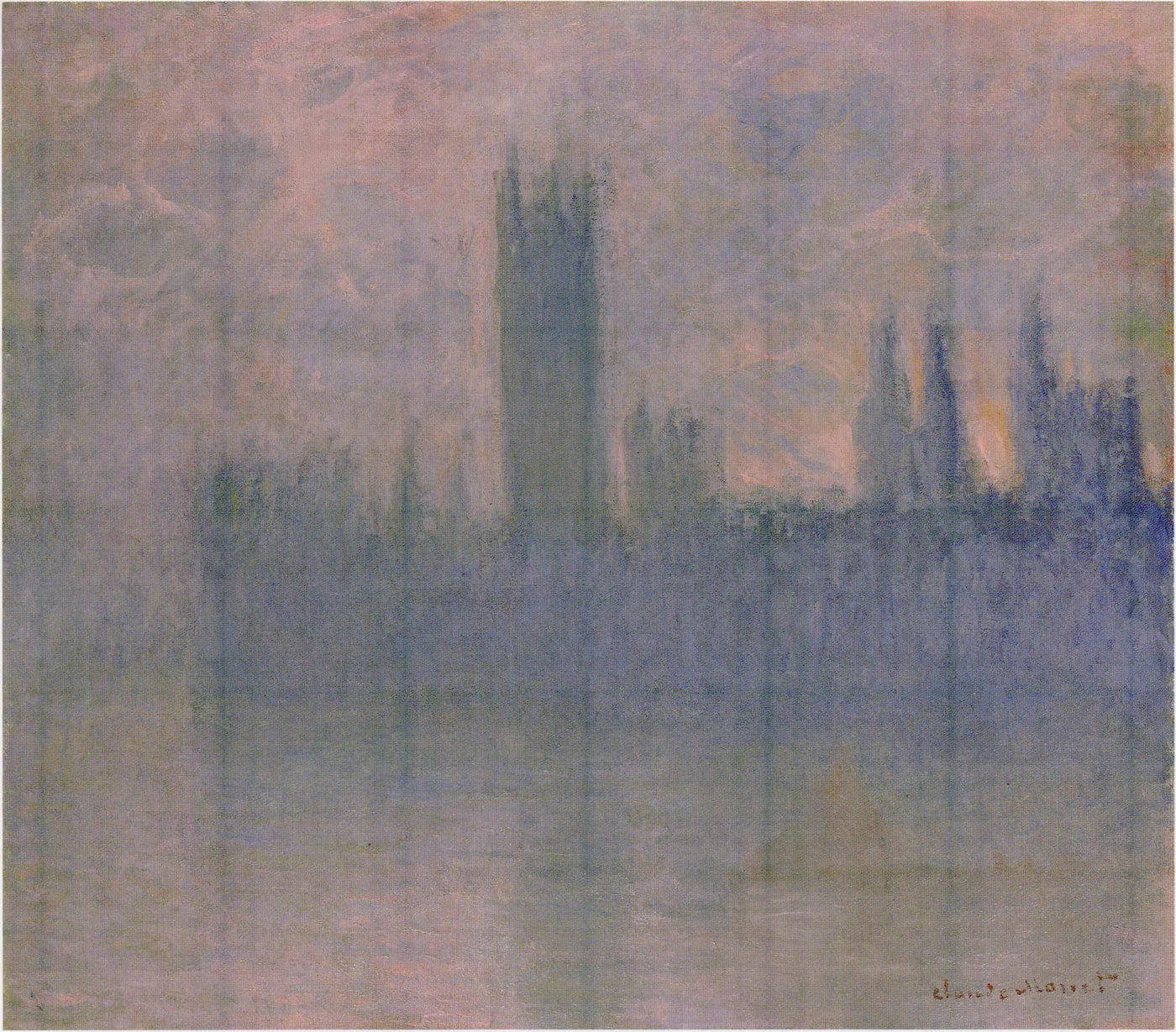
First, it removes detail progressively with distance, so a building loses its parts before it loses its outline. Second, it lifts the darkest tones, so nothing is ever truly dark; the silhouette of Parliament in these canvases is never black, it is a warm mauve or a dense blue or a smoky rose. Third, and most important, it makes the air itself the brightest thing in the scene, so the light appears to come from everywhere at once rather than from a source.
That is why these paintings feel strange even before you notice what is in them. The normal hierarchy is inverted: the solid object is dim and the empty space is luminous.
What to look at
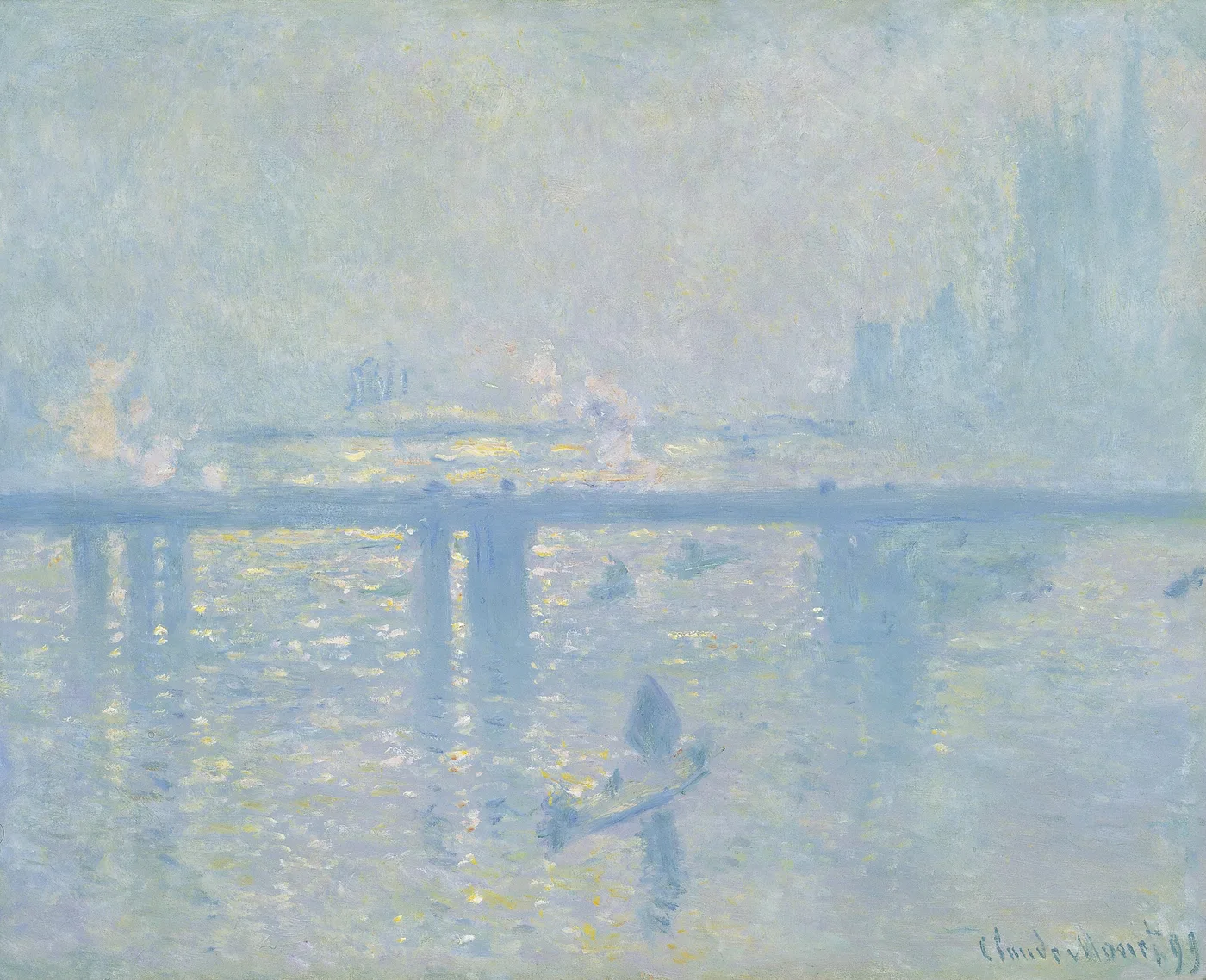
Take the silhouette first. The whole building is reduced to one continuous profile, a low mass with a tower at each end, and there is almost no information inside that shape; a few strokes suggest the vertical rhythm of the windows and then stop. Cover the towers and the picture loses its identity entirely; those two verticals carry the entire recognition load.
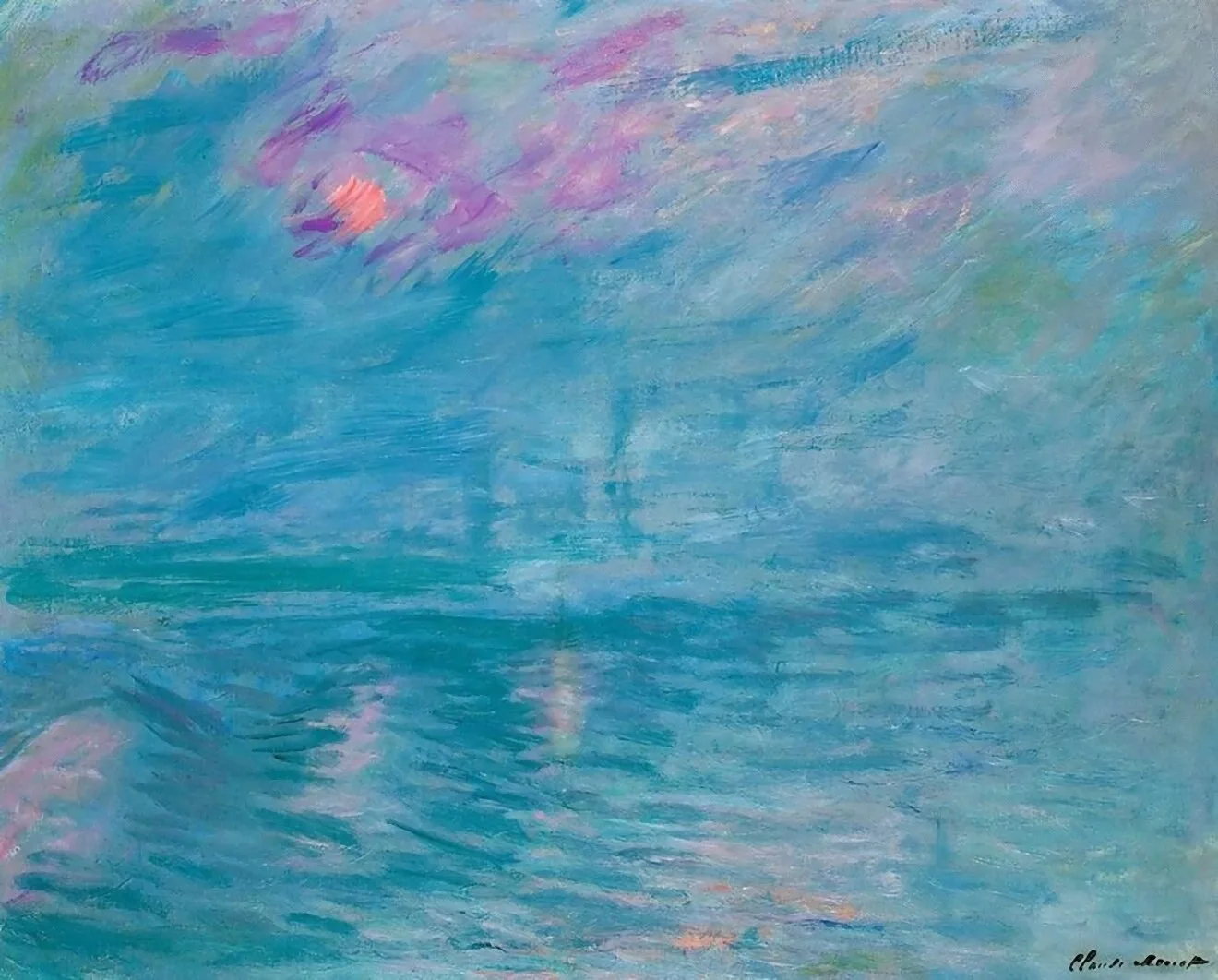
Then the sun. In the versions where it breaks through, it is a small disc of dense pigment and it is almost never yellow; it is orange, rose, sometimes nearly red, because it is being seen through a huge depth of dirty air. Below it, on the water, is its reflected column, and that column is the most heavily painted passage on the canvas: short broken horizontal strokes of pink, gold and pale green, each one a facet of moving water.
Now look at the water away from the reflection. It is not lighter or darker than the sky; it is almost exactly the same value, which is what makes these pictures so unstable. The horizon is not drawn. River and air meet in a zone rather than at a line, and your eye keeps hunting for the join.
Look for the boats or the piers, when they appear, sitting between you and the building. They are the only scale cue in the picture. Without them the tower could be two hundred metres away or two thousand.
One more test, and it is the one that shows how good these are. Look at the picture with your head close to the surface and then walk backwards across the room, watching it the whole way. At half a metre it is an incoherent mesh of dry strokes. At two metres the building assembles itself. At five metres the fog begins to move, because at that distance your eye can no longer resolve the individual marks and starts averaging them, which is precisely what real distance does to real air. The painting has a correct viewing distance built into its handling, and it was calculated.
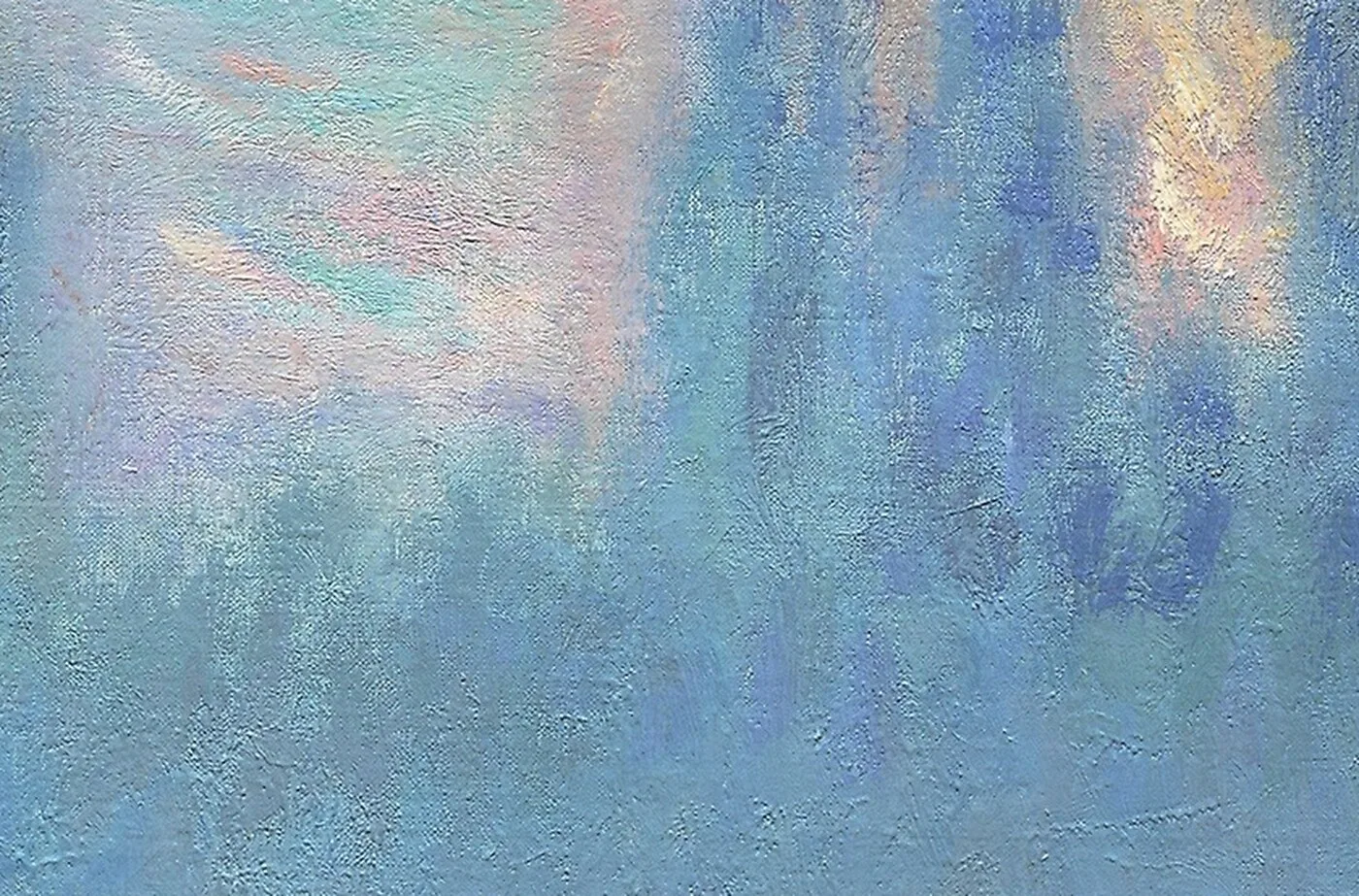
And step close to see how thin the paint is compared with the cathedral series. Here it is scumbled, dragged dry over an underlayer so that flecks of a different colour show through the top coat. That broken, gauzy surface is a direct physical equivalent for suspended particles in air. He painted fog with a technique that is itself semi-transparent.
Why it holds up
The London series is where his lifelong subject reaches its purest form. In the grainstacks there was still a solid object under the light; in the pond pictures there was still water. Here there is essentially nothing but atmosphere with a shape hidden in it, and a viewer supplies the building from memory. It is a painting about how little the eye actually needs.
It is also, incidentally, an accurate historical document of a specific kind of air that no longer exists; that particular colour of London winter was legislated out of existence in the following century.
On a wall this is the quietest and most atmospheric picture in his output, and it is the one that most changes a room’s mood without demanding attention. The range is narrow, a single dominant hue with a warm accent, so it never competes with the objects around it. In daylight the blues and greys hold and it reads as cool and spacious. Under lamplight the rose and orange in the sun and its reflection come forward and the whole canvas warms. It suits a room where you want depth rather than incident: a long wall, a place you pass rather than sit, or a space where the light is already low and you want the picture to agree with it rather than argue.
Sizes and materials for Houses of Parliament, London are listed on its product page.
More from this collection
Bring this painting home
Choose a hand-painted oil reproduction for real brushwork, or an archival canvas print for a crisp museum-image edition. Every size preserves the original proportions.
View this work & options
Further reading
Verify the original in the The Art Institute of Chicago collection record and continue through related works in the catalogue.