
The Bridge at Argenteuil
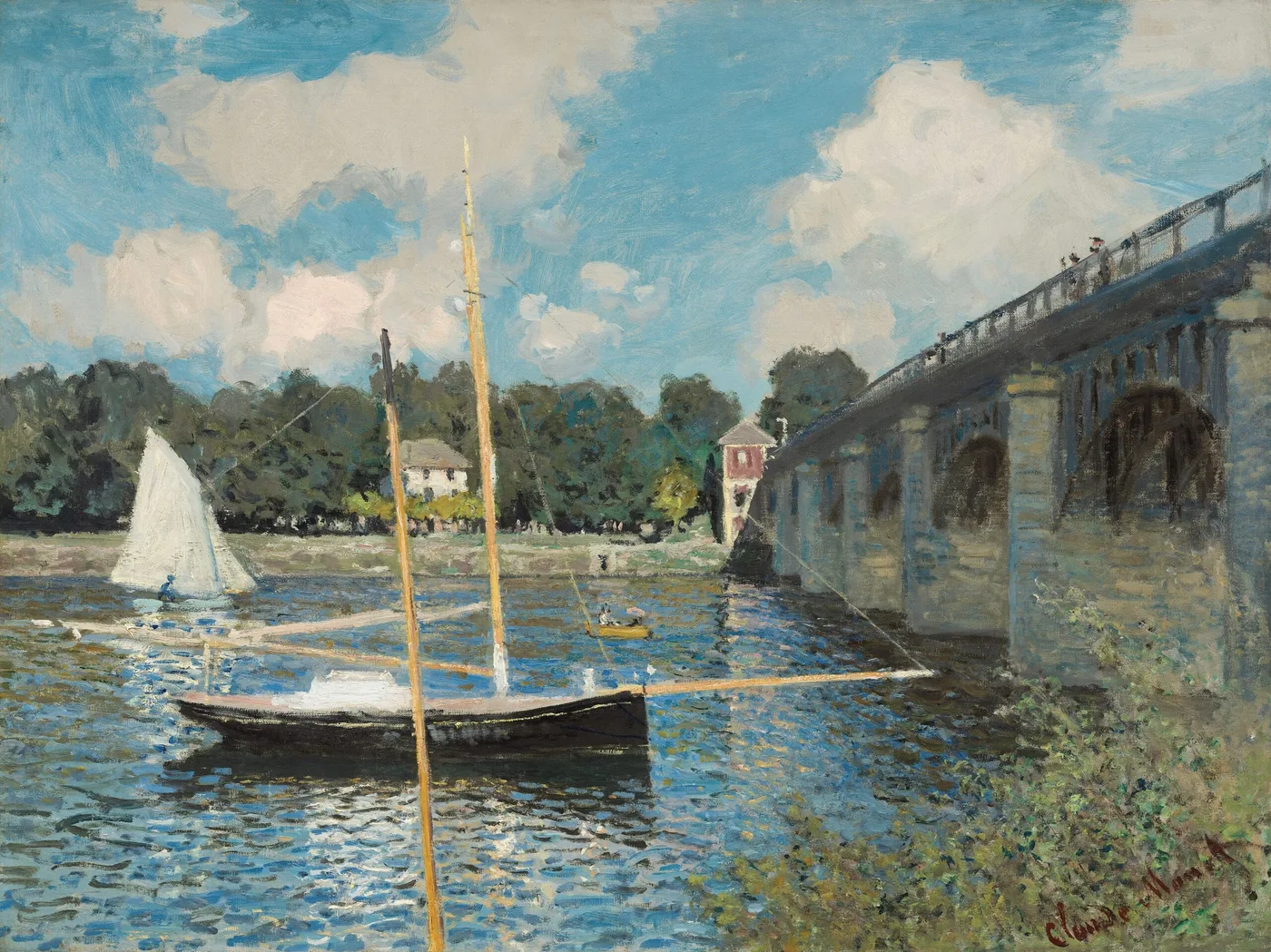
A flat-bottomed boat with a small cabin sits moored on the river, and a man is working in it. He has a canvas propped in front of him and the water is doing what water does under a boat, which is to move the whole studio very slightly, all the time. Sails go past. The river smells of weed and tar. Beyond the moorings the bridge crosses the water on a line of solid piers, and beyond that the bank goes on into a haze of summer trees.
The year is 1874. The place is Argenteuil, a river town within easy reach of the capital, where he lived from 1871 to 1878, and where he did as much to invent a new kind of painting as he did anywhere in his life.
The bridge in front of him was almost new. Four years earlier it had been wreckage.
A bridge that had been rubble
The war of 1870 to 1871 went through that part of the country and took the bridges with it. The one he is painting here had been destroyed and rebuilt, and everybody looking at it in 1874 knew that.
This changes the picture. It is easy to read it as a pleasant scene of boating on a summer afternoon, and it is that. But the structure at its centre is a repair. It is a piece of very recent engineering standing where a ruin had been, and the sailing boats moored beneath it belong to a town that had gone straight back to its weekend pleasures.
He does not comment on any of it. There is no rhetoric here, no ruin picturesquely left in the water, no flag. He paints the new piers as what they are: clean, regular, faintly industrial masonry, quite unlike the soft irregular world of trees and sails around them. The contrast between the engineered thing and the natural one is the picture’s structure, and it was the contrast a great deal of painting in that decade was interested in.
This was also the year the group he belonged to held its first independent exhibition, the one that gave the movement its name. He was thirty-four. The way of painting on display in this canvas, fast, bright, unblended, made outdoors, was at that moment a matter of active public dispute rather than settled taste.
The floating studio
The most important piece of equipment in this picture is not in it. It is the thing he is sitting in.
At Argenteuil he had a boat fitted out as a studio, and it changed what he could paint. From the bank you see a river across a foreground of grass and mud, from a fixed height, at a fixed distance. From a boat you are on the water, at its level, and you can put yourself anywhere on it. You can get in among the moored craft, look along the surface rather than down at it, and place the horizon exactly where you want it.
Everything about the viewpoint here depends on that. The water starts at the bottom edge of the canvas without any bank in between. You are not looking at a river; you are on one.
It also meant working fast, on a support that moved, in changing light, with reflections that reorganised themselves every time a boat went past. The technique that resulted is the whole visible surface of this painting: short separate strokes of unblended colour, laid down at speed and left alone. Nothing is smoothed. The reflection of a hull is a stack of horizontal marks with gaps of a different colour between them, and it works because the eye assembles it at a distance, not because it was described.
Five years after this summer, in 1879, his wife Camille died at thirty-two. The Argenteuil years, with their sails and their bright water and their new bridges, are the last stretch of his life before that; it is worth knowing when you look at how uncomplicated the light in this picture is.
Learning to see it: read the water first
Most people look at a river picture by looking at the boats. Start lower down instead.
- Take the bottom third on its own. Cover the rest with your hand. What remains is an abstract band of horizontal strokes in blue, green, white and dark red-brown. It makes no sense as an image at all. Uncover the top and it instantly becomes water, because the shapes above tell you what the shapes below are reflections of. That dependency is the trick the whole picture is built on.
- Look for the vertical reflections. Masts and hulls reflect as long vertical smears, broken by the movement of the surface. Note that the breaks are not painted as ripples; they are simply places where he changed colour. A reflection in his hands is a rhythm, not a drawing.
- Now the bridge. Follow the line of the piers into the distance and notice how quickly they shrink. That is the only strict perspective in the picture and it is doing all the work of establishing depth. Everything else, water, trees, sky, is atmospheric rather than measured.
- Compare the two blues. The blue of the sky and the blue of the water are not the same, and the difference between them is where the picture gets its air. The water is usually the greener and heavier of the two.
- Look at the shadows. There is no black anywhere. Shadows under hulls and beneath the bridge are painted in deep blue, violet and green. This was the specific point of technique that the movement was arguing about at the time, and here it is being used without hesitation.
Finally, stand back and notice how still it is. Boats at their moorings, a bridge, a quiet stretch of afternoon. For a picture made from a rocking boat with a fast hand, the result is remarkably calm.
How it behaves in a real room
This is the most sociable picture of the group, and the easiest to place.
It has what the late water paintings deliberately lack: a horizon, a structure, a middle distance and a sky. That makes it read unmistakably as a view, and a view is the most useful thing a picture can be in a room without one. On an interior wall, in a room facing a fence or a neighbouring building, a canvas with real distance in it does measurable work.
The palette is blue and green with white sails and a warm note in the masonry and the reflections. It is bright without being loud, and it goes with almost anything: painted wood, navy, cream, natural linen, brass. Against a white wall it is fresh and light. Against a soft blue-grey it is at its most harmonious. Against a deep colour the sails become the brightest points in the room and the whole thing gains contrast.
It is a good picture for rooms where people talk rather than contemplate: a living room, a dining room, a landing, a study, a hallway you walk down. Unlike the late pond panels, it does not require silence. It has enough incident that a glance is satisfying and enough craft that a long look is rewarded.
Hang it with the horizon line near standing eye level so the water sits below you, the way it did for the man in the boat. Avoid hanging it very high; a river seen from above loses exactly the quality the floating studio was built to get.
Sizes and materials for The Bridge at Argenteuil are listed on its product page.
More from this collection
Bring this painting home
Choose a hand-painted oil reproduction for real brushwork, or an archival canvas print for a crisp museum-image edition. Every size preserves the original proportions.
View this work & options
Further reading
Verify the original in the collection record and continue through related works in the catalogue.