
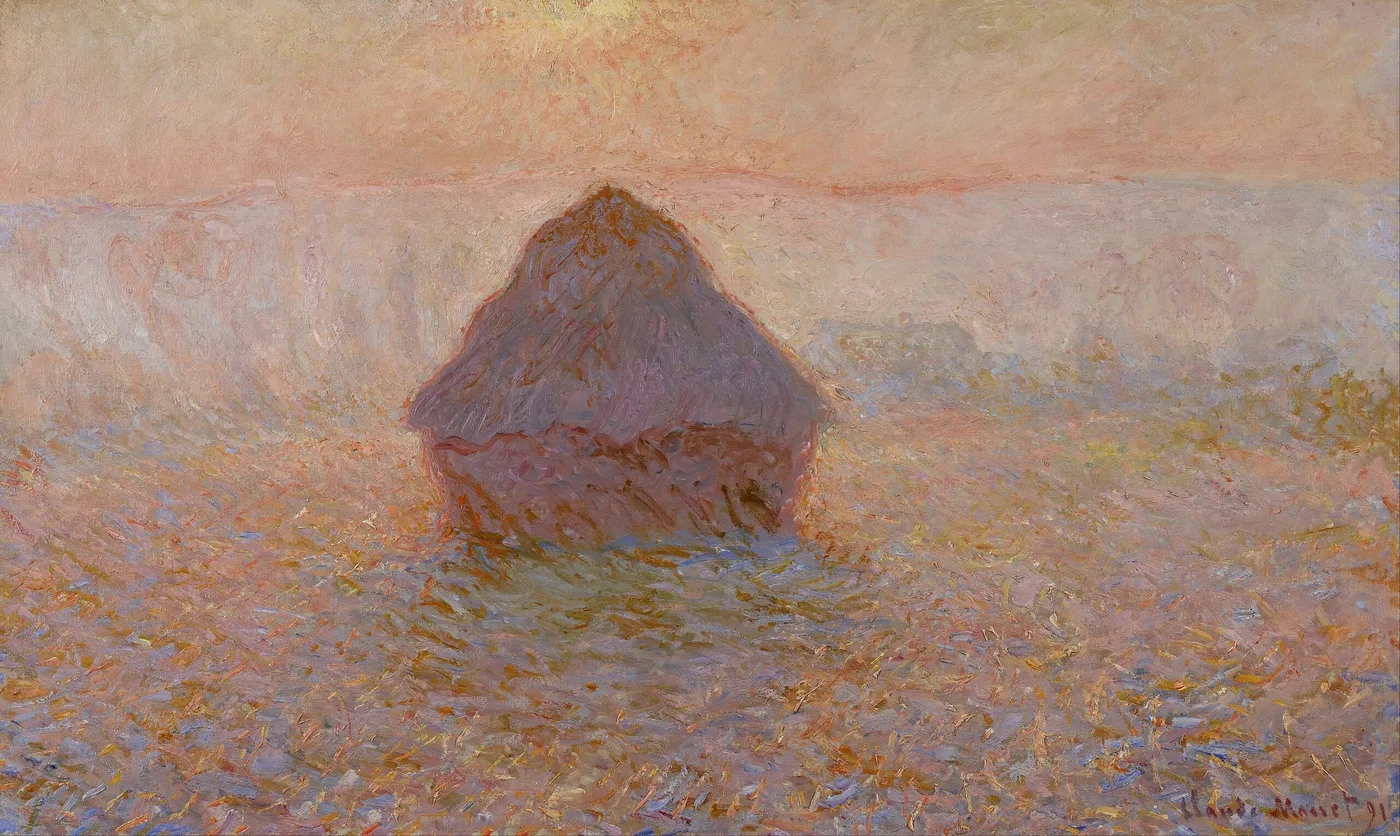
Haystacks: Snow Effect
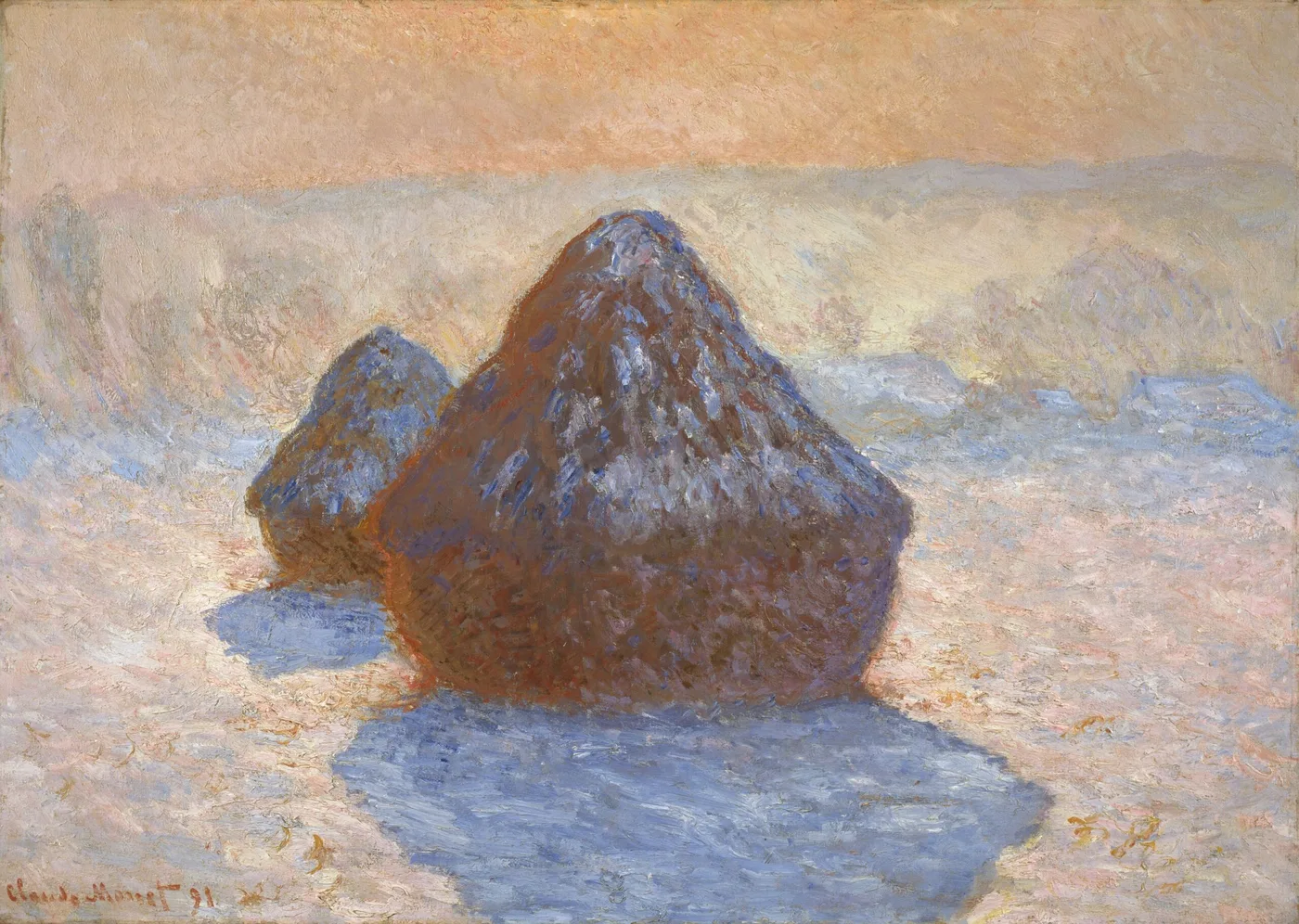
Cold is the part nobody paints. It is in this picture anyway, in a way you can feel before you can explain it.
Consider the practical situation. A field in winter, snow on the ground, the light usable for maybe four hours in the middle of the day and grey for the rest. Oil paint goes stiff and sluggish in the cold and does not want to leave the brush. Fingers stop working properly inside twenty minutes. The ground is frozen hard, so the easel legs will not go in and everything wobbles. And the light, the thing you came for, is changing faster in winter than at any other time of year because the sun is travelling low and quickly across a short arc.
Monet went out into that repeatedly, with several canvases, to paint a stack of straw.
The stack in winter is a different object
In late summer the stack in the field near his Giverny house is one warm mass among a lot of other warm things: dry stubble, gold light, a hot horizon. In snow it becomes the only dark thing in the world. The field has gone to a pale luminous sheet, the sky has closed down, and the stack stands there as a heavy silhouette with real weight, casting a long blue shadow across a surface that reflects almost everything falling on it.
That inversion is what makes the snow canvases the most graphically dramatic of the series. Everything else is quiet and the stack is loud. In the summer pictures the stack is the warm heart of a warm field. Here it is an intruder.
Look at what snow does to the stack itself, too. It does not coat it evenly. The thatched cap holds a band of it along the top and the windward side takes a crust, while the steep flanks stay bare because snow slides off packed straw. So the object acquires a highlight it does not have in any other season: a bright rim sitting directly on the darkest mass in the picture. That rim is the reason the stack reads as three dimensional in a scene that has almost no other modelling in it.
Notice too what snow does to the ground plane. Stubble in summer gives you texture, direction and a hundred small strokes to build distance with. Snow removes all of it. You are left with one continuous surface, and the only way to make it recede is to change its colour very slightly as it goes back. That is a far harder problem, and this is the kind of problem Monet went looking for.
Snow is not white
This is the single most useful thing this painting can teach anyone who looks at it properly.
Find the whitest patch of paint on the canvas. It is usually smaller than you expect and it is usually where direct light is hitting a slight rise in the ground. Now look at the shadow the stack throws. It is blue. Not grey with a blue feeling: blue, sometimes running to violet, occasionally with a green note where the sky is bouncing differently.
The physics behind it is simple and completely convincing once you see it. Snow is a near perfect reflector. Where the sun hits it, it takes the warm colour of sunlight. Where the sun does not hit it, it can only reflect what is above it, which is open sky, which is blue. So a snow shadow is not a dark version of a lit area. It is a different colour of light entirely.
Then look at the untouched middle ground and see how many distinct tints are in there: pink where a low sun is skimming it, pale yellow near the stack, cool lilac in the hollows. Almost none of it is white. The picture reads as blindingly snowy precisely because he refused to use white to say so.
Working several canvases in freezing weather
His method during the stack campaign of roughly 1890 and 1891 was to take multiple canvases into the field at once and move between them as the light turned, working each only under the conditions in which it was begun. In summer that is demanding. In winter it borders on absurd, because the conditions he needed might not come back for a week, and when they did they might last ninety minutes.
He complained about the weather constantly and he kept going, and the reason is visible here. A snow effect is a one shot event. Fresh snow settles differently every time. A thaw ruins a canvas that was started in hard frost. If you want the specific truth of one particular cold afternoon, you cannot reconstruct it later in a warm room. You have to be standing in the field with cold hands while it happens.
The series sold quickly and successfully through his dealer Durand-Ruel, and it was the making of him financially after decades of pressure. The snow canvases were part of that. Buyers responded to something the critics had missed for twenty years, which is that this way of painting is not vague. It is extremely precise about something most pictures never attempt.
What to look for
Look at the edge of the stack against the snow. It is the highest contrast boundary in the picture and he keeps it slightly soft, because a hard edge would flatten the stack into a cut out.
Look at the top of the stack where snow has settled on the thatched cap. That little band of light on top of a dark mass is what stops the stack reading as a hole in the canvas.
Look at the sky and check whether it is lighter or darker than the ground. In snow scenes it is very often darker, which feels wrong and is right, because a snow field can reflect more light than an overcast sky emits.
Look at the horizon band of trees or buildings and notice how little detail is there. In cold air with low sun, distance goes soft and slightly rose coloured, and he lets it.
How it hangs
Snow pictures are the easiest paintings in the world to live with and the most underrated. The value range is high and airy, the composition is simple, and the dominant colours are pale blue, lilac, cream and one strong dark. That combination brightens a wall without adding heat.
It is very good in rooms that already run warm, where a gold or orange picture would tip them over. It is excellent against white, pale grey and soft green walls, and unexpectedly beautiful against a deep charcoal or navy, where the snow field reads as pure light.
It also has a practical virtue: high key images do not go dead in low light. In a dim hallway or a room lit only in the evening, a dark painting disappears and this one keeps working.
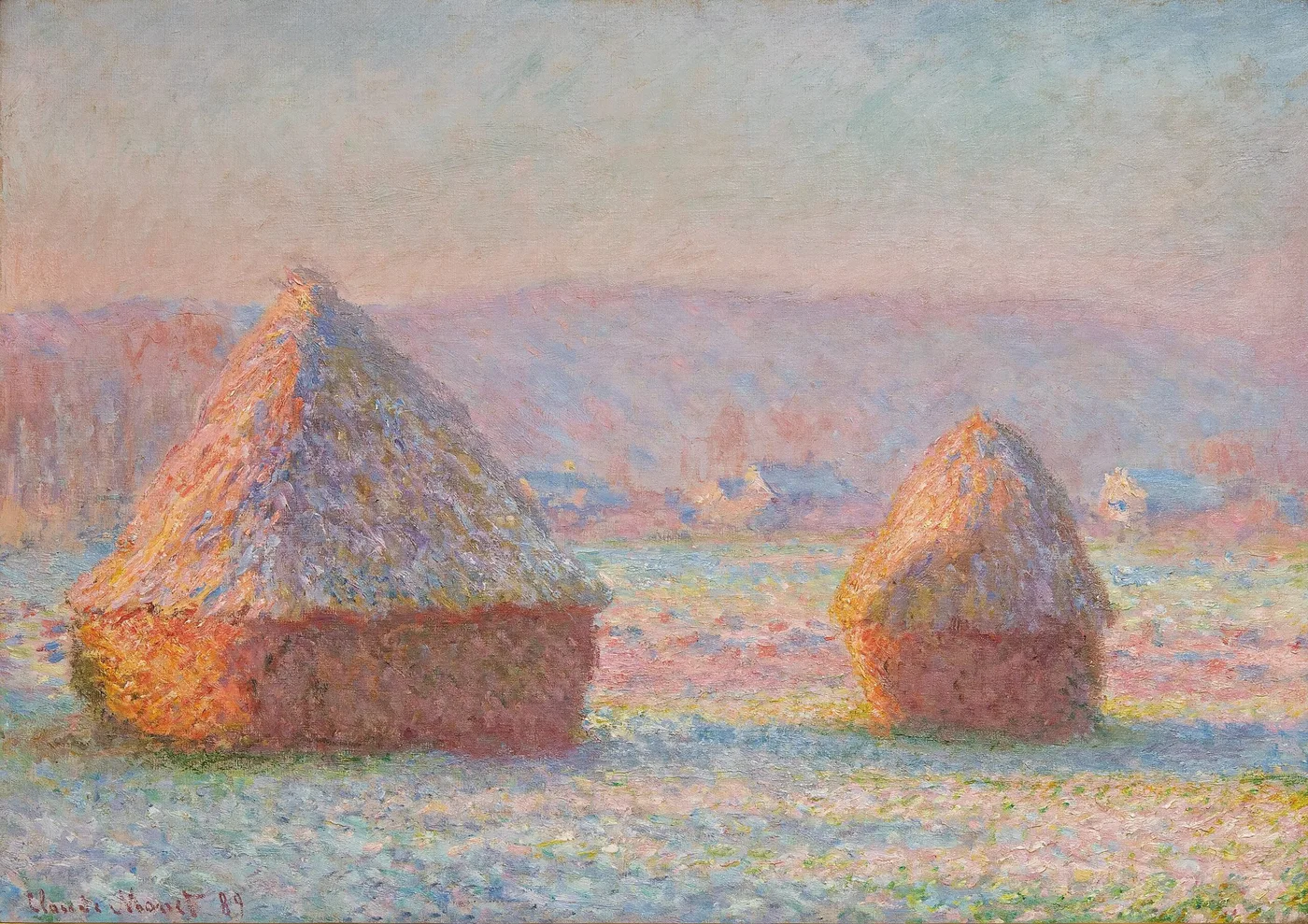
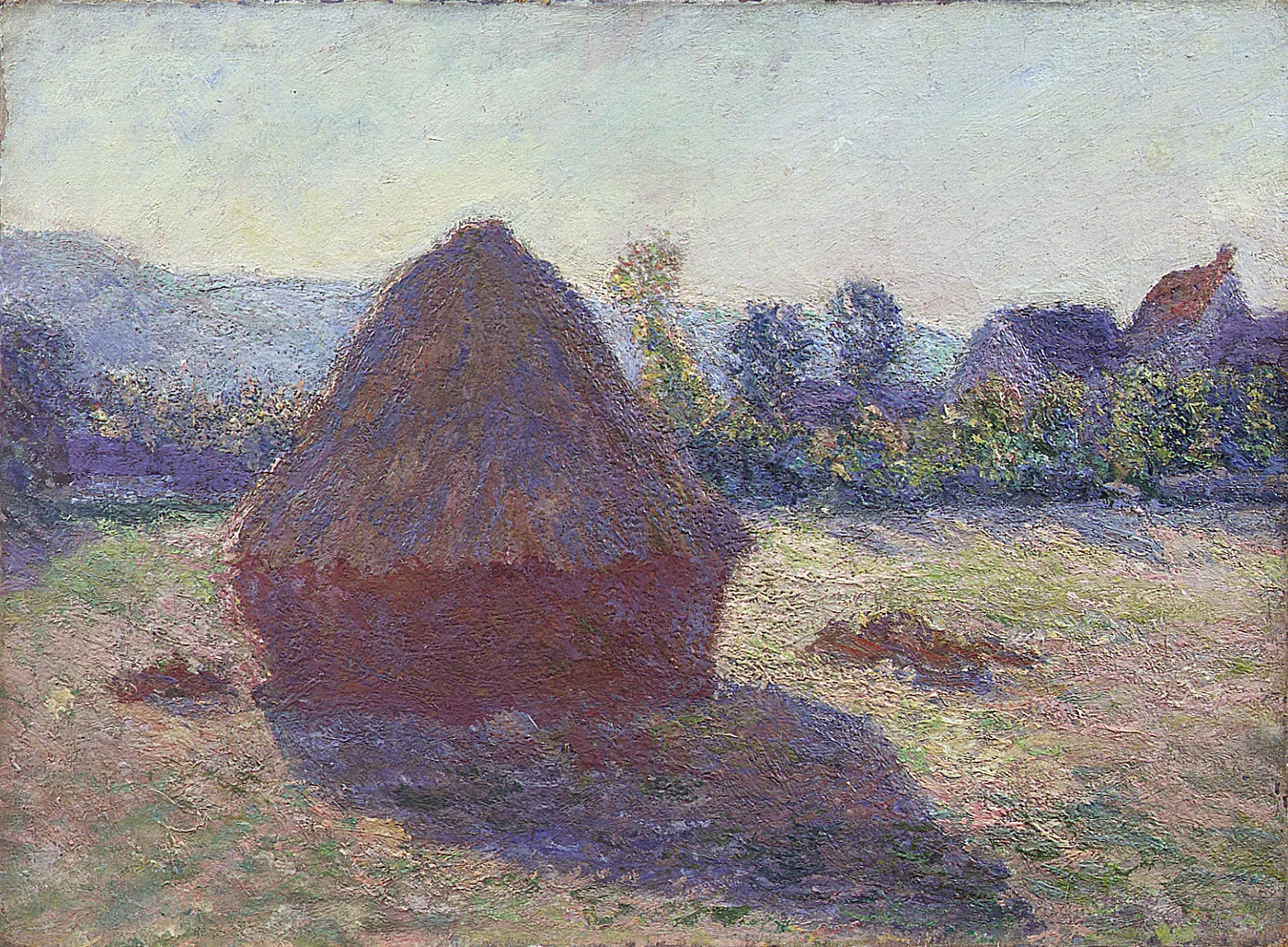
Hung as a pair or trio with a summer or autumn stack, it does the thing the series was built to do, which is to make the light itself the visible difference between two otherwise identical pictures.
Cold, recorded honestly
There is no drama in this painting and no sentiment about winter. A working stack of grain stands in a frozen field, throwing a blue shadow, waiting to be threshed. The picture is held by National Galleries Scotland. What it preserves is a couple of hours of specific cold from more than a century ago, painted by a man who could easily have stayed indoors.
Sizes and materials for Haystacks: Snow Effect are listed on its product page.
More from this collection
Bring this painting home
Choose a hand-painted oil reproduction for real brushwork, or an archival canvas print for a crisp museum-image edition. Every size preserves the original proportions.
View this work & options
Further reading
Verify the original in the National Galleries Scotland collection record and continue through related works in the catalogue.