
Venice, Palazzo Dario, 1908: Marble Above Blue-Green Water
The Palace at the Water’s Edge
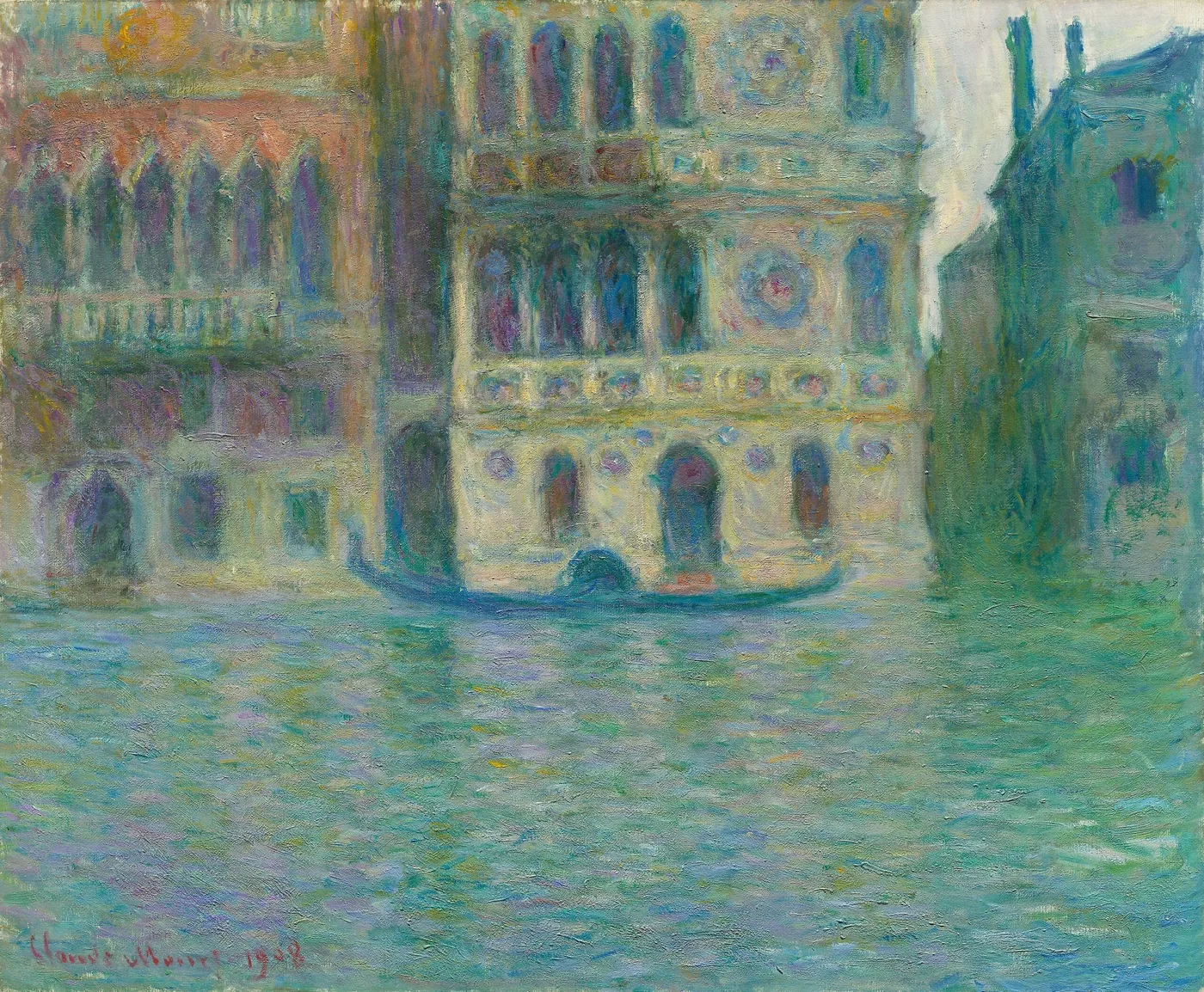
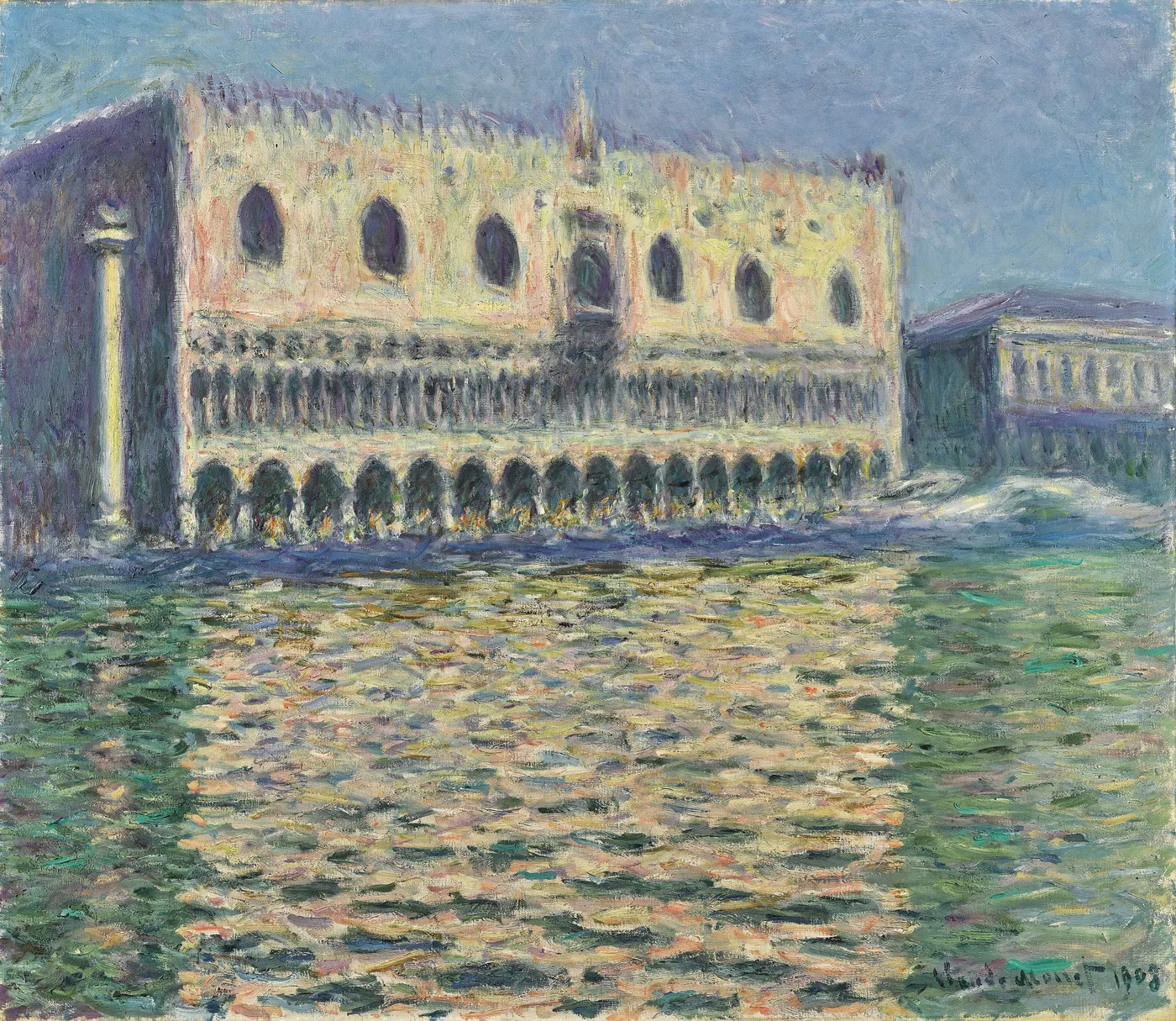
Claude Monet’s Venice, Palazzo Dario brings the palace facade close to the water. Pale pink and cream walls fill the upper part of the canvas. Below them, blue-green strokes spread across the canal. The architecture ends along a dark line near the middle of the image, with its colours continuing into the reflections beneath.
Monet painted this view in 1908. The Art Institute of Chicago explains that he had hesitated to paint Venice because images of the city were already so numerous. During the visit, its colour and atmosphere drew his attention. Here, a recognizable building provides repeated shapes that can also be followed as patches of colour.
The museum lists the dimensions as 66.2 × 81.8 cm (26 1/16 × 32 3/16 in.); Framed: 79.7 × 94 × 6.1 cm (31 3/8 × 37 × 2 3/8 in.). The canvas is horizontal, 66.2 cm high and 81.8 cm wide. The separate framed measurements include depth; they describe the museum presentation rather than the painted surface.
The palace is identified by its patterned marble facade, including circular ornaments between the arched openings. Monet leaves those forms legible while softening their edges through adjacent strokes. The effect can be examined in the painted windows and water without reconstructing an exact hour, timetable or conversation from his visit.
Circles, Arches and Broken Reflections
Round marble decorations occupy the wall between the windows. Their pale rims enclose cooler blue and violet areas, sometimes with a warmer mark near the centre. Similar circles recur at different heights. They interrupt the rectangular parts of the facade, giving the wall an arrangement that remains recognizable even where individual edges are blurred.
The windows form darker vertical groups. Their arched tops sit above narrow openings, separated by slender pale supports. Pink and violet strokes appear inside some of the shadows. The contrast with the lighter wall describes the openings, while the surrounding marks keep them connected to the rest of the painted surface.
A narrow boat lies near the base of the facade. Its dark curve meets the waterline below the central openings. The shape is distinct from the vertical marks in the windows and from the horizontal strokes across the canal. It supplies a small curved edge within the larger geometry of the building.
The water is built from overlapping horizontal marks of turquoise, blue and green, with pink and yellow passages mixed among them. Some follow colours higher on the facade; others interrupt them. The reflection therefore differs from an inverted drawing of the palace. Its architectural source can be recognized without matching every window to a separate reflected outline.
A Building Seen Through Its Colour
The wall at the right is lighter and less patterned than the central facade. Farther right, the neighbouring forms become cooler and darker. These changes prevent the palace from occupying the whole view as one isolated rectangle. The buildings meet at different angles, with a narrow glimpse of pale sky above them.
Monet’s Palm Trees at Bordighera offers another view of Mediterranean surroundings. Tall palm fronds and distant mountains organize that scene. Palazzo Dario instead brings the viewer close to a decorated facade. The differences can be traced through the visible setting, without giving both paintings a shared story about how Monet felt.
Reflections also occupy much of Bridge over a Pond of Water Lilies. There, the bridge arches over planted water; here, marble walls rise from a canal. Comparing the reflected shapes makes each setting easier to describe, particularly the difference between the palace’s repeated windows and the pond’s surrounding vegetation.
The Chicago Painting and Its Dimensions
The original belongs to the Art Institute of Chicago, accession 1933.446. Its record identifies Monet as the artist, gives the date as 1908 and names the medium as oil on canvas. These details establish this particular Palazzo Dario painting alongside the visible arrangement of marble circles and arched windows.
A title referring to Venice or the palace is not enough to identify every photograph. Match the complete arrangement, including the neighbouring wall at the right, the water beneath the facade and the narrow boat near its base. Cropping to the central windows would remove part of the architecture and a substantial area of reflection.
The museum’s catalogue and current visiting information can be consulted before a trip. Collection ownership does not guarantee that a painting remains on display in one gallery. For measurements, keep the canvas and framed-object entries separate: the museum’s listed frame belongs to the original’s presentation, rather than a new reproduction order.
The Full Facade and Canal
The main version offered on the Palazzo Dario product page is a hand-painted oil reproduction on canvas. A canvas print is also available. The oil edition is newly painted, while the print reproduces the image in ink. Marks visible in the reference do not make the two physical surfaces identical.
Keep the water as well as the palace when comparing a reproduction with the reference. A crop that enlarges the windows also reduces the field of blue-green strokes below. The balance between the solid facade and the broken reflections depends on their relative areas within the whole horizontal composition.
Use the available sizes and presentation options to plan the order. The museum’s canvas is 66.2 cm high by 81.8 cm wide; offered reproduction sizes and frames are separate choices. Check the finished dimensions against the wall. A digital view cannot guarantee that a particular bulb will alter the pink or turquoise in a specified way.
Questions About the Palazzo Dario View
When did Monet paint Palazzo Dario?
The Art Institute of Chicago dates this oil-on-canvas painting to 1908. Its collection number is 1933.446. The pale facade, round marble ornaments and canal distinguish the view reproduced here.
What are the circles on the building?
They are part of the palace’s marble decoration. In the image, pale circular rims surround cooler coloured centres between and around the darker arched openings.
Do the original dimensions include the museum frame?
No. The canvas is 66.2 by 81.8 cm. The separately recorded framed object is 79.7 by 94 by 6.1 cm. A reproduction’s selected frame has its own finished dimensions.
Is the reproduction painted by hand?
The principal oil reproduction is hand-painted on canvas. A canvas print is an alternative. Choose the intended medium on the linked product page before selecting the size and finish.
More from this collection
Bring this painting home
Choose a hand-painted oil reproduction for real brushwork, or an archival canvas print for a crisp museum-image edition. Every size preserves the original proportions.
View this work & options
Further reading
Verify the original in the The Art Institute of Chicago collection record and continue through related works in the catalogue.