
Waterloo Bridge, Sunlight Effect: Violet Arches in the Haze
A Bridge Across the Pale Haze
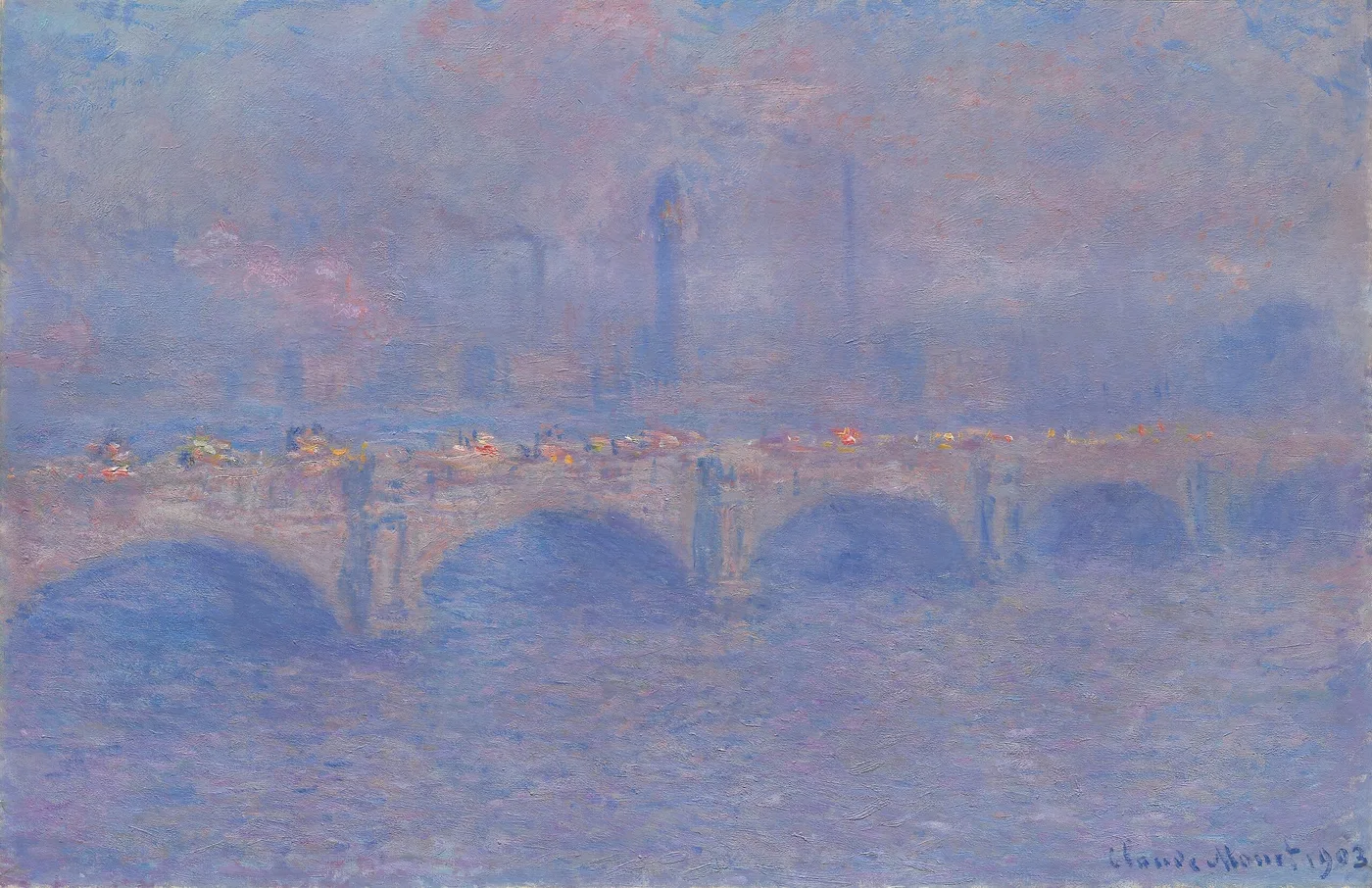
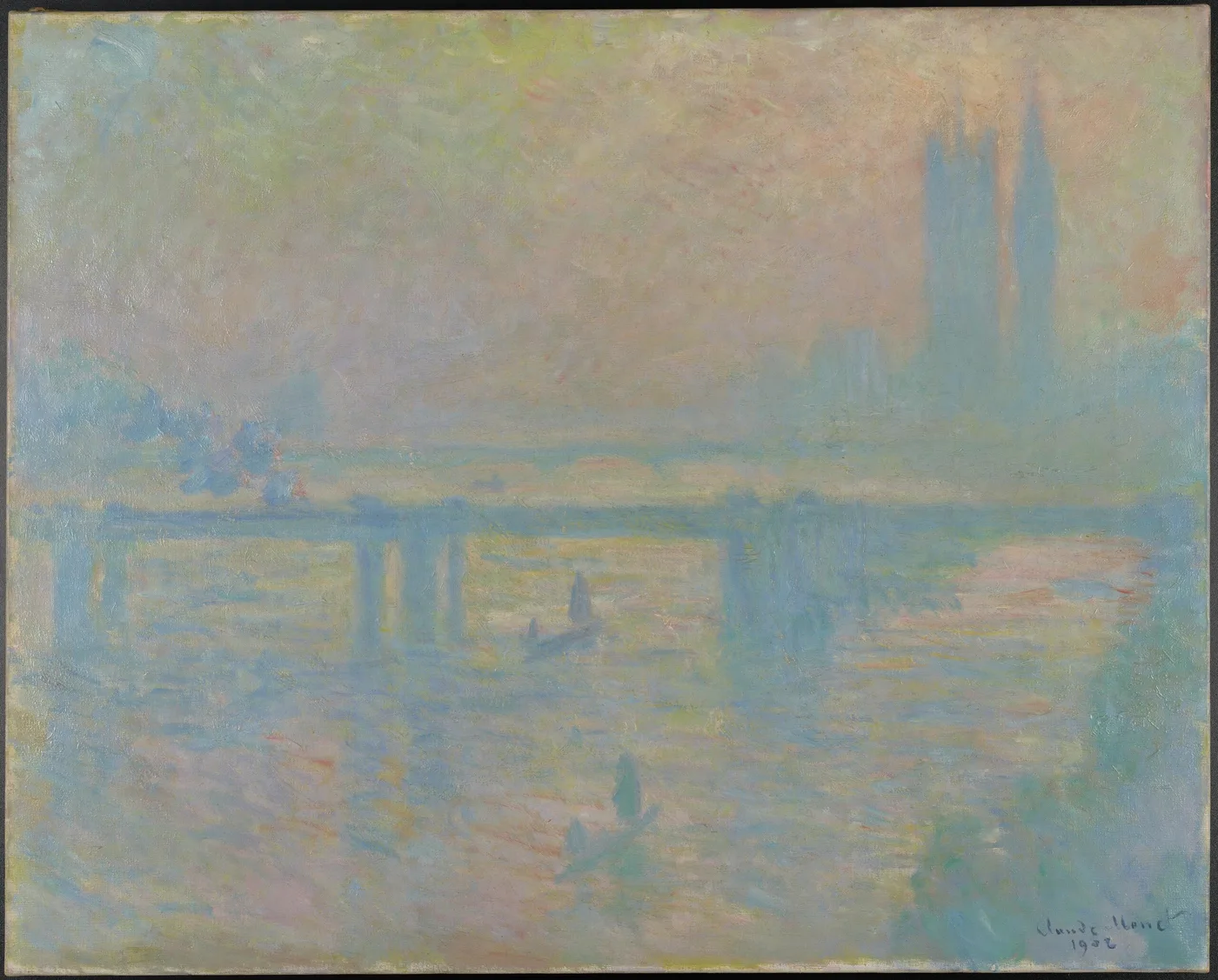
A long bridge crosses Claude Monet’s Waterloo Bridge, Sunlight Effect, its arches painted in violet and blue. Small marks of yellow, red and pale green gather along the roadway. Behind them, distant vertical forms rise through pink and mauve haze. The water occupies the lower part of the canvas, close in colour to the sky.
The painting is dated 1903, but the Art Institute of Chicago says it was likely begun in 1900. Monet observed Waterloo Bridge from his fifth-floor window at the Savoy Hotel in London. The date on the finished work should therefore be distinguished from the likely beginning of his work on this canvas.
He also worked on the London paintings in his studio at Giverny. The museum describes his wish to resolve them as an ensemble before sending them to his dealer. The surviving image combines observation of a London subject with later studio work; it cannot be timed as a single uninterrupted session at the hotel window.
The dimensions are listed as 65.7 × 101 cm (25 7/8 × 39 3/4 in.); Framed: 88.9 × 123.2 × 10.8 cm (35 × 48 1/2 × 4 1/4 in.). The canvas is 65.7 cm high and 101 cm wide. Its horizontal proportions give the bridge room to stretch across the scene; the framed measurements describe a larger object.
Following the Arches Through the Mist
The dark openings beneath the bridge provide its clearest repeated shapes. Each curved top meets a lighter pier, with the water below continuing in broken blue strokes. The edges vary in sharpness. Some sections of the bridge are easier to follow than others, although the long structure remains legible across the width of the image.
The roadway carries small, separate touches of colour. They suggest traffic at a distance, without describing every vehicle or person. Several warm marks sit against a cooler violet band. Their scale differs from the broad arches beneath them, so the bridge reads as a substantial structure carrying much smaller forms.
Beyond it, chimneys and other tall forms are described with narrow blue-violet strokes. Their upper edges merge into the surrounding pale paint. The tallest dark form near the centre stands out more than the faint verticals to either side. Distance appears through differences in colour and definition rather than a sequence of detailed buildings.
The sky contains pale blue, pink and lavender passages. The water repeats some of those colours in shorter, more varied marks. There is no sharply outlined orange sun at the centre of this canvas. The title’s sunlight effect can be considered through the lighter haze and coloured surfaces that are visible throughout the scene.
A London View Finished as Part of a Series
The bridge divides the composition into broad areas above and below it, but no hard horizon separates the distant bank from the sky. Pale passages overlap the vertical forms behind the roadway. The result leaves the architecture identifiable while withholding the detail a clear, close view would supply.
Atmosphere takes another visible form in Monet’s Arrival of the Normandy Train. Steam gathers beneath the station roof there, among rails and engines. Waterloo Bridge has a more open setting. Comparing the two keeps the industrial subjects distinct while showing how pale paint can interrupt the outlines of structures.
In the sunlit Rouen Cathedral facade, masonry fills an upright view with a small area of sky. Here, arches form a horizontal band within an expanse of air and water. These views give different proportions to architecture and its surroundings; their light effects should be read from those particular arrangements.
The 1903 Canvas in Chicago
The Art Institute of Chicago owns this original, accession 1933.1163. Its catalogue identifies the work as Waterloo Bridge, Sunlight Effect, oil on canvas, dated 1903. The record explains the likely earlier start and later Giverny work, rather than presenting the signed year as proof that Monet painted it entirely in London then.
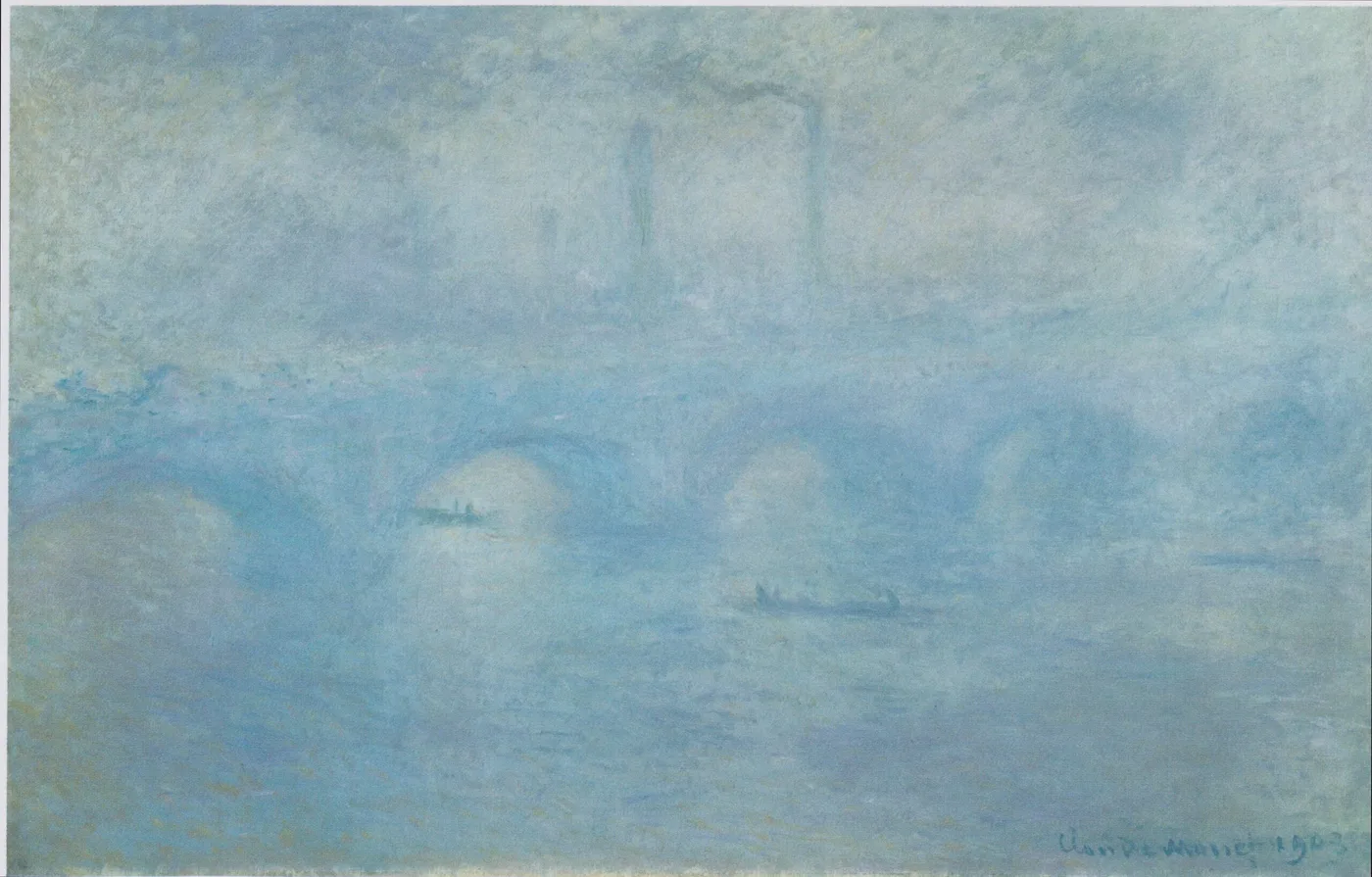
Several Monet works share the bridge subject. Use the title, date and accession together when identifying this one. Its long violet arches, pale pink-blue surroundings and small coloured marks on the roadway provide visual checks. A more intensely orange or differently proportioned view may be another canvas from the series.
Display arrangements can change, so consult the museum before travelling to see the original. Its canvas dimensions and frame dimensions answer different questions. The first describes the painted support; the second describes the object with its museum presentation. Neither determines the available sizes of a reproduction made to order.
Keeping the Long Span Intact
The Waterloo Bridge, Sunlight Effect reproduction is offered mainly as a hand-painted oil painting on canvas. A canvas print provides an alternative medium. Painted and printed surfaces differ even when they follow the same image, so make the medium choice before comparing finish and size options.
The complete horizontal view preserves the span of the bridge and the taller forms behind it. A close crop around an arch could lose that relationship, while a crop of the upper half would remove much of the water. Check the whole composition against the proposed dimensions rather than relying only on a detail photograph.
The product’s current configurator lists the sizes and presentations offered for the reproduction. Measure the wall area and allow for the chosen frame if applicable. The pale colours in the reference do not establish how a new physical painting will respond to a specific room, wall colour or lamp.
Questions About the Date and the Light
Was the painting made in 1900 or 1903?
It is dated 1903. The Art Institute considers it likely that Monet began it in 1900, then continued working on the London paintings at Giverny before regarding them as finished.
Where did Monet observe Waterloo Bridge?
The museum identifies the viewpoint as his fifth-floor window at the Savoy Hotel in London. That documented position does not establish an exact duration for painting this canvas.
Is there a bright orange sun in this version?
The visible image has pale pink, blue and violet haze above the bridge. It does not show a sharply defined orange disc. Other paintings of the bridge have different colour arrangements.
Can I order a hand-painted oil version?
Yes. The oil reproduction is painted by hand on canvas and is the principal edition. A canvas print is also offered. The linked product selector distinguishes the medium and available presentations.
More from this collection
Bring this painting home
Choose a hand-painted oil reproduction for real brushwork, or an archival canvas print for a crisp museum-image edition. Every size preserves the original proportions.
View this work & options
Further reading
Verify the original in the The Art Institute of Chicago collection record and continue through related works in the catalogue.