
Water Lilies at the Met: Red Flowers Across a Dark Pond
A Pond Filling the Whole Canvas
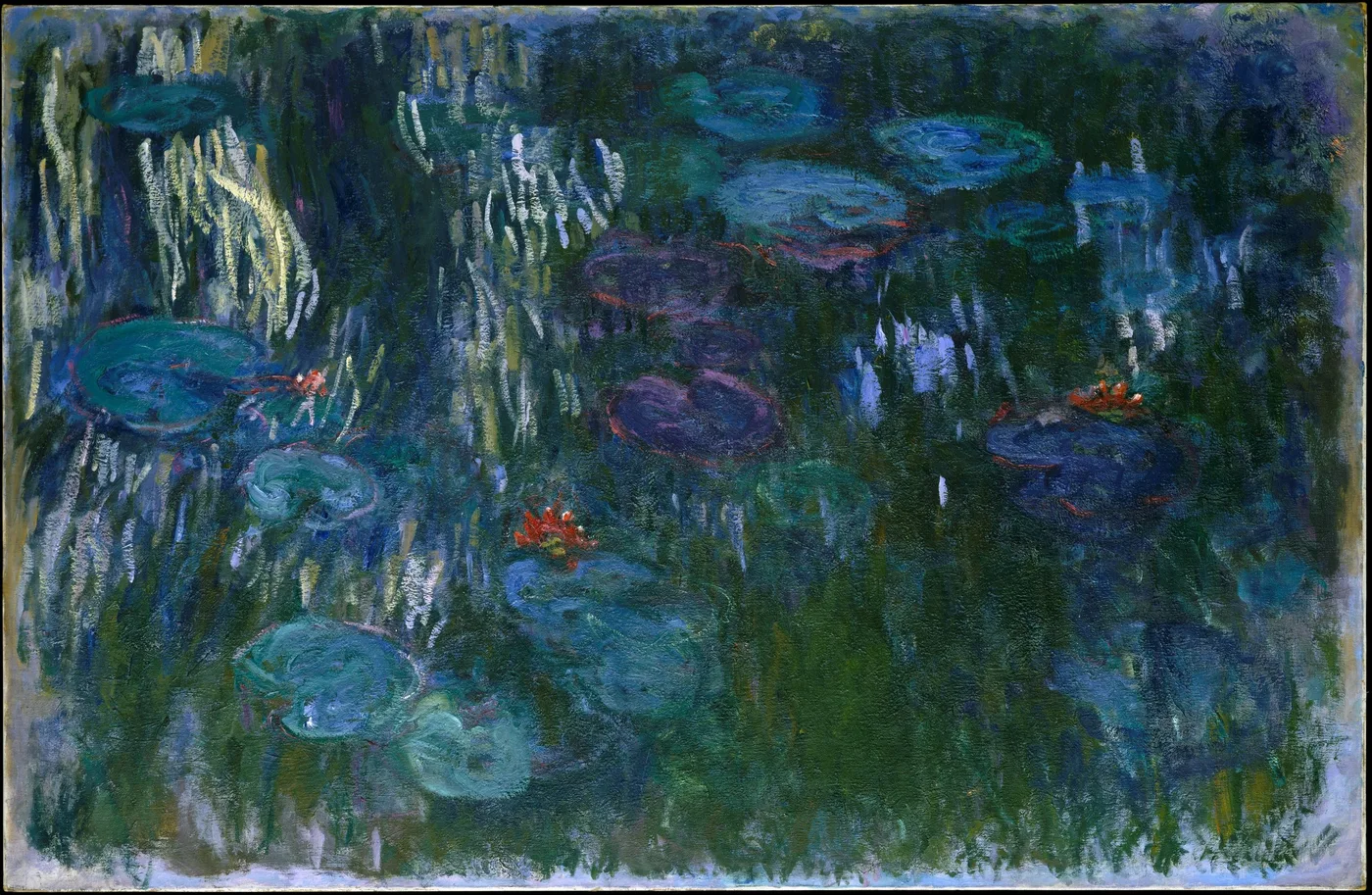
Monet’s Water Lilies, dated 1916-1919, shows blue-green pads and red flowers against dark water crossed by pale reflections. The pond fills the picture from edge to edge. The Metropolitan Museum of Art in New York holds this version, accession 1983.532.
Monet developed the water garden at Giverny as part of his wider gardening plans. The Met records that he had a pond dug and planted with lilies in 1893, then returned to the subject repeatedly from 1899 onwards. This canvas belongs to the later part of that work.
The painted surface is broad, measuring 130.2 cm high by 200.7 cm wide. The museum records the medium as oil on canvas. Those facts distinguish this object from other paintings called Water Lilies, including works with different proportions and arrangements of flowers.
The Water Lilies reproduction page uses the complete image of this canvas. Large pads descend through the left half, smaller ones float near the top, and flowers appear in separate passages across the water. A close detail alone would leave much of that arrangement out.
Blue Pads, Red Flowers and Pale Vertical Marks
The largest lily pads occupy the left and lower-left areas. Their rounded shapes overlap, with cooler blue and green touches around their edges. A smaller, darker pad lies nearer the top left, separated from the lower group by pale, wavering marks.
More pads gather towards the upper centre. Some appear as flattened blue ovals; others have pink and violet touches within their outlines. Their different sizes and positions interrupt the darker water without forming a regular row.
Red and orange flowers sit above several of these pads. A small blossom appears left of centre, another lower down near the middle, and a brighter group lies further right. Their warmer colour makes them easy to locate within the cooler blues and greens.
Pale strokes descend beside the left-hand pads and across the right half. They bend and break as they pass through the darker areas. These marks suggest reflected branches without giving us a separate view of the trees standing above the pond.
The direction of the paint changes across the surface. Many pale reflections run vertically, while short blue strokes spread over the pads. Darker green touches lie between both. Following those changes helps separate the floating leaves from the shapes reflected around them.
The lower edge contains a thin, lighter band beneath the deeper greens. Near the right edge, pale blue and violet strokes rise into the water. These small passages are part of the full composition, even though a crop concentrating on one flower would make them easy to miss.
Finding a Surface Without a Horizon
There is no visible horizon dividing land from sky. No bridge crosses the water, and no bank provides a firm edge within the scene. The canvas gives the pond itself almost all the space usually shared by several parts of a landscape.
The pads provide shapes to follow through that space. Their rounded edges remain relatively easy to recognise. Around them, the reflections loosen into stripes and broken patches of colour, so the image shifts between identifiable plants and less definite painted forms.
The Met describes Monet’s late handling of the pond as fluid and approaching abstraction. You can see that in the uneven edges of the reflections and the way darker passages join together. The flowers still identify the subject, while the surrounding marks have room to spread.
Compare this with Bridge over a Pond of Water Lilies. Its arch gives the eye a structure to recognise above the water. Here, the recurring pads and pale reflections organise the view across a much wider field.
The Met Version, Accession 1983.532
This Water Lilies belongs to the Metropolitan Museum of Art. The collection entry identifies it as the gift of Louise Reinhardt Smith. Use accession 1983.532 alongside the date range when comparing catalogue records, since Monet used this subject across many separate canvases.
The museum’s complete measurement is 51 1/4 x 79 in. (130.2 x 200.7 cm). It describes the height first and width second. The horizontal shape is important to this particular arrangement: the pale reflections on the right balance the heavier grouping of pads on the left.
The full source image shows the outer edges of the painted field. Keeping those edges matters when identifying a reproduction. Look for the upper group of smaller pads and the red flowers towards the right as well as the more obvious plants near the lower left.
For another use of colour across a landscape, see Haystacks, Effect of Snow and Sun. Its stacks and their shadows create firmer shapes to follow. In Water Lilies, the boundaries between reflected foliage and water are much less definite.
Check the Met’s current collection page before planning a visit. Display locations and loans can change. Its catalogue entry remains the reference for the work’s title, date range, support and measurements.
Choosing an Edition of the Full Image
The Water Lilies product page offers a hand-painted oil reproduction and an archival canvas art print. A painter recreates the image in oil for the painted edition. The print reproduces the visible marks within a printed surface.
The pale reflections and the overlapping pads are useful areas to compare when choosing a medium. Some marks are narrow and separate, while others join into larger patches. The oil version has handmade variation in its painted surface; the print gives a more consistent rendering of the source image.
Allow for the whole horizontal composition when deciding where it will hang. The largest pads occupy one side, while darker water and pale reflections fill the other. A view showing only the left-hand detail changes that balance and omits flowers present in the complete canvas.
Painting the oil by hand takes 2 to 4 weeks. Print production takes 2 to 4 business days. Delivery after shipping takes 5 to 7 business days. Choose the size and presentation separately on the product page, then check the selected medium when planning the order.
Questions About This Water Lilies
Which Water Lilies is reproduced here?
It is the Met’s horizontal canvas dated 1916-1919, accession 1983.532. Blue-green pads, red flowers and pale vertical reflections identify its arrangement.
What are the original height and width?
The museum records a height of 130.2 cm and a width of 200.7 cm. Those measurements describe the original canvas; the shop’s reproduction sizes are listed on the product page.
Why is there no horizon?
Monet fills this view with the pond, floating plants and reflections. The picture has no separate strip of land or sky above the water, which leaves the painted surface open across its full width.
Is the canvas print also hand-painted?
The canvas print is printed. The oil reproduction is painted by hand, so the two editions have different physical surfaces even though they use the same source image.
More from this collection

Bring this painting home
Choose a hand-painted oil reproduction for real brushwork, or an archival canvas print for a crisp museum-image edition. Every size preserves the original proportions.
View this work & options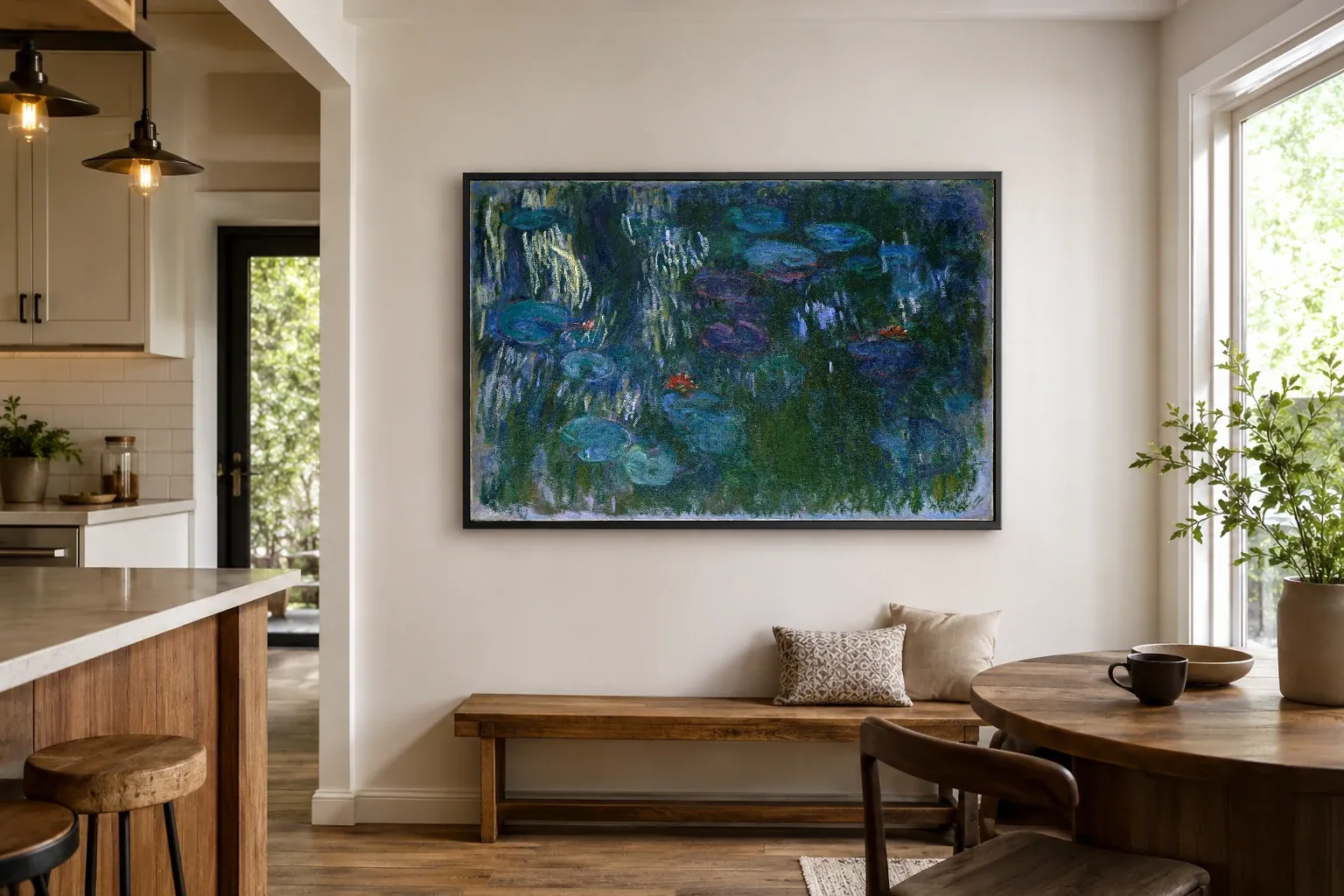
Further reading
Verify the original in the The Metropolitan Museum of Art, New York collection record and continue through related works in the catalogue.