
Sunrise (Marine)
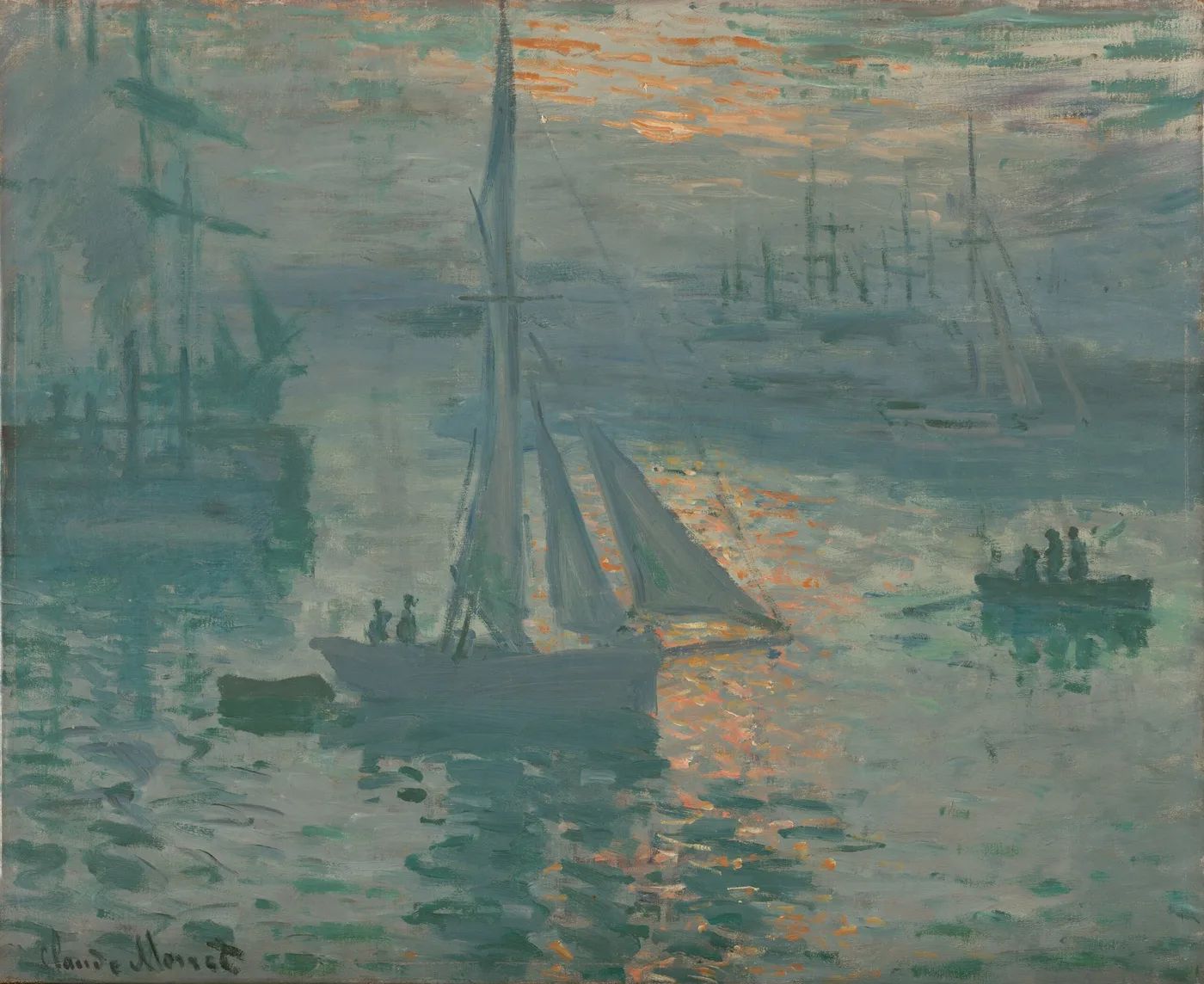
To paint a sunrise you have to lose the night. That means the walk down to the water in the dark, the cold that gets into the fingers first and the wrists second, the smell of tar and low tide, and then a long wait in which nothing happens except that the sky very slowly stops being black. There is no dramatic moment. There is a grey, then a warmer grey, then a flush along one edge, and then, all at once, the water has a stripe down it and the day has started.
Sunrise (Marine) is a record of roughly fifteen minutes in that sequence. Everything in it is provisional. The masts are suggestions. The far bank is a smudge with a few darker verticals implying that industry exists over there. The boats in the foreground are the only things solid enough to have edges, and even they are painted with three or four strokes each. It is a picture of a world that has not yet been fully assembled.
A man in his early thirties with everything to prove
The early 1870s were the hinge of Monet’s life. He had come out of the Franco-Prussian war years displaced, with a spell in London and a stay in Holland behind him, and had settled at Argenteuil on the Seine, where he stayed until 1878. He was in his early thirties, married to Camille, with a young son, and he was working in a manner that a large part of the art world regarded as either incompetent or provocative.
The complaint was always the same. The pictures looked unfinished. There was no drawing in them, no modelling, nothing you could point to and call a completed passage. In front of a canvas like this one it is easy to see why the accusation was made and impossible to agree with it. The apparent roughness is the whole method. He is not painting a harbour. He is painting the exact quantity of information the eye actually receives at first light, which is very little, and refusing to add the rest from memory.
Harbours at dawn occupied him repeatedly in these years. Water gives you the light twice, once in the sky and once broken up beneath it, and a working port gives you human shapes to hang the scale on. Boats, rigging, the black arithmetic of masts against a soft ground.
A working port at first light is also one of the few places where you can be outdoors at that hour without being conspicuous. Everyone else is up too. Boats go out on the tide, not on the clock, so there are men moving on the water before there is enough light to see their faces, and the noise arrives before the image does: an oar knocking, a chain, a voice across water carrying much further than it should. None of that is depicted in the painting, because none of it can be. But the picture was made inside it, and there is a reason the two dark boats sit exactly where they do. They are the only evidence that the place is inhabited.
The trick that makes the sun glow
Here is the thing most people miss, and it is the reason this picture keeps working when reproductions of far grander sunsets go dead. The sun in this canvas is not very bright. Photograph it in black and white and the disc almost disappears into the sky around it. Its lightness and the sky’s lightness are close to identical.
What separates it is temperature, not brightness. The disc is hot orange sitting inside a field of cool blue grey, and the eye reads that hue difference as radiance because it has nothing else to read it as. This is the difference between a sun that glows and a sun that looks like a sticker. Add white to make it brighter and it goes flat and papery. Keep it the same value and change only the colour and it burns.
The same logic runs through the water. The reflected column under the sun is not a solid stripe. It is a broken run of short horizontal touches with dark water showing between them, and the gaps are what make it shimmer. Monet leaves the interruptions in. A tidier painter fills them and kills the effect.
What to look at, close and far
Stand near it and hunt for the darkest marks. They will be the small boats and their occupants, and they are the only true darks in the entire picture. Everything else lives in a narrow middle band of soft greys and muted warms. That restraint is deliberate: a scene this quiet only holds together if almost nothing shouts.
Now look at the horizon and notice how uncertain it is. There is no crisp line where water meets sky. The two zones bleed, and the far bank floats without touching down. Early light does that. Haze at dawn removes the ground plane and leaves objects hanging.
Look at the sky texture. It is not one flat wash. It is thin, dragged, scrubbed paint with the weave showing through in places, which is why it reads as vapour rather than paint. And look at how few objects there actually are. Two or three vessels near, a suggestion of shipping far, a disc, a stripe. That is the whole inventory. The picture is mostly nothing, and the nothing is the subject.
One more thing. Check the edges of the canvas, the outer few centimetres on each side. In a picture built almost entirely from atmosphere, the corners are where a weaker painter loses the thread and starts filling. Here they stay empty and thinly painted, which is what keeps the middle from being crowded. A quiet picture is made by everything the painter agreed not to put in it.
How it lives in a room
This is one of the few images that genuinely changes the atmosphere of a space rather than decorating it. Its value range is narrow and mostly soft, so it does not fight with anything. Its one warm accent gives a room a small heat source, the way a lamp does.
It is unusually good in rooms you use at either end of the day. In a bedroom it does not intrude at night and it agrees with morning light. In a dining room lit low in the evening the orange disc pulls forward and the greys recede, and the picture appears to warm up as the room does.
Because so much of it is atmosphere, it wants a little breathing room. Hang it with space around it rather than in a tight cluster. Against a cool pale wall it reads as an opening. Against a deep blue or charcoal wall the sun becomes the brightest thing in the room, which is exactly the effect the painting was built to produce.
Why a small dawn outlasts a big statement
Nothing happens in this picture. No storm, no wreck, no incident. A harbour is waking up and a man who got up in the dark is standing there watching the light arrive. The ambition is not in the subject, it is in the honesty about how much you can actually see at that hour and the refusal to paint one stroke more than that.
The canvas is held by the J. Paul Getty Museum. People tend to walk past it and then come back, because at a distance it looks like almost nothing and at the right distance it turns into the specific, particular cold of five in the morning by the water. That is a rare thing for an object made of pigment and cloth to do.
Sizes and materials for Sunrise (Marine) are listed on its product page.
More from this collection
Bring this painting home
Choose a hand-painted oil reproduction for real brushwork, or an archival canvas print for a crisp museum-image edition. Every size preserves the original proportions.
View this work & options
Further reading
Verify the original in the J. Paul Getty Museum collection record and continue through related works in the catalogue.