
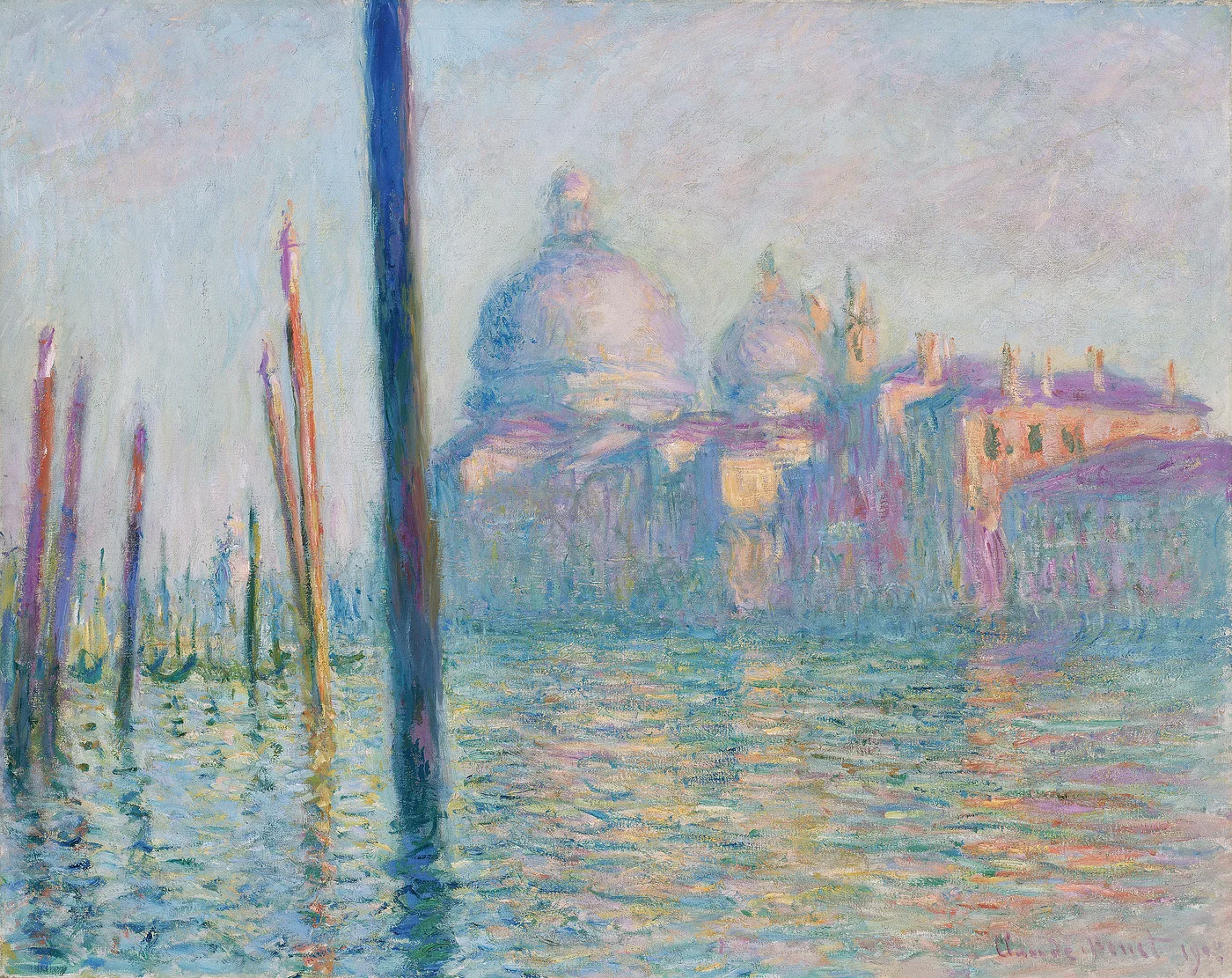
Gondola in Venice
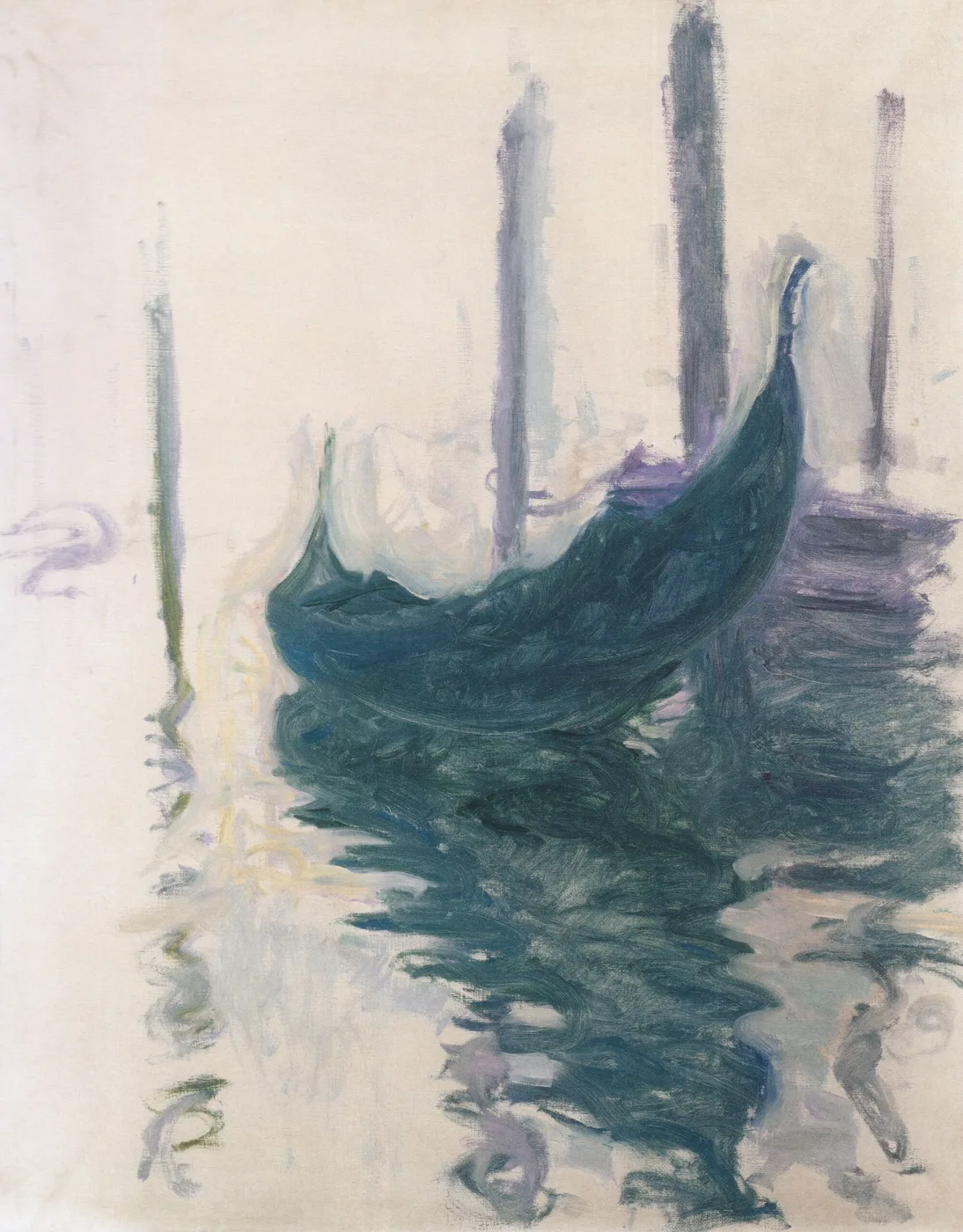
A lagoon gives a painter two light sources and no solid ground. One comes down from the sky, thin and silvered in October. The other comes up off the water, restless, scattering loose coins of brightness across every hull and wall above it. Nothing holds still. A city built on stone behaves, in paint, like something afloat, and a boat sitting in front of it becomes the only fixed dark thing in the whole field of view.
Monet came to Venice in the autumn of 1908. He was sixty-eight. He had spent forty years training his eye on rivers, cliffs, gardens and stacks of wheat, and he arrived in a city that had already been painted by other people for centuries. Everyone knows what Venice looks like before they see it. That is a difficult condition for a man whose entire method depended on looking at a thing as though nobody had ever described it.
An old man on a strict clock
He worked to a timetable. Not a loose one. Each motif belonged to a particular hour, and when that hour ended he moved to the next, and the next, so that a day was a sequence of appointments with the light rather than a stroll with a sketchbook. Alice, his second wife, was with him. They had been married a long time by then, and the Venice weeks have the quality of a late trip taken by two people who had stopped expecting new places.
None of the canvases were finished there. He carried them home unresolved and worked on them afterwards, over months, in the way he had learned to work: pushing a painting toward the memory of a sensation rather than the record of a view. Then Alice died in 1911, and the Venice pictures became hard for him to face. They had stopped being paintings of a city. They had become paintings of a particular autumn with a particular person, and he had to finish them anyway.
That is the tension inside this quiet green picture. It looks serene. It was made by a man racing a clock, and completed by a man who could no longer look at it without a private ache.
Why the boat matters more than the buildings
Look at the gondola and notice how little of it is actually described. There is no rigging of detail, no carved prow rendered plank by plank, no boatman posed for effect. It is a long dark shape, tapered, sitting low, with its own darkness continued downward into the water as though the vessel and its reflection were one animal.
What the shape does is anchor everything else. The water and air in this painting are made of small broken touches, blue over green over rose, none of them settling into a firm surface. Your eye would drift forever in that if it had nothing to hold. The black hull is the hold. Cover it with your thumb and the rest of the canvas becomes weather. Uncover it and the weather becomes a place.
How it was made
The handling is loose and layered rather than smooth. Colour sits on colour, wet touches dragged across half-dry ones, so that the surface has a faint tooth to it when light rakes across the canvas. Nothing is blended into a haze. If you look closely you can see individual decisions: a stroke of cool green laid beside a warmer one, left alone, allowed to do the mixing in your eye instead of on the brush.
The palette is narrow on purpose. Greens, blue-greens, a violet that keeps surfacing in the shadows, and small warm notes that read as reflected stonework. Against that, the near-black of the boat. Monet had spent the previous two decades proving that a picture can be built out of a very few colours held at a very high pitch, and Venice, where everything is either water or the reflection of something in water, suited that method exactly.
The finishing at home matters to what you see. Pictures completed away from the motif tend to gain unity and lose incident. Details drop out. Relationships tighten. This canvas has that late quality: less reportage, more chord.
A city with no ground
Everywhere else Monet worked had earth in it. A field has soil under the stack. A cliff has a path and a beach. Even a river has banks holding it in place, and a bank is a solid thing that tells your eye how far away the water is. Venice removes all of that. Buildings begin at the waterline with no visible footing, so the eye is given no evidence of how anything is supported, and the reflection beneath a wall is often more strongly coloured than the wall itself.
For a painter who had spent his career describing where things stand, that is either a disaster or a liberation. Monet treated it as the second. The absence of ground let him do what he had been edging toward for years: build a picture out of nothing but colour relationships, with no drawn structure underneath. No line, no measured perspective, no architectural correctness. Just one patch of colour set against another until the space appears.
You can test this. Try to find a single hard edge in the canvas that separates a solid from a liquid. The boundary between hull and water is not a line at all, it is a change of colour and a slight change of touch, and where the reflection begins is anyone’s guess. That vagueness is not a failure of finish. It is the accurate report of what happens when a black boat sits on moving water and the reflected light from that water is thrown back up onto the boat.
Learn to see it properly
Give it a slow minute and work through it in this order.
- Find the darkest point in the painting. It will be somewhere in the hull. Everything else in the picture is measured against that dark, which is why the pale water looks luminous rather than merely light.
- Follow the reflection downward from the boat. Notice where the reflected dark stops being a mirror and starts being a smear. That break is where the water was moving.
- Look at the direction of the brushwork. The water is built mostly in horizontal touches, which is how a painter tells you a surface is lying flat and travelling away from you.
- Now look at the background. It is softer, cooler, and less worked than the foreground, so the space opens without a single drawn perspective line.
- Finally, step back and let it blur. The individual strokes drop out and the whole thing resolves into air. That resolution is the painting. Close reading is a way of earning it, not a substitute for it.
How it behaves on a real wall
This is a low-contrast picture with one very strong dark, which makes it unusually well-behaved in a room. It does not fight furniture. The green and blue field reads almost as a tone at distance, while the hull gives the eye somewhere to land from across the room, so the painting works at both six feet and sixteen.
It responds strongly to daylight. In morning light the greens cool and the picture goes quiet and watery. Under warm evening lamps the violets in the shadow come forward and the whole surface warms by a noticeable degree. If you hang it where the daylight changes through the day, you effectively get several paintings, which is a fitting fate for a canvas made by a man chasing exactly that phenomenon.
It sits comfortably with weathered wood, linen, unpolished brass and pale plaster. It does badly next to loud pattern or a competing strong dark, because the hull needs to be the only serious black in the visual field to keep doing its job. Give it a wall of its own rather than a gallery arrangement, and hang it at seated eye level in a room where people stay a while. Venice was painted at the pace of an appointment. It rewards being looked at at the pace of an evening.
Sizes and materials for Gondola in Venice are listed on its product page.
More from this collection
Bring this painting home
Choose a hand-painted oil reproduction for real brushwork, or an archival canvas print for a crisp museum-image edition. Every size preserves the original proportions.
View this work & options
Further reading
Verify the original in the Nantes Museum of Arts collection record and continue through related works in the catalogue.