
Grainstack at Giverny: Why He Chose the Least Interesting Thing in the Field
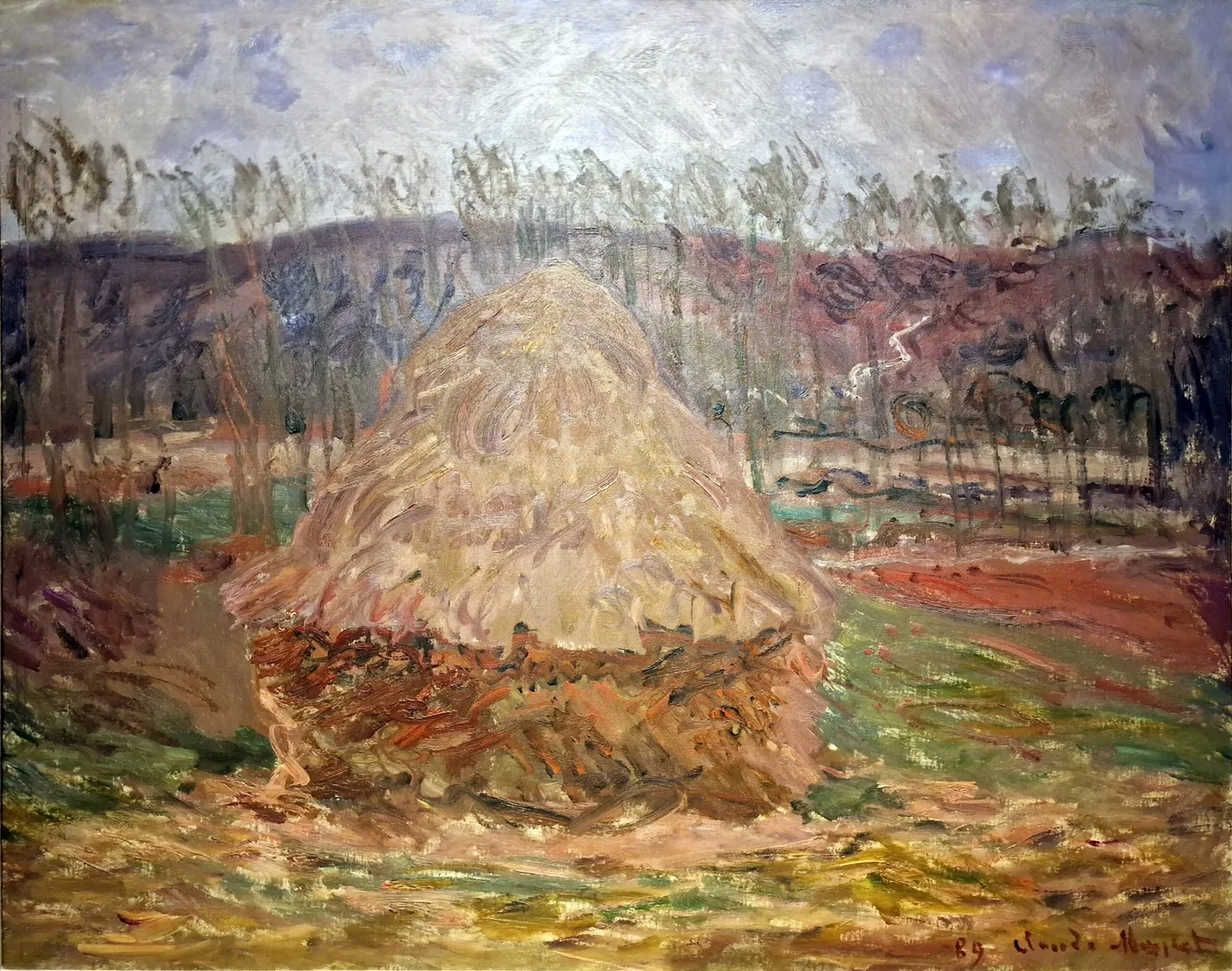
A field at the end of a working day in late summer. The stubble is sharp and pale and still holds the heat of the afternoon. There is chaff in the air and it catches the low sun so that the whole field seems faintly dusty. And out in the middle of it stands a thing about the size of a small cottage, thatched, blunt, and casting a shadow long enough to reach the hedge.
It is not a monument. It is a pile of grain. In 1889 a painter who lived a short walk away decided it was worth his complete attention.
What a grainstack actually was
Modern eyes see a shape. A farmer of the period saw a bank account. The stack held the harvest, built up carefully after cutting, with the grain heads turned inward and the outside combed and capped with thatch so that rain would run off it rather than into it. Built well, it kept the year’s crop dry through the wet months. Built badly, it rotted from the inside and the family lost the year.
It also had a lifespan. Through the winter it was cut into and taken apart in stages for threshing, so it changed shape as the season went on, shrinking, developing flat faces where it had been worked. What looks in a painting like a permanent feature of the landscape was in fact a temporary structure with a schedule, put up in one season and eaten away through the next.
And it belonged to somebody. These stood in fields near his house at Giverny, where he had been living since 1883, on land that was not his. The most famous subject of his later life was other people’s property, seen on walks near home, and the campaign that would turn these stacks into a series and make them widely known came a season or two after this canvas.
Why anybody would paint a pile of grain
Here is the thing that took him years to work out and that most people miss even now. He did not paint the stack because the stack was interesting. He painted it because it was not.
A cathedral, a mountain or a famous river is a subject with its own opinions. Whatever you do with the light, the viewer will still mostly see the cathedral. A grainstack has no story attached, no associations, no fame. It is a simple mass sitting in a field. That makes it a nearly perfect instrument, because if you paint it twice and the two pictures differ, the difference cannot be about the stack. It has to be about the light, the hour, the weather, the season, the air. The subject is deliberately null so that everything else becomes visible.
This is a strange and quite radical idea, and it arrived by patience rather than theory. It came from walking past the same objects daily for years and slowly noticing that the object was the least changeable thing in the view.
There is a practical joke buried in the method too. The stack is the one thing in the field that does not move. Clouds move, crops move, shadows swing round through the day, the colour of the ground shifts with every change in the sky. Setting a fixed dark mass in the middle of all that gives you a control, a piece of the world that stays put while you measure everything else against it.
There is one more advantage to a subject like this, and it is entirely practical. A stack does not need permission, it does not get bored, it does not go home at five, and it is still there tomorrow at the same hour. A model tires. A river town changes. A coastline is at the mercy of the tide. A stack in a field near your house is available every single day for months, and it will hold whatever position you found it in until the farmer decides otherwise. For a painter who had spent twenty years being defeated by weather and by subjects that would not stay put, that reliability was worth more than any amount of picturesque interest.
How to read one
Start with the silhouette. Follow the outline of the stack all the way round, and notice how the shape is simplified almost to a geometry, a cone or a rounded dome sitting on a heavier body. That simplicity is why it works at any distance and why it is legible from across a room.
Then look at the edge itself, closely. In the light it is soft and slightly broken up, with the field colour eating into the stack. On the shaded side it is firmer. Light dissolves contours and shade preserves them, and once you notice that happening, you start seeing it in the real world.
Now the shadow. This is the most instructive passage in the picture. Find where the stack’s shadow lies on the ground and resist the assumption that it is grey. It will contain blue, violet, sometimes a green that is a good deal more colourful than the sunlit stubble nearby. A cast shadow on open ground is lit by the sky, and the sky is blue, so the shadow is blue. Painting that honestly, rather than painting shadow as darkness, is most of the difference between a landscape that glows and one that does not.
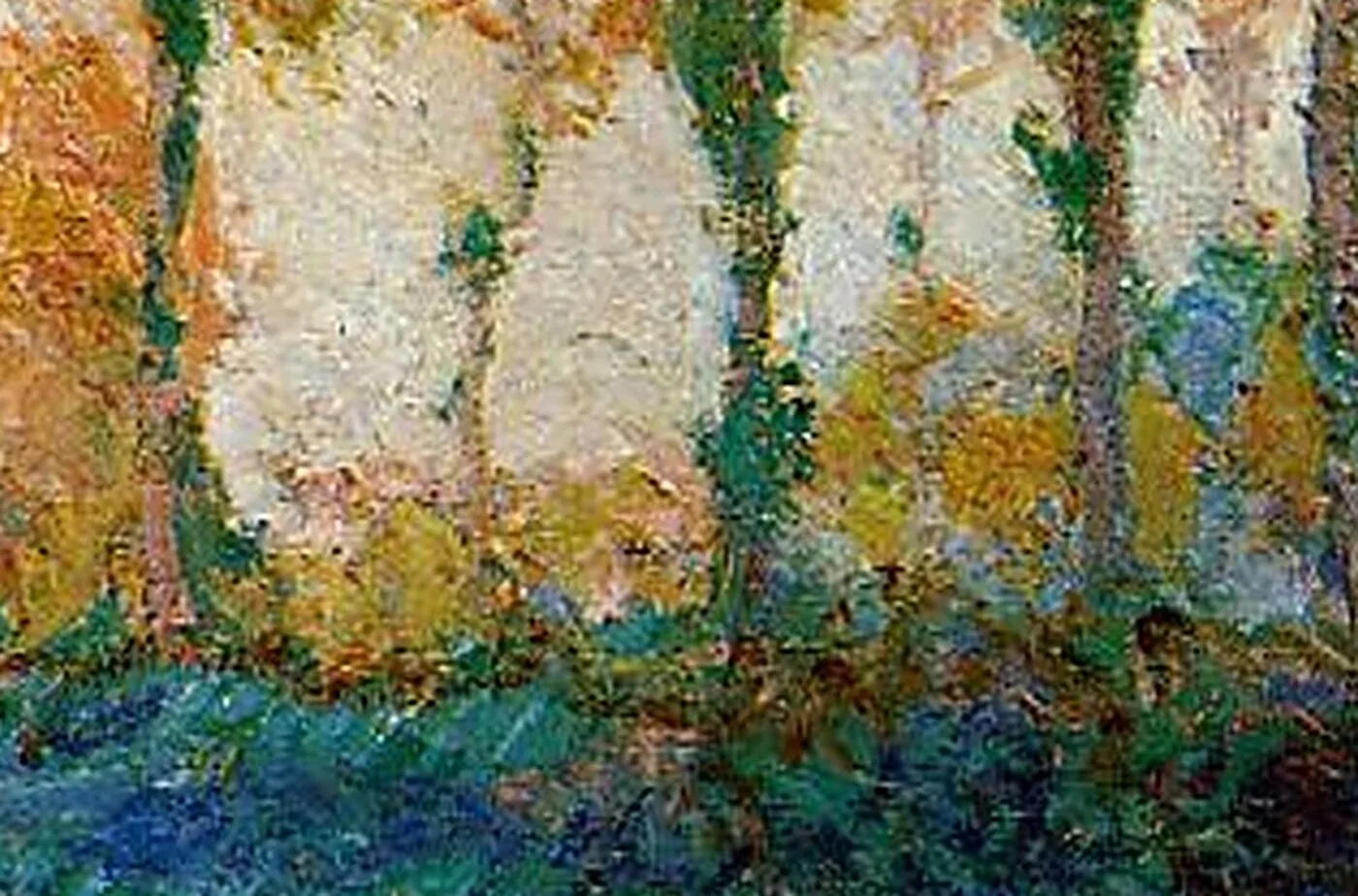
Then the field. Look at how many separate colours are stacked into what your eye had summarised as a stubble field. Pale gold, pink, sharp yellow green, dry mauve, laid in short strokes going in the direction the ground lies. The field is doing more work than the stack.
Finally, look at the top edge of the picture. Whatever sits behind, a treeline, a hill, a strip of sky, it is pitched to sit quietly, so that nothing competes with the one shape in the middle. Cover the stack with your hand and the picture becomes a pleasant field. Uncover it and the field becomes a stage.
Living with a single shape
Paintings with one clear subject and a calm background are among the most reliable things you can hang, and this is close to the purest example of the type. From twenty feet you see the shape. From five you see the field. From one you see hundreds of separate touches of colour. Three different pictures, one canvas.
Because the composition is centred and simple, it holds a wall on its own without needing anything to balance it. It suits a chimney breast, the space between two windows, the wall at the top of a staircase, anywhere a single object has to stand up alone.
The colour is late season warmth, gold and rose and dry green, with cool violets in the shadow. That combination sits particularly well against off white, warm grey and natural wood, and it will lift a room that has gone slightly cold. It is also a picture that behaves well in evening light, when lamps push the golds forward and the shadow blues drop back into shade, so the whole thing warms by a stop or two after dark.
If you ever hang it as a pair with another work of a similar palette, place them at exactly the same height and give them equal space. These pictures were conceived as members of a family, made to be compared, and two of them together do something one cannot, which is to make the change in the light the actual subject of your wall rather than the object sitting in it.
Sizes and materials for Grainstack at Giverny are listed on its product page.
More from this collection
Bring this painting home
Choose a hand-painted oil reproduction for real brushwork, or an archival canvas print for a crisp museum-image edition. Every size preserves the original proportions.
View this work & options
Further reading
Verify the original in the Tel Aviv Museum of Art collection record and continue through related works in the catalogue.