Snow Effect at Argenteuil: Nothing in This Painting Is White
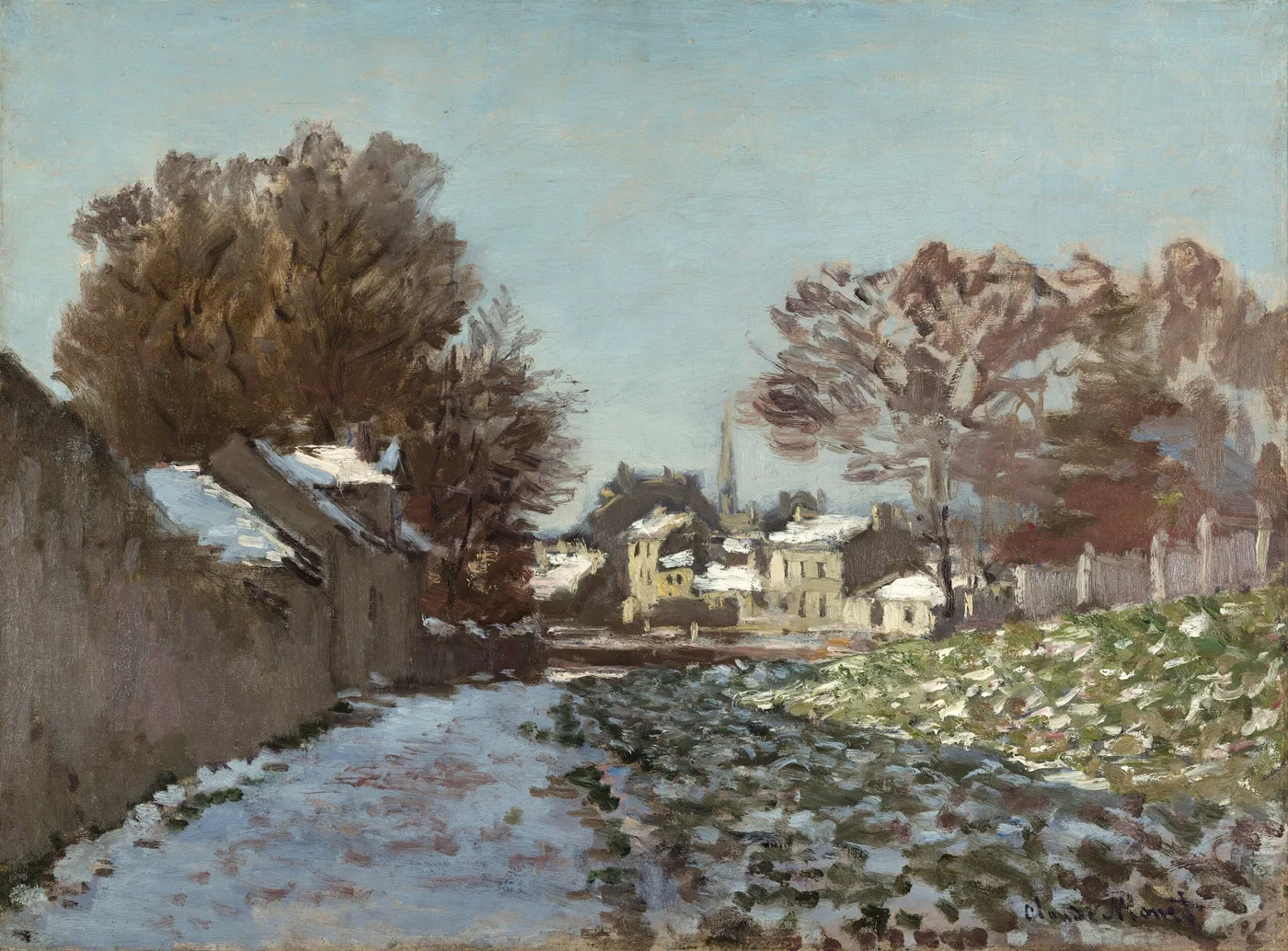
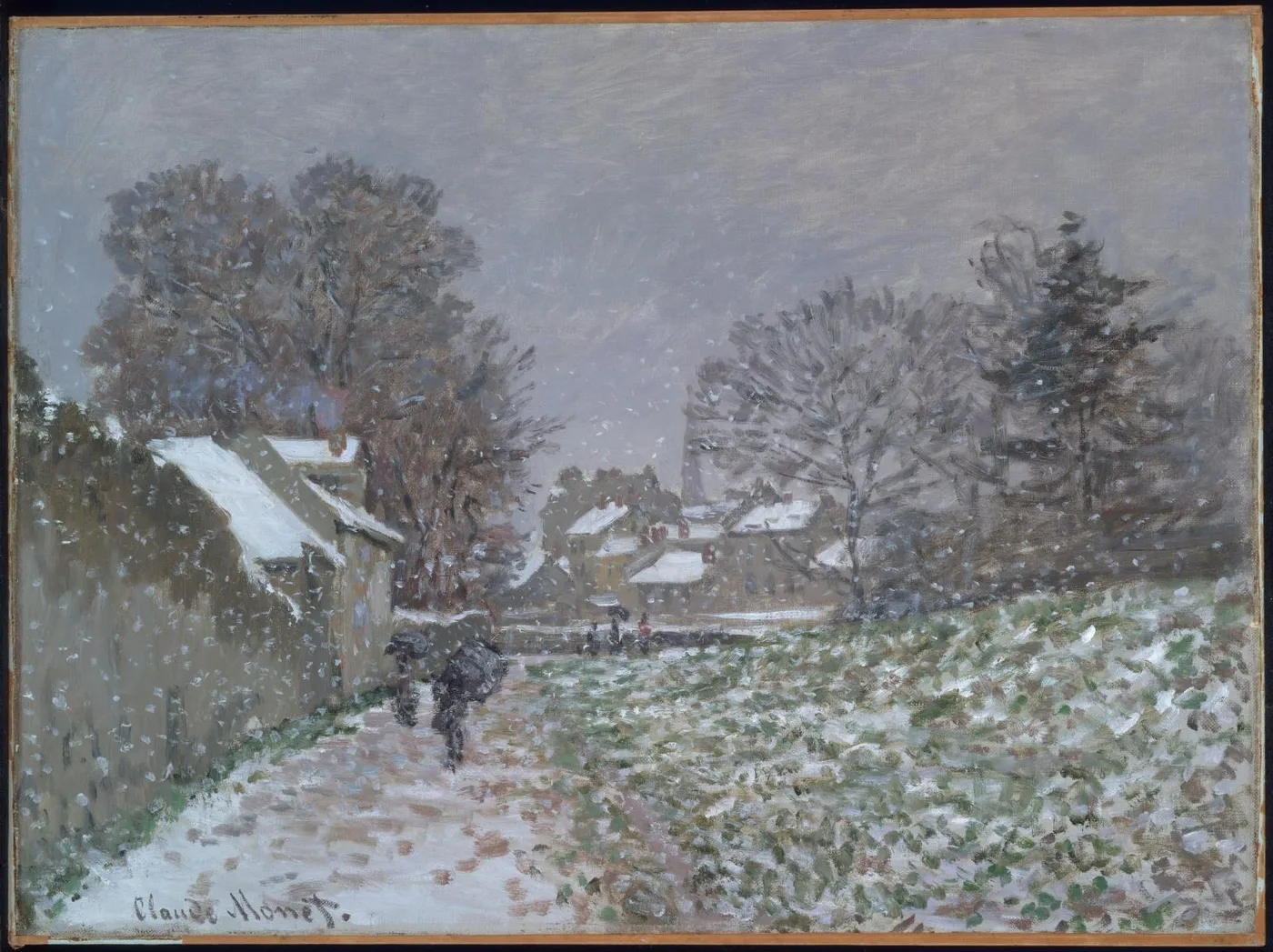
Snow has been down for days and the town has stopped looking like itself. The road is a soft trough between banks. Roofs have lost their edges. The sky is the same value as the ground, so the horizon has quietly disappeared and the whole world has collapsed into one pale substance with a few dark posts and figures stuck into it. It is late in the afternoon, the light is going, and it is cold enough that the oil in a paint tube has gone stiff.
A man is standing in it with an easel, and he has been standing in it for a couple of hours.
The winters at Argenteuil
He lived at Argenteuil from 1871 to 1878, a river town within easy reach of the city, and those years included several hard, snowbound winters. Most painters treated deep winter as the season for staying indoors and finishing things. He treated it as a subject that only came round once a year and would not wait.
Understand the physical reality, because it is not romantic. Oil paint thickens as it cools and becomes reluctant to leave the brush. Fingers stop working accurately after twenty minutes of exposure and after an hour they are a liability. Standing still in cold air is far worse than walking in it, and painting requires standing still. Snow reflects light upward into your eyes all day. Wet snow lands on the canvas and sits there as a bead until it melts into the surface.
Set against that is the reason anyone would do it. Snow is the best teacher of light that exists. A snowfield is a nearly white, nearly matte surface, which means it reports the colour of whatever is illuminating it more truthfully than anything else in nature. Under a blue sky it is blue. Near a warm sunset it is apricot. In flat cloud it is a dozen greys with a violet cast. Snow is a light meter you can stand in, and a man whose lifelong project was the behaviour of light was never going to leave that alone for four months of the year.
Nothing in this picture is white
Try an experiment with your eyes. Look at the brightest patch of snow in the painting, then look at a piece of white paper, then look back. The snow will suddenly appear coloured, and slightly dirty, and yet a moment ago your brain reported it as white.
That gap between what is there and what we report is the whole subject. Look into the snow and start naming what you actually find. There will be blue in the shadowed hollows. There will be a pinkish or apricot cast where the last of the sun is reaching. There will be pale green where the ground is showing through or where light is bouncing off something nearby. There will be a warm grey in the trodden road. In many of these canvases the purest white on the surface is used very sparingly, saved for one or two accents, because if you use it early you have nowhere left to go.
Then look at the darks, and notice how few there are and how much colour they contain. A bare tree against snow is not black. It is a deep violet brown, and its thin upper branches break into a haze where they are too fine to be individually seen. Figures on the road are dark accents rather than described people, muffled shapes reduced to their outlines, and they are placed exactly where the composition needs a full stop.
There is a second reason winter suited him, and it has to do with simplification. Snow removes detail. It buries the untidy middle ground of a landscape, the ruts and the weeds and the fences and the hundred small incidents that a summer field is full of, and leaves you with large clean areas and a few dark verticals. A subject that would have been impossibly busy in July becomes, under six inches of snow, four or five shapes and a decision about temperature. For a painter interested in relationships rather than in inventory, that is not a loss of information. It is the landscape being edited down to the part he actually cared about.
What to look at
Start with the horizon and try to find it. In most snow pictures of this kind it is barely there, because sky and ground are pitched at close values on purpose. That closeness is what produces the particular hush of the image. Contrast is noise, and this picture has almost none.
Then look at the road. Snow on a used road is a record of traffic, ruts and footprints and dirt dragged up from underneath, so it will be warmer and more broken than the untouched snow either side of it. Painters love this because the road gives them a channel of texture running into the distance, and your eye will follow it whether you intend to or not.
Now look at the roofs and how the snow sits on them. It is laid on with thick, short strokes that stand up off the surface, and along the eaves the paint often lifts into a physical ridge. That impasto is not a flourish. Real snow on a roof edge is a heaped ridge, and thick paint is the most efficient way to say so.
Then look at the sky. It is not a backdrop. It is the light source, and everything in the picture takes its colour from it, so check the sky’s temperature against the snow’s temperature and you will find they agree exactly. That agreement is what makes a snow scene convincing.
Finally, hunt for the warm notes. A window, a chimney, a patch of wall, a figure’s coat. There are usually only a handful, and they are what stop the picture from turning into a cold grey field. Cover them with a finger and watch the temperature of the whole canvas drop.
How a snow picture lives in a room
The first surprise for most people is that a snow painting does not make a room feel cold. It makes it feel bright. Because the canvas is dominated by high values with very few darks, it reflects a lot of light back into the space, and it will lighten a dim wall more effectively than a picture with strong colour in it.
The near absence of contrast makes it exceptionally easy to place. There is no loud accent to clash with a sofa or a rug, and the palette, cool whites with violet and a trace of warmth, is close to neutral. It will sit against white walls, grey walls, panelling or brick without argument.
It is best hung where it gets soft, even light. A spotlight is the one thing that ruins it, because a hot beam blows out the pale passages and destroys the fine gradations that the entire picture consists of. Ambient daylight, or a low lamp at a distance, is what it wants.
Hang it somewhere you pass often rather than somewhere you sit and stare, and hang it at eye level. The image is built on quiet transitions, so it gives up its rewards a little at a time, over months. And on a genuinely cold morning, when your own windows have gone flat and grey, look at it again. You will see something a man with numb hands stood in the road to find out, which is that a landscape with all its colour apparently removed actually has more colour in it than a summer field.
Sizes and materials for Snow Effect at Argenteuil are listed on its product page.